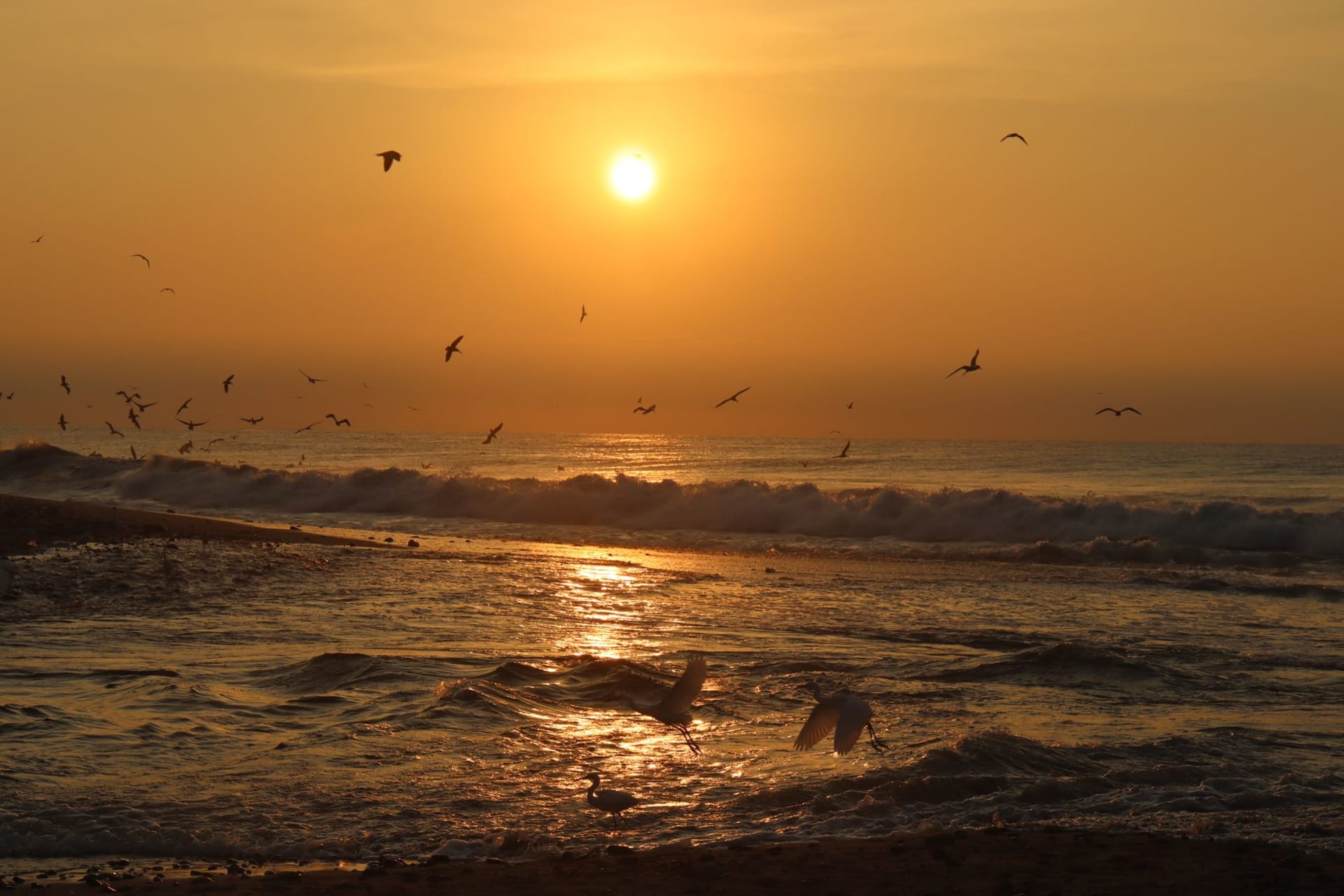
Boca de Pascuales
"The wave picks up, throws, and closes out in about two seconds. The person inside it was committed before that math became clear. I winced. The ceviche was excellent."
I don’t surf. This is not modesty — I genuinely don’t know how, and I am at an age and a level of physical courage where learning on a wave that injures people regularly seems like a project for a different life. I went to Boca de Pascuales because Lia had read about it and because we were doing a loop of Colima’s coast and it was in the direction we were already going, and because “a fishing village with a famous dangerous wave” sounded like a reason to be somewhere rather than just another Pacific beach.
The wave is real. It breaks as a shore break — not the kind of long, open-face swells you get at point breaks or reef breaks, but a wave that detonates when it hits the shallow sandbar just offshore and throws a heavy, fast, barreling tube that closes out before anyone reasonable would consider exiting. The surfing terminology for this type is “heavy slab,” and the world has very few surfers who ride these competently, and several of those surfers travel specifically to Boca de Pascuales when the southern hemisphere swells hit right.
On the Beach
We arrived in the early afternoon when the swell was running at something the palapa restaurant owner, who spoke some English, described as “medium.” A medium swell at Boca de Pascuales looked to me like a large swell everywhere I had ever seen one. The waves broke with a sound like something structural giving way.
There were four surfers in the water. I watched them for forty-five minutes from a plastic chair at the nearest palapa, the one closest to the break. In that time, one of them caught a wave that gave him perhaps three seconds inside the barrel before it closed out and drove him into the sand in a way that seemed to require a longer recovery time than it apparently did, because he was paddling back out within two minutes. The other three applauded.
The beach itself is dark sand — the volcanic Pacific coast color, not the white or golden sand of the Caribbean — and the fishing boats are pulled up above the tide line in a row, painted in the primary colors that Mexican fishing villages paint their boats: red, blue, yellow, green, each one with a name usually involving the Virgin or a woman’s name that may be the same thing depending on the boat owner. The contrast between the painted boats and the dark sand is one of those compositions that feels deliberate and isn’t.

The Food
The palapa restaurants at Boca de Pascuales are the primary reason a non-surfer goes there, and they justify the trip. The menu at the one where I sat was written on a chalkboard that someone updated each morning based on what the boats had brought in: that day it included Pacific red snapper, sierra (a local mackerel-adjacent fish), prawns, and the octopus that appears in ceviche and in a braised preparation.
I ordered the ceviche. It came in a large glass bowl with the fish — snapper — cured in lime juice and mixed with white onion, tomato, cucumber, serrano chile, and cilantro. This is the Pacific coast ceviche style, which is different from the Veracruz or Yucatán styles in ways that are mostly about balance: the Pacific version here leans into the fresh acidity of the lime with less sweetener or tropical fruit than you sometimes find elsewhere. With tostadas and a cold beer, in a plastic chair twelve meters from the most dangerous wave I had ever seen, it was the kind of lunch that justifies the driving.
Lia had the braised octopus in a chile negro sauce that the kitchen had made in a quantity suggesting they had done this before and knew what they were doing. She ate it at the pace of someone who is not going to let anything interrupt them. This is the appropriate pace.
The fishing village economy is what funds these restaurants, not tourist money, which means the ingredients are what was caught this morning by people who live here, which means the quality is consistent in the way things are consistent when they are not being produced for an outside market.
Why the General Infrastructure Never Arrived
Most places where serious surfers go eventually accumulate a tourist economy around the surfing: surf camps, yoga studios, smoothie cafés, guesthouses with surf storage. Boca de Pascuales has not had this happen. The wave is too consequential — the injury rate discourages beginners, and the village doesn’t have the infrastructure to support the kind of extended-stay surf tourism that other spots sustain. There are a few simple rooms to rent in the village, but no boutique hotel, no surf school, no cold-pressed juice.
The result is a place that has been found by the specific community that came for the specific thing it has and that has remained as it was for everyone else. The fishing village is still a fishing village. The palapa restaurants serve the food that the fishing village produces. The surfers who come are serious enough not to need the packaging.
I stayed three hours total. I watched the surf, I ate the ceviche, I watched the surf some more. On the drive back toward Colima City, Lia said it had been the best afternoon of the trip. I agreed. Neither of us had surfed.

Getting There
Boca de Pascuales is about 90 kilometers southwest of Colima City — roughly an hour and a half on the highway to Tecomán and then a short road to the coast. Car is the only practical way to visit. The village has basic services — the palapa restaurants, some simple accommodation — but nothing that requires advance reservation except possibly during the highest swell season, which draws significant numbers of serious surfers between May and October. The best non-surfing visit is on any day when you want lunch with an extraordinary view and no particular agenda.