Piedras Negras
"The nachos were fine. Not transcendent. Fine. Perhaps that is the honest fate of all origin stories."
I want to be upfront about my expectations going into Piedras Negras, because I think transparency about expectations is useful when writing about a place. I went because I wanted to eat a nacho in the city where the nacho was invented, and I had perhaps constructed a private narrative in which this would be a meaningful gastronomic experience, a pilgrimage to an origin point that would clarify something about the dish and its relationship to the culture that produced it.
The nachos were fine. They were correct nachos — tortilla chips, melted cheese, jalapeños — made competently at a restaurant near the central plaza that was clearly accustomed to serving tourists who had come for the same reason I had. The cheese was proper melted white cheese, not the orange processed product that the nacho became once it crossed into American stadium culture. They were good nachos. They were not a revelation.
This is not the restaurant’s fault. Origin myths rarely survive contact with the original.
The Nacho Story
The story is this: in 1943, a group of wives of US military officers stationed at Fort Duncan in Eagle Pass crossed the bridge to Piedras Negras for dinner and arrived at the Victory Club restaurant after it had closed for the evening. The maitre d’, a man named Ignacio Anaya — whose nickname was Nacho — improvised a snack from what was available in the kitchen: tostadas, Wisconsin cheese, pickled jalapeños. He served them. The women loved them. The dish spread to restaurants in the Eagle Pass area, then Texas, then the world, in the way that things spread when they are genuinely good and also require no particular effort to make.
Anaya reportedly called the dish “Nacho’s especiales.” The name simplified in transmission.
There is a monument near the old site of the Victory Club — a plaque and a small commemorative marker — that I visited on a Tuesday morning in the company of a pigeon and no other humans. The monument is not grand. It is proportional to the gravity of the achievement, which was the invention of a snack rather than the resolution of a war. I photographed it anyway, because I had come this far.
The City Itself
Beyond the nacho mythology, Piedras Negras is a working border city of around 200,000 people whose economy and culture are oriented fundamentally toward the crossing. The bridge to Eagle Pass is the organizing fact of the place — the restaurants, the commerce, the employment, the daily rhythms all exist in relation to that bridge and what crosses it in both directions. This is true of all border cities, but Piedras Negras is compact enough that the border feels immediate in a way it doesn’t always in larger crossings like Juárez or Nuevo Laredo.
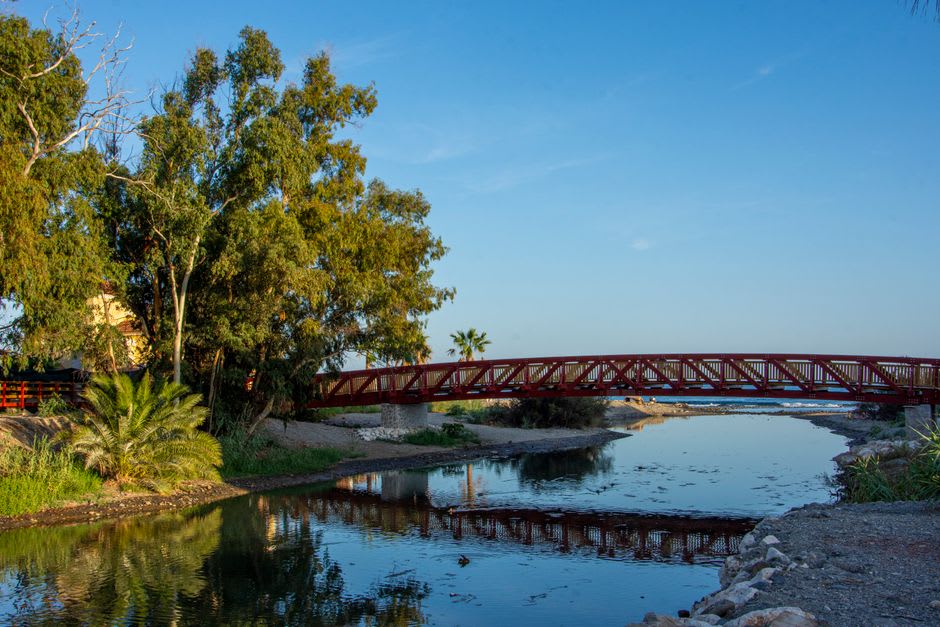
The malecón along the Río Bravo is where I spent an evening, walking the path along the river with the bridge in one direction and the city in the other. The Rio Grande/Río Bravo here is not especially wide or dramatic — it is a medium-sized river doing river things between two deserts — but the light over it in the early evening was genuinely good, going orange and then pink over the Texas bank, and there were families out walking and teenagers on bicycles and the specific Mexican-border leisure energy that I find more comfortable than many other kinds of leisure.
The norteño food culture here is what it should be: carne asada, machaca, cabrito if you ask around, flour tortillas the size of small tablecloths. I ate well at a parrilla near the plaza where the coals were live and the cuts were thick and the salsa tasted like it had been made that morning, which it probably had.
On Border Cities Generally
I have spent more time in Mexican border cities than most French travelers who come to Mexico, I think, partly because I find them interesting and partly because my routes through northern Mexico keep depositing me at crossing points. Each border city is different in character — Tijuana is enormous and cosmopolitan and slightly exhausting; Ojinaga is minimal and quiet; Matamoros carries its own history — but they share a quality of double exposure, of existing in two registers simultaneously. The street sign is in Spanish but the commercial logic references the dollar. The music is norteño but the TV in the restaurant gets Texas stations.
Piedras Negras is not a destination in the conventional travel sense. I would not tell someone to plan their Mexico trip around it. But I am glad I went, and not only because of the nachos.
Getting There
Buses run from Monterrey and from Saltillo to Piedras Negras; the journey from Monterrey is about three and a half hours. The Eagle Pass crossing is straightforward if you’re driving from Texas. The city has a reasonable range of accommodation. Eat at a parrilla rather than a tourist restaurant, pay your respects at the nacho monument, walk the malecón in the evening, and then decide whether you’re going north or south.