
Amatenango del Valle
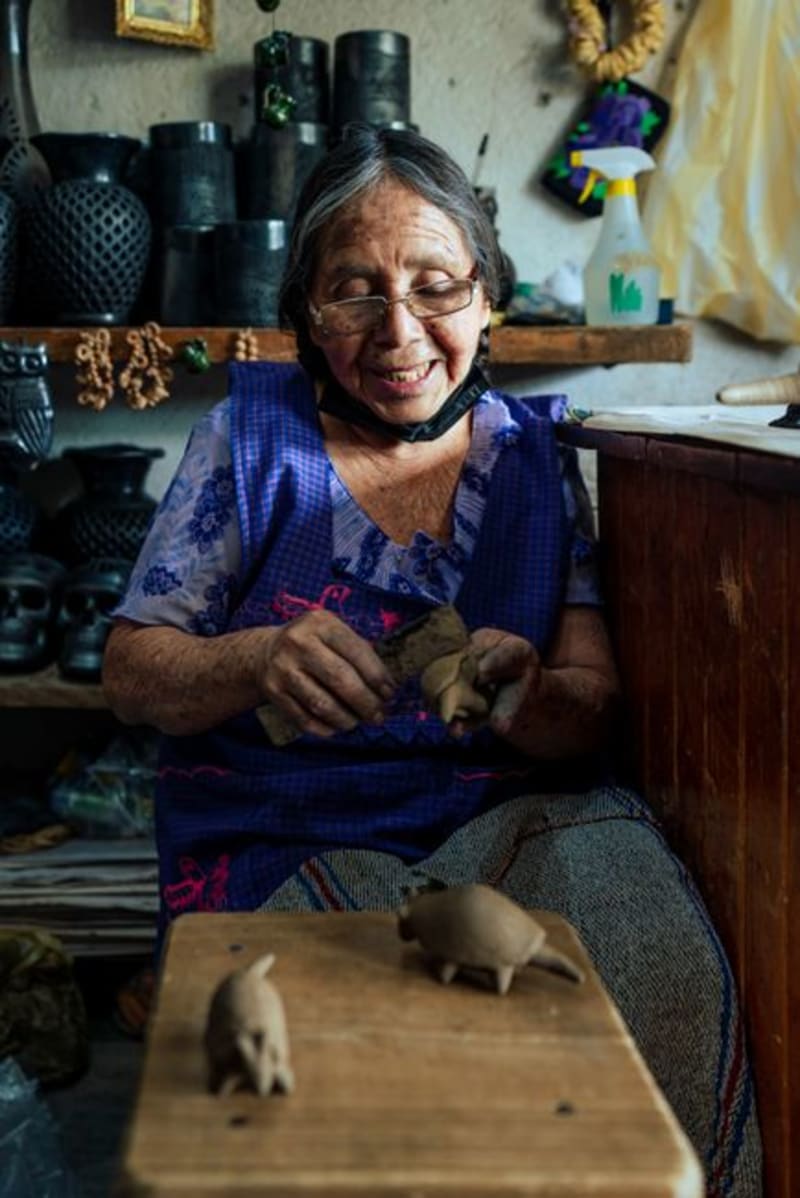
"A girl of maybe ten showing me how she builds a pot without a wheel, her hands moving with the confidence of someone who has been doing it since before she could read."
A Tzeltal village on the Pan-American Highway where women have been hand-building pottery without wheels or kilns for centuries. The ceramic animals and water vessels sold along the roadside are made directly in wood fires, and buying one from the hands that shaped it is one of the more honest transactions you can make in Chiapas.

The colectivo from San Cristóbal drops you on the highway, and for a moment the village looks like nothing: a few stalls, some women sitting in shade. Then you notice the shelves. Ceramic jaguars in rows. Birds mid-flight, painted in ochre and blue. Water vessels wider at the base than any kiln-fired pot I have seen. I had told myself I was just passing through on the way to Comitán. I ended up sitting in the dust for two hours watching a woman named Catalina build a bowl from a lump of local clay, her thumbs circling inward without a single tool in sight.
The Pottery and the Hands Behind It
What makes Amatenango different from every craft village in Mexico is not the objects themselves — though they are beautiful — but the fact that the technique is genuinely pre-colonial. No potter’s wheel. No gas kiln. Women here, and it is almost exclusively women, coil the clay by hand, smooth it with a piece of dried gourd, and fire the finished pieces directly in wood fires built in the yard. The temperature is lower than a kiln, which is why the ceramics have that particular matte warmth — slightly porous, slightly raw at the base where the fire sat underneath.
A girl of maybe ten was building a small jaguar at the table beside Catalina, her movements unhurried and exact. She did not look up when I arrived. This was not performance. She was just working.
The pieces sold roadside are made by the same women selling them, which matters. Prices are negotiated but fair — a medium water vessel runs around 150 to 200 pesos, a hand-painted bird maybe 80. I bought two jaguars and a small bowl and fit them in my bag wrapped in a rebozo I had not intended to buy either.

The Village Behind the Stalls
Away from the highway, Amatenango is quiet in the way small Tzeltal communities in the highlands tend to be — not unwelcoming, just self-contained. The plaza has a colonial church, and a few women sell atole and tamales de rajas from pots set on stones. I ate lunch there around noon, standing under a jacaranda that had lost most of its blooms. Nobody was trying to sell me anything. The crafts market is essentially the highway-facing edge of the village; the rest of it goes about its day.
The surrounding hills are planted with milpa — corn, squash, beans together in the same fields — and the light in the afternoon turns everything a particular yellow I keep associating with the Chiapas highlands specifically, not anywhere else I have been in Mexico.

When to Come
The stalls are busiest on weekend mornings, when families from San Cristóbal and Comitán stop in. If you want to watch the work rather than the selling, a weekday midmorning is better — potters are at it early, before the heat, and there is more patience on both sides of the conversation. There is no tourism infrastructure here beyond the stalls themselves: no restaurant, no hostel, no guided tour. That is, in this case, exactly the point.

Getting There
Amatenango del Valle sits about 37 kilometers southeast of San Cristóbal de las Casas on the Pan-American Highway toward Comitán. Any colectivo heading to Comitán from the terminal on Avenida Insurgentes will drop you at the roadside stalls — tell the driver before you board and he will call it out. The ride takes roughly 40 minutes and costs around 35 pesos.
Keep exploring
More of Chiapas
Keep exploring
More from Chiapas
 mexico
 Amatenango del Valle
A Tzeltal Maya village on the Pan-American Highway between San Cristóbal and Comitán where women have been shaping and firing clay by hand for over a thousand years. Every home doubles as a workshop, and the pottery — animals, vessels, figurines — is fired in open wood fires rather than kilns, giving each piece a warm, slightly rough surface you won't find anywhere else.
Explore mexico
 San Cristóbal de las Casas
A highland colonial town wrapped in indigenous culture, cloud-forest mist, and the best coffee in Mexico. Chiapas at its most concentrated.
Explore mexico
 Comitán de Domínguez
A Chiapas colonial city at 1,635 meters on the plateau above the Guatemalan border, the closest major town to the Lagos de Montebello lakes, the place where Mexico's independence from Spain was declared for the first time — four days before the rest of the country.
Explore mexico
 San Juan Chamula
A Tzotzil Maya municipality ten kilometers from San Cristóbal de las Casas that governs itself entirely under its own civic and religious laws. Its church of San Juan Bautista — carpeted in pine needles, lit by hundreds of candles at floor level, filled with the sound of shamanic prayer and Coca-Cola offerings — is unlike any other religious space I have entered in this country.
Explore mexico
 Zinacantan
A Tzotzil Maya village above San Cristóbal where carnation fields cover the hillsides and men still move through their days in rose-embroidered black tunics. Family kitchens open to visitors for posh and weaving demonstrations that feel like actual hospitality rather than theater.
Explore mexico
 Tenam Puente
Tenam Puente is a Maya archaeological site perched on a forested hilltop above the Comitán valley, with a ball court, royal palace platforms, and pyramid mounds you can still climb freely. Almost no one comes here, which means you get the kind of unhurried, unmediated contact with a pre-Columbian city that has become nearly impossible elsewhere in Mexico.
Explore