Edzná
"At some point I realized I was the only person visible anywhere in the site. Not a voice, not a footstep. Just the wind in the trees and an iguana watching me from a carved stele."
The week before I went to Edzná I had been to Chichén Itzá. I’m glad I went to Chichén Itzá. I’m also glad I went in the off-season, in the early morning, on a weekday, which is the only strategy that makes the place bearable. Even then, by nine in the morning, the buses were arriving from Cancún and the vendors had deployed their blankets of obsidian skulls and the photographs became difficult. Chichén Itzá is magnificent and extraordinary and also you are sharing the experience with several thousand other people at all times, and those two things coexist without resolving.
Edzná is sixty kilometres from Campeche city. I drove it in just over an hour on a flat road through cattle country, egrets picking through the fields alongside the road, a haze of heat already building even in December. The entrance is a gate on a two-lane road. There was one guard, two cars in the parking lot, and a kiosk selling water. I paid a small entrance fee and walked in.
For the next four hours, I mostly had it to myself.
The Building of the Five Floors
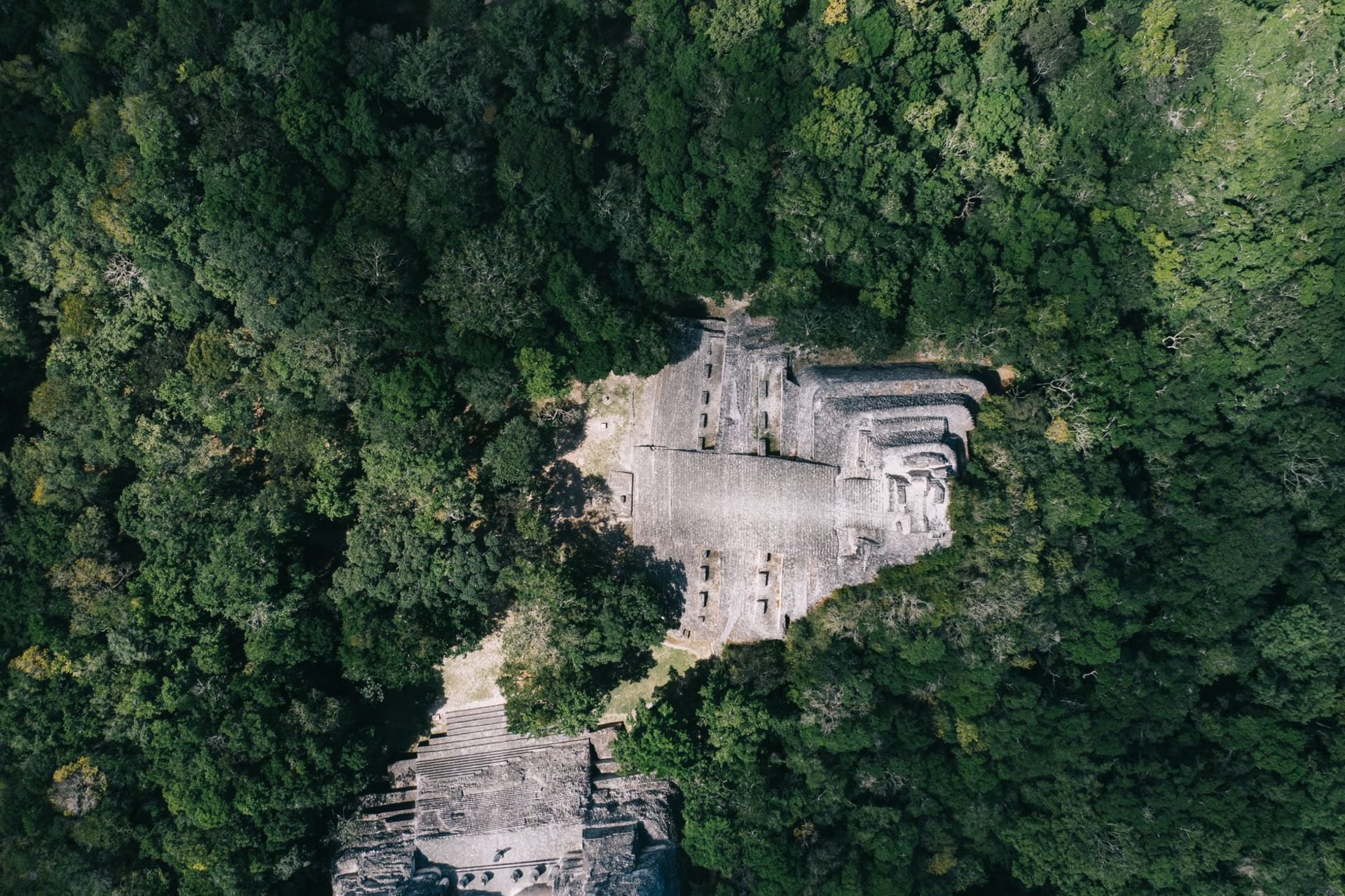
The site at Edzná was occupied for over a thousand years and reached its peak in the Classic period, roughly 600–900 CE. It was a major political center, which is evident in the scale of what remains. The Gran Acropolis — the main ceremonial platform — is enormous, a raised base covering several city blocks from which a cluster of temples and palaces rise. And rising above all of it is the Edificio de los Cinco Pisos: the Building of the Five Floors.
It is, by some margin, the most architecturally interesting building I have seen in the Maya world, which is a competition with serious contenders. Most Maya pyramids are pyramids — a series of terraces narrowing toward a temple at the top. The Building of the Five Floors is something stranger: a five-story structure where each floor has a series of rooms with doorways opening onto an exterior gallery, so that the building looks simultaneously like a pyramid and like a very tall palace. The combination of functions — it is believed to have served as an administrative building and a temple simultaneously — is unusual in Maya architecture and gives it a silhouette unlike anything else.
I walked to the base and looked up. Then I climbed.
The stairs are steep in the way that makes you recalibrate your relationship with Mesoamerican architecture. These were not designed to be climbed casually. They were designed to be visible from a distance, to communicate the importance of the ascent, and the angle is aggressive enough that on the upper sections I was using my hands as well as my feet. From the top level, I could see in every direction: the jungle canopy in all quadrants, the plain of Campeche to the north, and below me the entirety of the Gran Acropolis laid out like a map. A frieze on the upper temple registers the face of an ancestor or deity, still clearly visible, looking out with an expression that is either serene or impassive depending on the angle.
I was at the top for perhaps twenty minutes. Two other visitors appeared briefly on the platform below, photographed the staircase, and left. I ate a biscuit from my bag and looked at the jungle and thought about the people who had built this, and why this particular place — there are cenotes in the region, and an elaborate canal and water management system that was Edzná’s great engineering achievement — and what the city had looked like when the population was estimated at some tens of thousands, and what sound it had made.
The Acoustics, the Iguanas, and the Quality of Silence
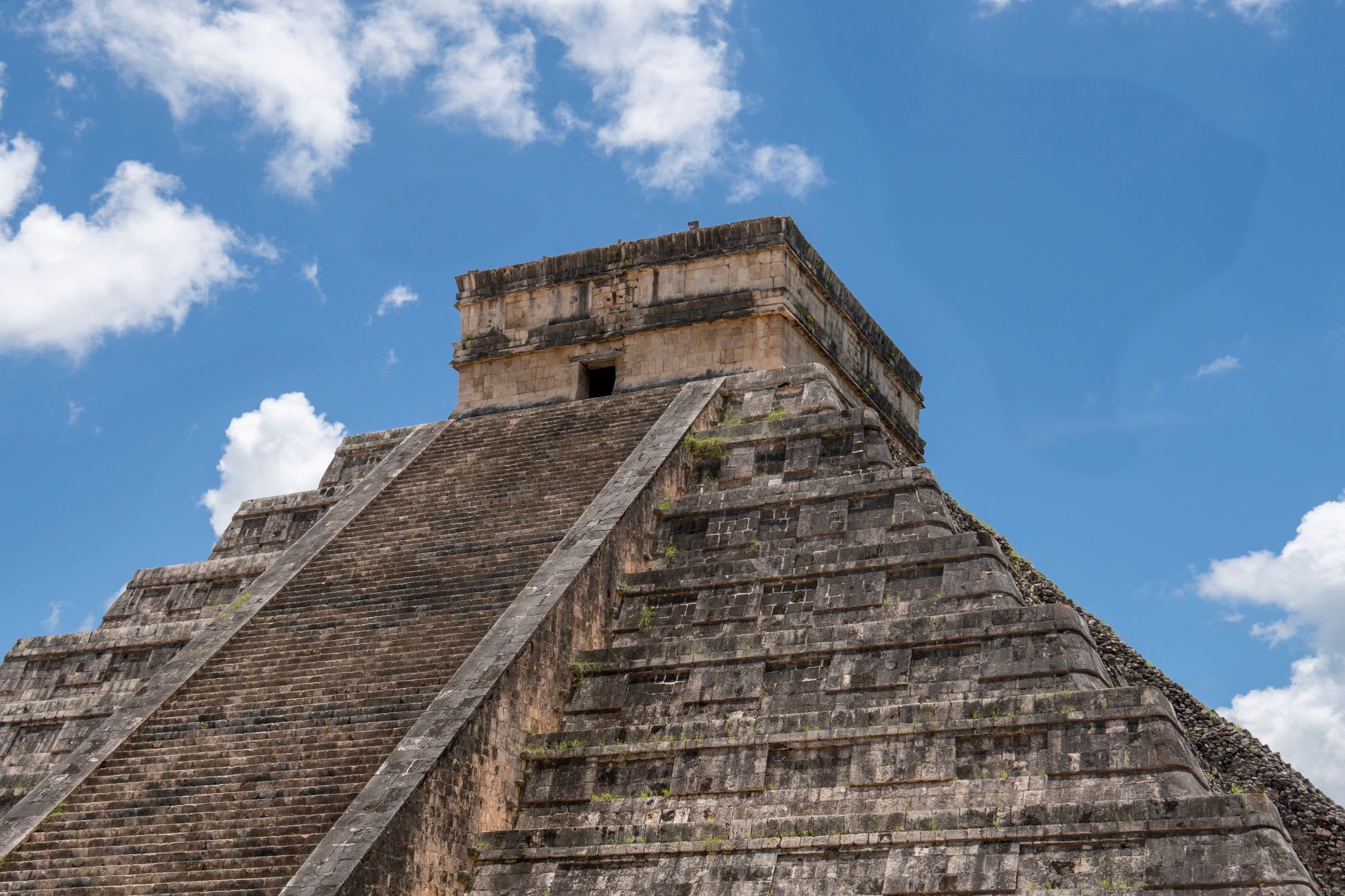
The acoustic properties of Maya sites are something I had read about without fully believing. The theory is that the positioning and geometry of certain structures was intentional — that the builders designed sound effects into their architecture in the way they designed stone carvings, as a meaningful element of the space. At Edzná, standing at the base of the main pyramid and clapping your hands produces an echo that returns as something sharper and more complex than the original sound — an elongated, metallic return that has been described by acousticians as resembling the call of the quetzal bird.
I clapped. The echo came back. I clapped again, louder. The echo came back different. I spent a few minutes experimenting with this alone, which felt both scientifically reasonable and mildly ridiculous. No one was watching. Actually, something was watching: one of the iguanas.
The iguanas of Edzná deserve their own paragraph. They are enormous — the large adults are easily a meter and a half from nose to tail tip — and they are everywhere in the site, occupying the carved surfaces with the entitlement of animals who have been there much longer than the archaeologists. On the Gran Acropolis, a green iguana of commanding size had installed itself on a carved stele. The stele is important — it bears a calendar inscription — but the iguana had positioned itself directly across the carved face in a way that suggested it had evaluated the stele’s function and determined that the primary function was now sunbathing.
I needed to walk around the stele to look at the other side. The iguana did not move. It opened one eye, assessed me, and closed the eye again. I walked around it. It occupied the stele for the rest of the morning as far as I could tell.
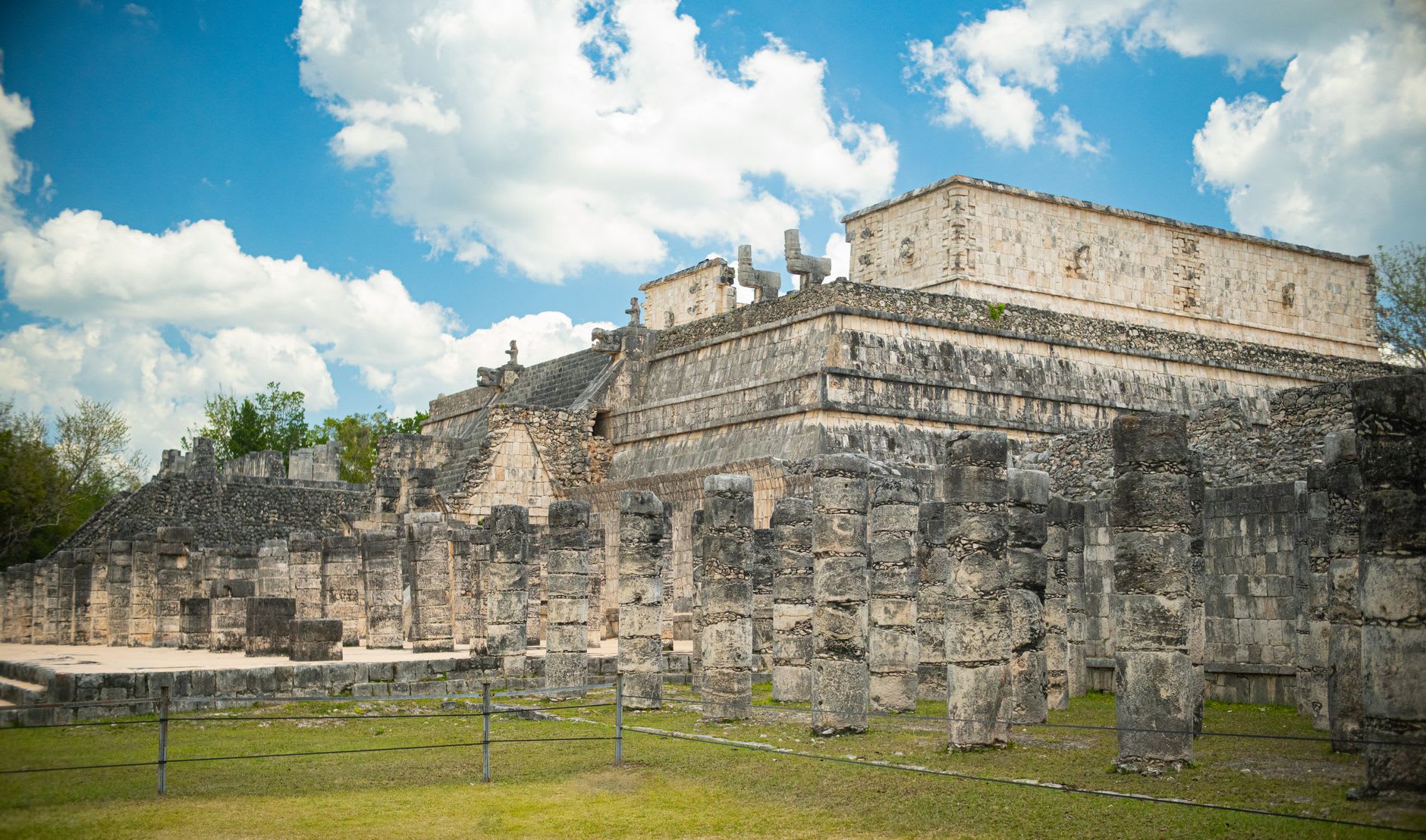
There were iguanas on the temple steps, iguanas in the grass of the lower platform, iguanas on the walls of the nohochná — the great house, a long building along the west side of the Gran Acropolis that served as administrative offices and which most visitors walk past quickly on their way to the big pyramid. The nohochná is worth slowing down for. Its long facade is interrupted by a series of doorways with corbeled arches, and in the late morning light the shadows of the arch interiors cast striped patterns across the ground in front of it.
Alone in a Maya City
At some point in my second hour at Edzná, I realized I was the only person visible anywhere in the site. This sounds like a small thing. It isn’t.
When you visit an archaeological site with other people around — even a few — you are reminded constantly that this is an archaeological site, a place that is being visited, interpreted, managed. The experience is mediated by the presence of other visitors in the frame. When you are alone, something different happens. The mediation goes away. You are just standing in a city.
I sat on a low stone wall near the south platform and ate a sandwich I had bought from a bakery in Campeche that morning. In front of me, an iguana was eating a yellow flower. It bit off the flower head, chewed it slowly, and looked around for another one. I watched this for a while. The silence was not total — there were birds, wind in the ceiba trees at the edge of the cleared area — but it was the specific silence of a place where human voices are absent. In the city of Campeche, thirty minutes’ drive away, people were going about their Tuesday. Here, nothing had been Tuesday for a very long time.
France has Roman ruins that I find extraordinary — the Pont du Gard, the arena at Nîmes, the amphitheater at Orange. They’re impressive in scale and excellent in condition, but they’re never empty. They’re never even close to empty. Tourist density at major European heritage sites has reached a level where the experience of the site and the experience of the tourist infrastructure around the site have become essentially the same thing. Edzná, by contrast, is a UNESCO-adjacent site of genuine archaeological importance, an hour from a regional capital, with good road access — and on a Tuesday in December there were eleven people there when I arrived and perhaps twenty by the time I left.
I don’t fully understand the distribution of tourist attention in Mexico. Tulum is overrun, Palenque is busy, Chichén Itzá is overwhelmed. Edzná — which is not smaller or less significant than several sites that are overwhelmed — had me and an iguana eating a flower and the wind in the trees. I am not complaining.
Getting There, When to Go, What to Bring
Edzná is about 60km from Campeche city on a road that is straightforward to drive. The most convenient option is renting a car in Campeche — the drive takes just over an hour each way, and the site is best spent three or four hours, so a half-day excursion works well.
If you don’t have a car, there are colectivos (shared minibuses) from Campeche that go toward the town of Pich and pass the Edzná junction — ask at the market or the bus terminal for current schedules, as they change. A taxi from Campeche can be arranged for a full excursion with waiting time; negotiate the price beforehand and it’s reasonable by any standard.
The site is open daily; check the INAH website for current hours and entrance fees, which are modest. There is a small information office at the entrance where you can pick up a site map.
Go early. The platforms on the Gran Acropolis are exposed stone with no shade whatsoever, and by late morning in winter the sun is fierce; in spring and summer it becomes genuinely punishing. Aim to arrive at opening and plan to leave by noon. Bring at least two liters of water per person — the kiosk at the entrance has water but I wouldn’t rely on it exclusively. Sunscreen is not optional. Shoes with grip are better than sandals; the pyramid stairs are steep and some of the stone is worn smooth.
The site has no restaurant or café. Bring food. A sandwich from the Campeche market is both practical and delicious, and you can eat it on a stone wall while watching an iguana eat a flower, which I recommend.