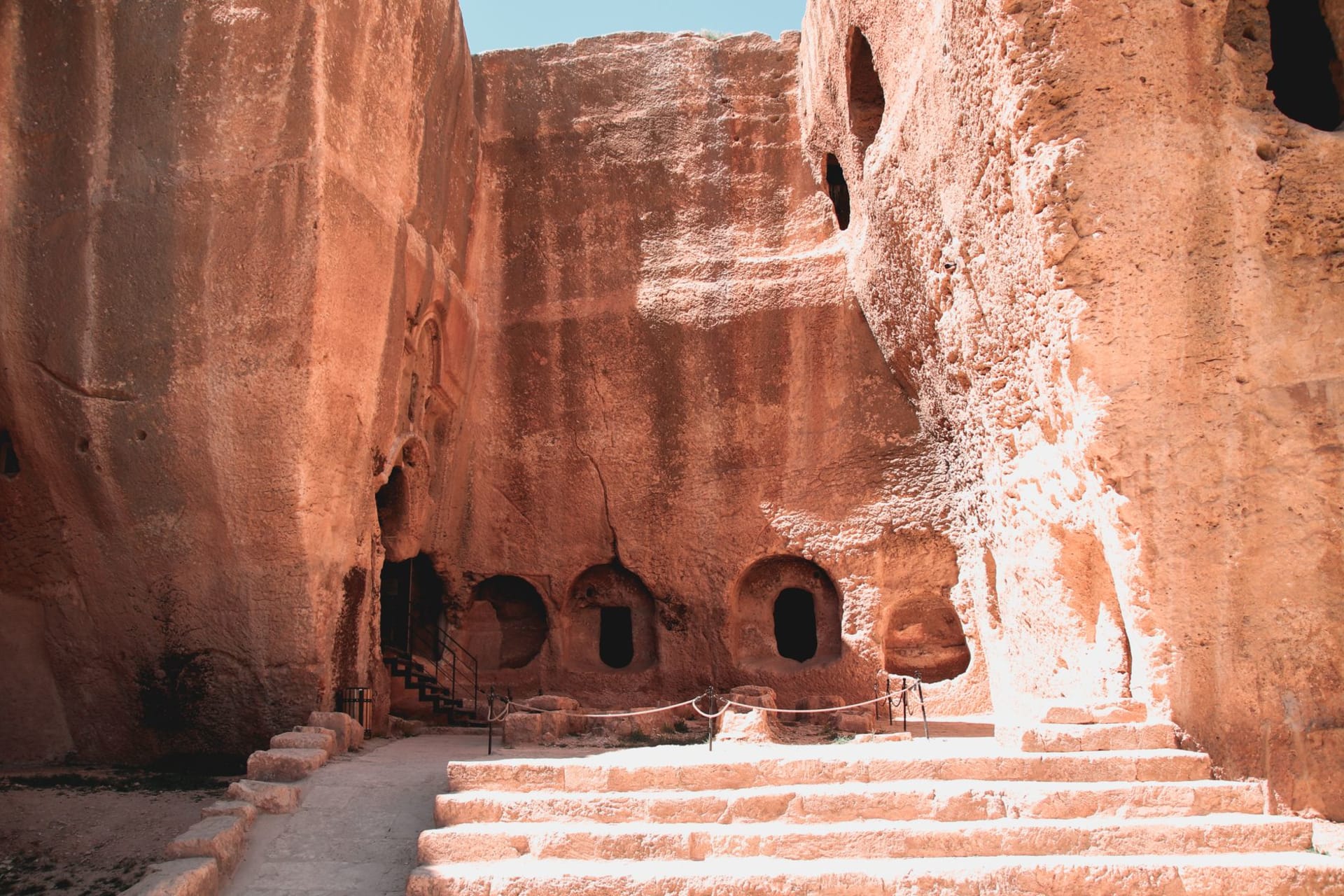
Nimrud
"At Nimrud I kept thinking: they knew exactly what they were doing, both when they built it and when they destroyed it."
Nimrud sits thirty kilometers south of Mosul on a low bluff above the Tigris, and arriving there involves driving through agricultural land — date palms, flat fields, the occasional village — before the mound rises suddenly from the plain, ancient and unmistakable. The Assyrian capital was founded in the thirteenth century BCE and reached its apogee under Ashurnasirpal II in the ninth century BCE, when he threw a ten-day feast here for 69,574 guests. Archaeologists found the guest list, inscribed in stone, which is the kind of detail that makes Mesopotamian archaeology feel like social history rather than architectural recovery. The palace reliefs he commissioned — carved orthostats lining the throne room and reception halls — depicted his military campaigns, his hunts, his divine protection, in a visual language of absolute power.
I walked the site in late October, the air cool enough for a jacket in the morning, the plain around the mound showing that brief Mesopotamian green before the winter desiccation sets in. The damage from ISIS’s 2015–2016 occupation was immediately, viscerally apparent. They used bulldozers on the principal palace. They blew up the lamassu at the Northwest Palace gate. They mined the tunnels. What had taken Austen Henry Layard and his successors a century of painstaking excavation to uncover was bulldozed in days, and some of it — the colossal winged bulls, the carved alabaster panels — simply gone: sold, broken, buried again under different rubble.

What makes Nimrud still worth visiting — and it is, despite everything — is what survived by circumstance and what has been uncovered since. The outer walls of the citadel remain substantial. The Temple of Nabu, god of writing, is recognizable. And in 1989, Iraqi archaeologists discovered the Royal Tombs of the Assyrian Queens beneath the throne room floor: intact graves containing gold jewelry of extraordinary refinement — golden earrings with granulation work, necklaces, crowns — now in the Iraq Museum in Baghdad. The queens’ curses are inscribed on clay tablets inside the tombs: “Whoever disturbs my tomb… may his spirit wander in thirst.” The tombs survived ISIS only because their location was hidden from the occupation’s records.
The site manager, a soft-spoken archaeologist from Mosul University, met me at the entrance with a laminated map and walked me through the site for two hours. He had been working Nimrud since before 2014, had evacuated when ISIS took the area, and returned immediately after liberation. He showed me photographs of the lamassu before their destruction and pointed to where they had stood. Then he said something I’ve been thinking about since: “We know exactly what was here. It’s all documented. We can rebuild the knowledge even if we can’t rebuild the stones.” He said it without bitterness, which was more devastating than bitterness would have been.

Getting to Nimrud requires Mosul as a base and either a private driver or a connection with local archaeologists. There is no public transport to the site. The road south from Mosul is entirely safe; the drive takes forty minutes and passes through agricultural land that feels entirely peaceable, the sort of countryside where people wave at unfamiliar cars.
When to go: October through April. Spring is particularly striking — the plain around the site turns briefly green, and the Tigris is higher and more visible from the citadel mound. The exposed ruins at Nimrud offer no shade at all; avoid summer entirely.