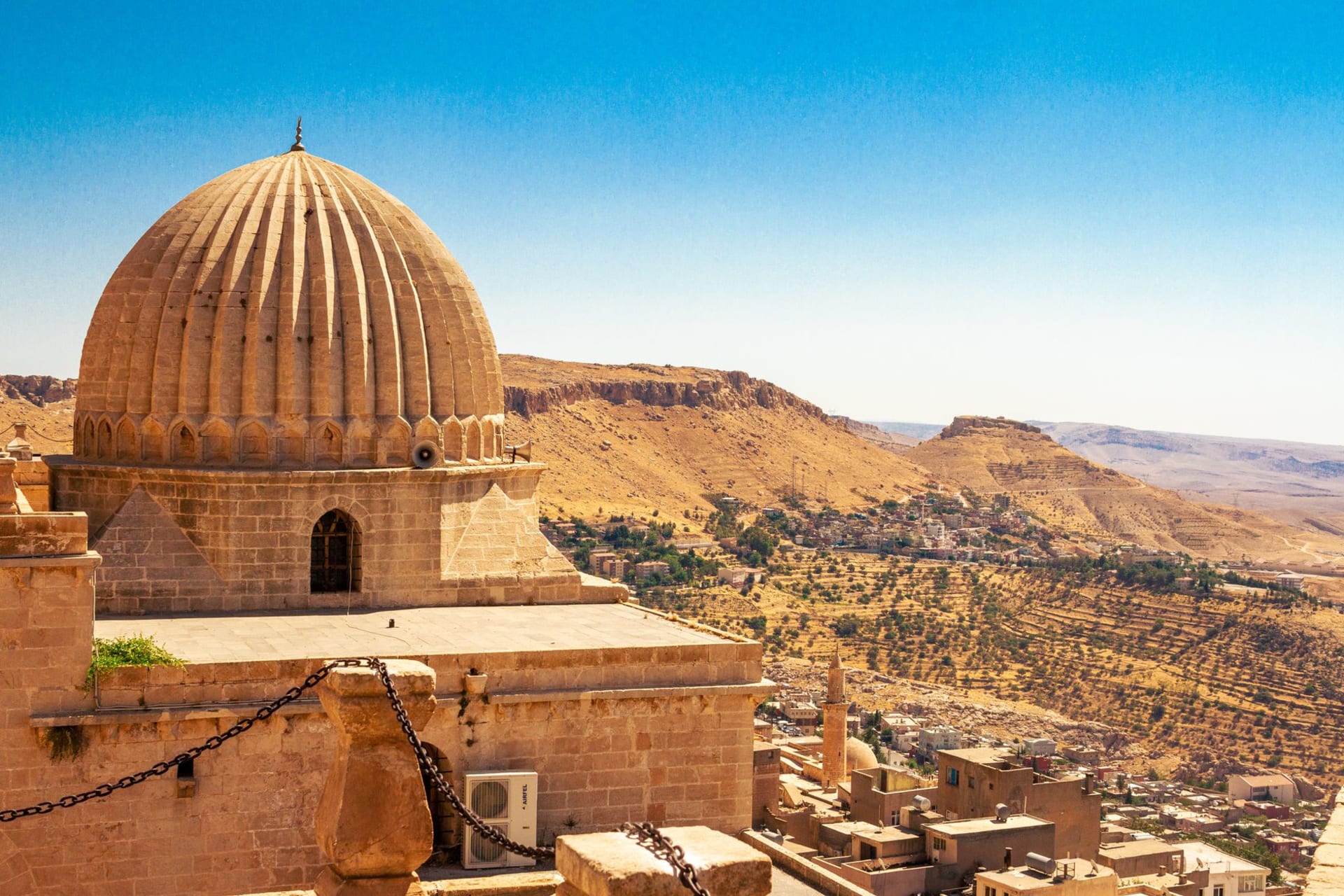
Hatra
"Hatra is where empires came to negotiate — and left their temples as evidence of the compromise."
The temples at Hatra are confounding in the best possible way. Standing in front of the Great Temple complex — the iwans, the colonnaded courts, the vaulted halls — you cycle through style-recognition and get stuck every time. The arched halls are Parthian. The columns are Corinthian. The gods inside were Mesopotamian. The inscriptions on the walls shift between Aramaic and Greek and the names of Arab tribal kings. Hatra was built at the intersection of empires — the Parthian empire to the east, the Roman empire to the west, the Nabataean and Arab cultures of the steppe — and the city’s extraordinary architecture is the physical evidence of a civilization that decided the correct response to that intersection was to build a syncretic sanctuary where all the gods could be honored and all the merchants could trade.
The city flourished between the first and third centuries CE. It was the capital of an Arab kingdom within the Parthian sphere, ruled by kings with names like Sanatruq and Abdsamiya. It withstood two sieges by Roman emperors — Trajan failed to take it in 116 CE, Septimius Severus failed in 198 CE — earning a reputation for impregnability that rested partly on its walls (still standing, six kilometers in circuit, the outer wall four meters thick) and partly on the legendary divine protection of its gods. When the Sassanid Persians finally took Hatra in 241 CE, the city was abandoned almost immediately, as if without its sacred status it had no reason to exist. The desert reclaimed it, and it slept for seventeen centuries.

Archaeologists began uncovering Hatra in the nineteenth and twentieth centuries. What they found — and what you can still walk through — is a temple complex of astonishing completeness. The iwans of the Great Temple are among the best-preserved Parthian architectural forms anywhere: vast arched halls open to the sky at one end, their stone faces carved with elaborate decorative programs. The statues found here — many now in the Iraq Museum — show that syncretic blending at its most striking: a sun god with Apollo’s features, a female deity in Hellenistic drapery but with a Mesopotamian headdress, a warrior god bearing a shield with a Greek Gorgon head.
ISIS demolished significant portions of Hatra with sledgehammers and drills in 2015, filming the destruction and releasing it as a propaganda statement against pre-Islamic idol worship. The UNESCO-listed site had been designated as world heritage in 1985. The videos are still online. What remains after the destruction is — again, as at Nineveh and Nimrud — more than you might expect, partly because the Islamic State’s teams were not systematic and partly because the site is large enough that much of the outer precincts were never reached. The Great Temple’s main iwans are damaged but standing.

I visited Hatra from Mosul, three hours south through a landscape that shifts from agricultural land to pale steppe as you go southwest. A lone caretaker met me at the gate. The site was entirely empty. I walked the Great Temple complex for two hours and sat in one of the side iwans — the stone still cool in the morning — and tried to understand what the syncretic confusion of the gods meant to the people who built this. Not confusion, I decided finally. Comprehensiveness. The acknowledgment that anyone who might be listening deserved a proper house.
When to go: October through April. The steppe around Hatra is cold in winter — the wind comes off the desert without obstruction — and blazing in summer. Spring is brief but the plain around the site flowers unexpectedly after winter rains, an extraordinary contrast to the stone city. The drive from Mosul makes this a full-day excursion.