Baghdad
"Baghdad smells like diesel and cardamom and something older — the particular exhaustion of a city that has always known it matters."
The Tigris at Karrada is wide and brown and moves with a purpose that surprises you in a flat city. I arrived on a Thursday evening, the traffic around Tahrir Square locked in its usual gridlock, the air thick with grilled meat from the kebab stands that line the street regardless of season, regardless of anything. A man on the pavement was selling bootleg novels stacked in towers — Arabic translations of Dan Brown next to Naguib Mahfouz next to what appeared to be Iraqi poetry published in the 1970s. Next to him, a boy was selling phone chargers from a plastic tray. The ordinary commercial chaos of a city that had survived things that shouldn’t be survivable and was, in the most fundamental sense, getting on with it.
Baghdad was the Abbasid capital from 762 CE, built as a circular city — Madinat al-Salam, City of Peace — by the Caliph al-Mansur on the western bank of the Tigris. It became, for four centuries, the intellectual and commercial center of the known world. The Bayt al-Hikma, the House of Wisdom, translated the entire corpus of Greek philosophy into Arabic. Algebra was formalized here. The decimal system, astronomical tables, medicine, optics. The Mongols ended it in 1258 in ten days of destruction that residents described as the sky turning black from burning books thrown into the Tigris. The river ran blue with ink and red with blood, they wrote. Baghdad rebuilt. It always has.

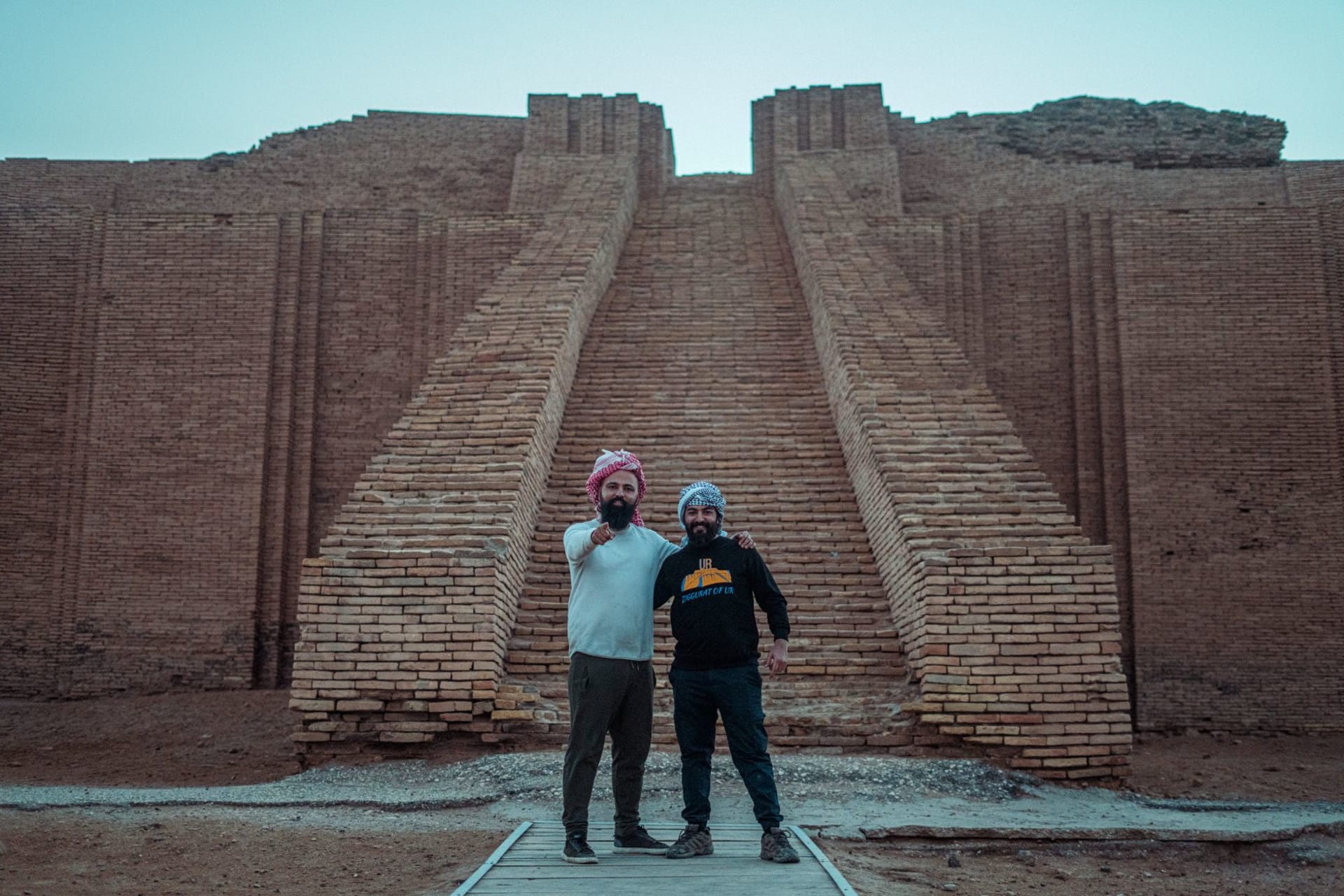
The National Museum of Iraq, on Kindi Street, reopened after the 2003 looting and holds what remains of one of the world’s great collections — the Warka Vase, the Uruk-period figurines, the Nimrud gold. A morning there is essential and not quite sufficient. The collection puts the ruins I visited in southern Iraq into a different register: here are the objects those ruins produced, golden headdresses and cylinder seals and cuneiform records, gathered under one roof. The museum director told me the collection is still only partially catalogued after the looting, that objects still surface periodically in auction houses abroad. He said it with the controlled tone of someone who has been furious for a long time.
Afternoons in Baghdad belong to Mutanabi Street — the book market that runs every Friday along the street named for the tenth-century poet, just east of the Tigris. Booksellers spread their stock on pavements and tables: old manuscripts, communist pamphlets from the 1960s, Iraqi novels, translated philosophy, religious texts, maps. The market was bombed in 2007, thirty-eight people killed, and rebuilt. I bought a 1960s Iraqi cookbook with recipes I couldn’t read and a map of Baghdad from 1973 showing a city vastly smaller than the one it now is. The seller wrapped them in newspaper and handed them to me with the particular satisfaction of someone who knows they’ve sold something irreplaceable.

Dinner in Karrada: masgouf, the national fish dish, grilled split over open fire at the riverside restaurants. The fish arrives on a platter the size of a bicycle wheel, its flesh smoky and firm, served with tomatoes and pickled vegetables and flatbread. Everyone orders too much. The river runs dark just outside. The generator cuts on when the grid goes down, which it does, and the lights flicker and hold and the evening continues.
When to go: November through March. Baghdad’s summers are genuinely extreme — 50°C days are normal in July and August, and the combination of heat, intermittent electricity, and urban density makes it miserable. Spring (March–April) is brief and beautiful, with the Tigris high and the city in a gentler mood.