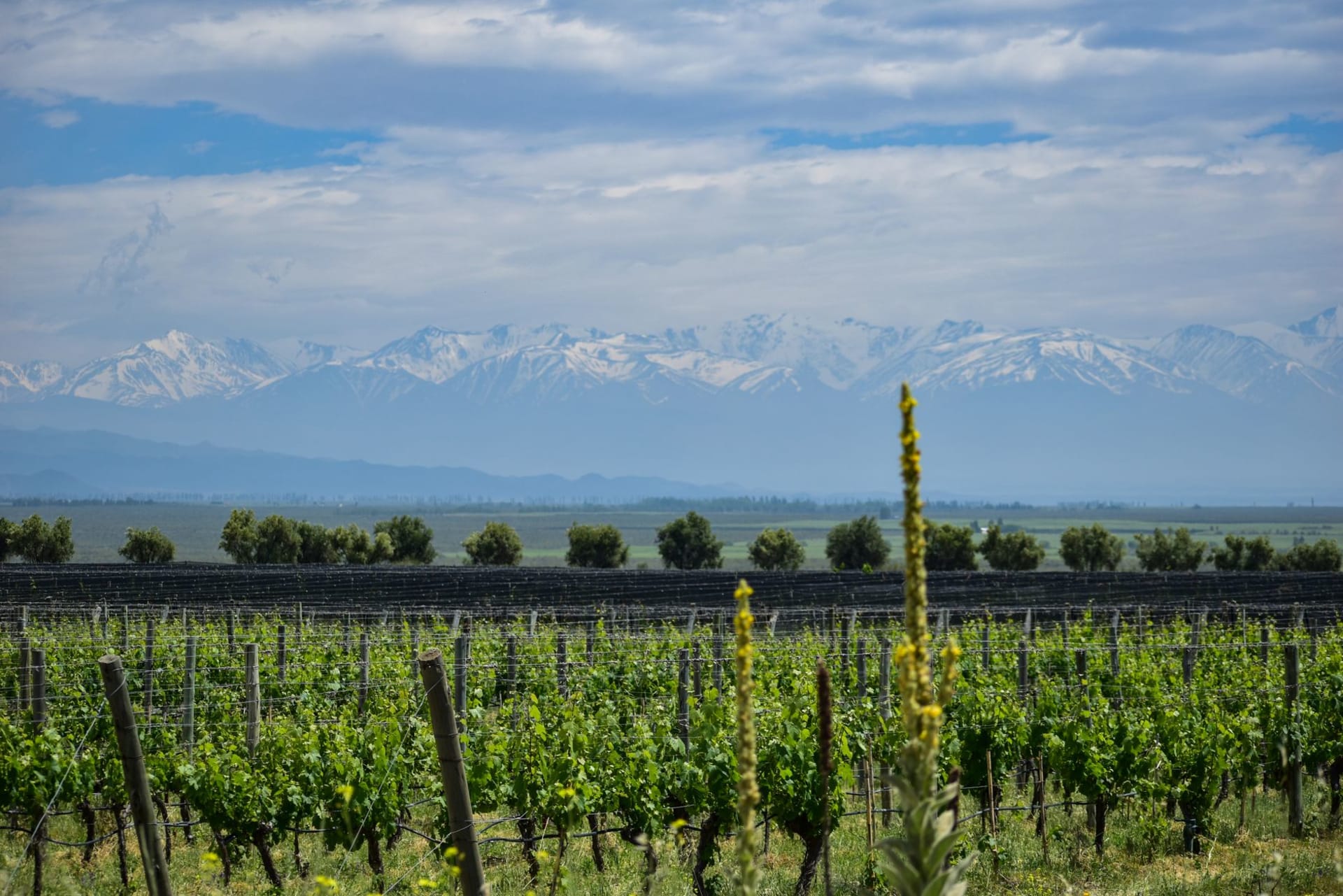
Agrelo
"Standing at the foot of that pyramid winery, I thought: someone built this to make wine feel like religion. And here in Agrelo, it actually is."
The Catena Zapata winery announces itself from a distance, rising out of the vineyard floor in the shape of a Mayan pyramid — four stepped levels of pale stone that catch the morning light and throw it back in a way that feels deliberately theatrical. It is theatrical. But when you stand inside, looking out over rows of Malbec vines through the cellar’s underground glass panels, watching the gravel soils recede toward the Andes, the theatricality starts to make a different kind of sense. Nicolas Catena Zapata designed his winery this way because he wanted people to feel the weight of what this place is. In Agrelo, the ground itself does most of the work.
The district of Agrelo sits within the Luján de Cuyo appellation, south of the city, at around 900 to 1,000 metres of altitude. The soils here are what distinguish it — deep gravel and sandy loam with high calcium carbonate content, poor in nutrients, which forces the vines to drive their roots deep and work hard for what they find. The Malbec that comes out of this ground is structured, mineral, and age-worthy in a way that surprises people who think of Malbec as a simple, early-drinking grape. A Catena Zapata Adrianna Vineyard from a good year needs a decade before it shows its full character. When it does, the wine tastes of the distance between this village and the mountain behind it.

Beyond Catena Zapata — whose visit and tasting requires advance booking and runs to a professional formality befitting its ambitions — Agrelo has a quieter, more agricultural texture. The village itself is small, a cluster of houses and a school and a pulpería that doubles as a hardware store, surrounded by vineyards that stretch to the foot of the mountains. I stopped at a family operation called Finca Sophenia, whose bodega sits among their own planted rows in a way that makes the connection between vine and bottle feel unmediated. Their Altosur Malbec — the entry-level wine — is the kind of bottle you drink on a Tuesday without ceremony and think: how does this cost so little and taste so much like somewhere?

The wine road through Agrelo runs alongside irrigation canals shaded by poplars — álamos, the straight-trunked trees that serve as windbreaks throughout this part of Mendoza — and in the late afternoon the light turns the whole corridor gold. I sat outside a roadside parrilla about two kilometres from the Catena Zapata gate and ordered a rib-eye and a half bottle of a local Cabernet Sauvignon, and watched the Andes change colour through the hour between five and six. The mountain goes from white to pink to purple to almost black. Then the temperature drops ten degrees in twenty minutes and you go inside for another glass.
When to go: April and early May for the post-harvest clarity — the dust of the picking season settles, the air is crisp, and the bodegas are often running final cellar tours before winter. Book Catena Zapata well in advance regardless of season. The Andes are snow-covered and visible from October through July; in late summer (January–February), morning haze can reduce the dramatic backdrop.