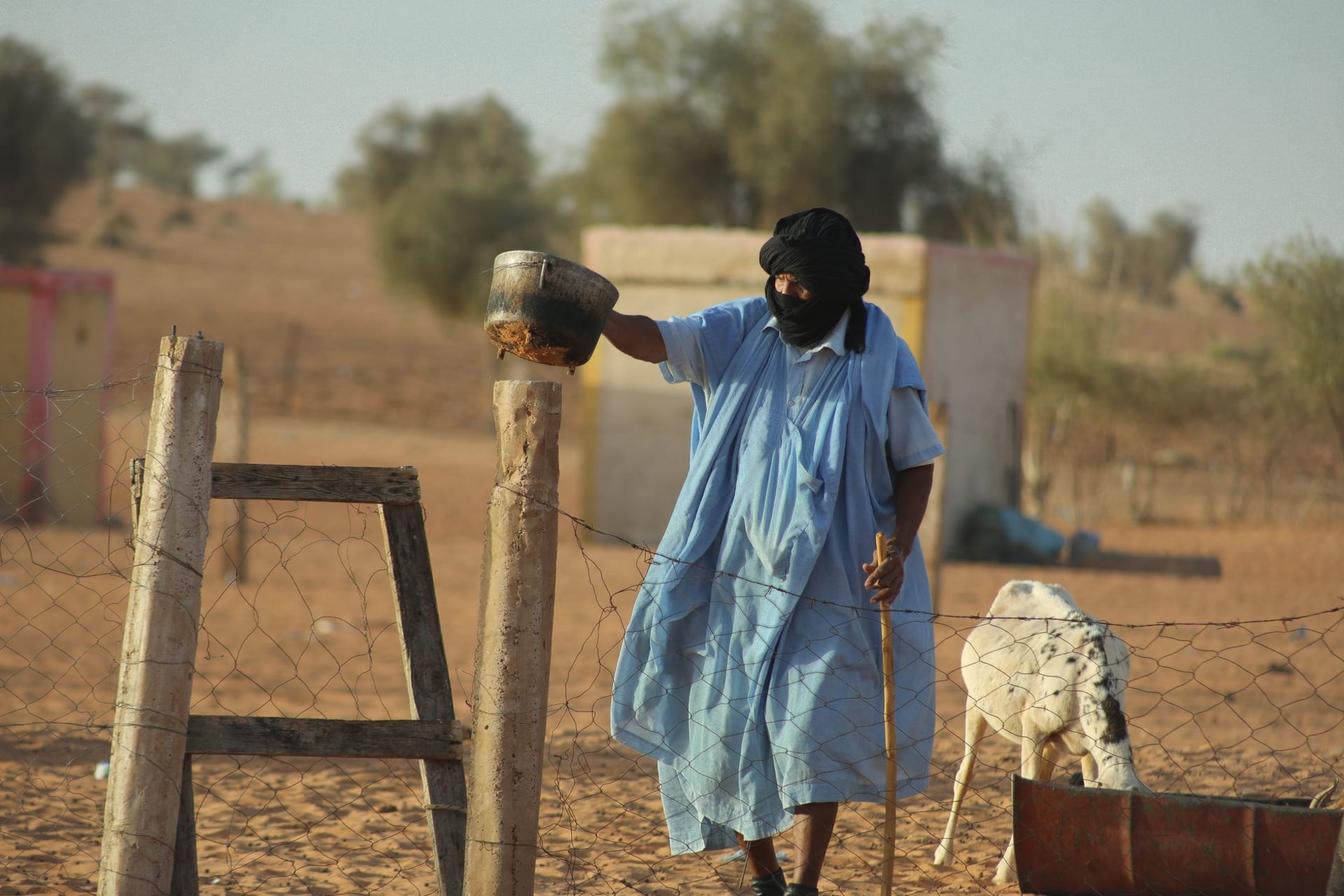
Nouakchott
"Every other fish market I've been to is just a fish market. This one feels like the whole ocean decided to show up."
Nobody really plans to love Nouakchott. You arrive with low expectations — it is not a beautiful city in any conventional sense, it has no old medina, no grand monuments, no tree-lined boulevards — and then something catches you off guard and you end up spending twice as long as you intended. For me it was the fish market, though I didn’t find it until my second morning. A taxi driver named Cheikh, who had been patiently suffering my terrible French all evening, finally gave up on diplomacy at 5 a.m. and knocked on my guesthouse door. “You come now,” he said. “If you wait it will be finished.”
The Marché au Poisson covers an enormous stretch of packed sand near the coast, and what happens there in the hour before and after sunrise is something that doesn’t translate well into description. Hundreds of small wooden pirogues have come in from the night’s fishing, and the catch — grouper, barracuda, octopus, sea bream in quantities that seem impossible — is being sorted, iced, and sold with an efficiency that has the quality of long choreography. Women in melhafa wrap luminous fabric in purples and yellows and electric greens, stacking fish with bare hands into pyramids that seem to defy physics. The smell is salt and cold and iron. Men haul blocks of ice in ancient wheelbarrows. There is shouting, but it is the shouting of a working system, not of disorder.

I ate breakfast at a stall at the market’s edge: thiéboudienne, the national rice-and-fish dish, served on a communal plate with a wedge of lime and a few broken crackers for scooping. The rice was cooked in the fish stock until it had absorbed everything — the brine, the tomato, the smoke of the wood fire — and the grouper on top had been fried first and then set to steam in the pot. I paid the equivalent of about two euros and sat on an overturned crate and felt the sun come up warm against my back and thought: this is the best thing I have eaten in months. I meant it.
The rest of Nouakchott is harder to love but worth the effort. The city grew with shocking speed after independence in 1960 — from a small administrative village of a few thousand to a sprawling metropolis of more than a million — and the expansion left few concessions to beauty or order. But the central market, the Marché Capital, has a compressed energy I find in the great African markets: hardware and mobile phones and bolts of fabric and butchers and spice sellers all occupying the same warren of passages, with the whole thing turning into a river of color on Friday mornings when the weekend crowds arrive. The Grand Mosque, pale and modern, sits at the center of the city and becomes a gathering point at prayer times, when the city briefly pauses from its perpetual motion.

At night, the beach neighborhood of Cinquième fills with people who have come to watch the Atlantic. There is no promenade to speak of — just sand running to the water, and rusted fishing boats hauled up above the tide line — but families spread out mats and sit in the dark watching the waves, and tea sellers move among them with kettles balanced on charcoal braziers. Nouakchott has wind all the time, but at night on the beach it feels like a gift rather than an assault. I stayed until the tea sellers started packing up and the moon was high enough to light the foam.
When to go: November through February offers the most livable temperatures, roughly 20–28°C during the day. The city’s coastal position makes summers marginally more bearable than the interior, but the humidity in July and August is its own particular punishment. The fish market is worth attending any day of the week, but Thursday and Friday mornings see the largest volume.