Néma
"Nine hundred kilometers of desert road ends here. Everything on the other side is a different world, and you can see it from the market."
The Route de l’Espoir is exactly what it sounds like — a road that crosses a landscape so unforgiving that the act of building it and calling it “hope” was either an extraordinary act of optimism or a fairly dark joke. I drove it in its entirety, from Nouakchott east through the flat gravel of the Aoukar basin, through the Hodh el-Chargui region where the acacia trees get greener and the sky gets taller, to Néma at the far end, nine hundred kilometers from where I started. The journey takes the better part of a day in good conditions and the landscape changes register about three hours from the end: the Sahara proper gives way to something drier and more tentative than the Sahel but less absolute than the desert, a transitional zone where the sand is red instead of beige and stunted grass appears in isolated patches.
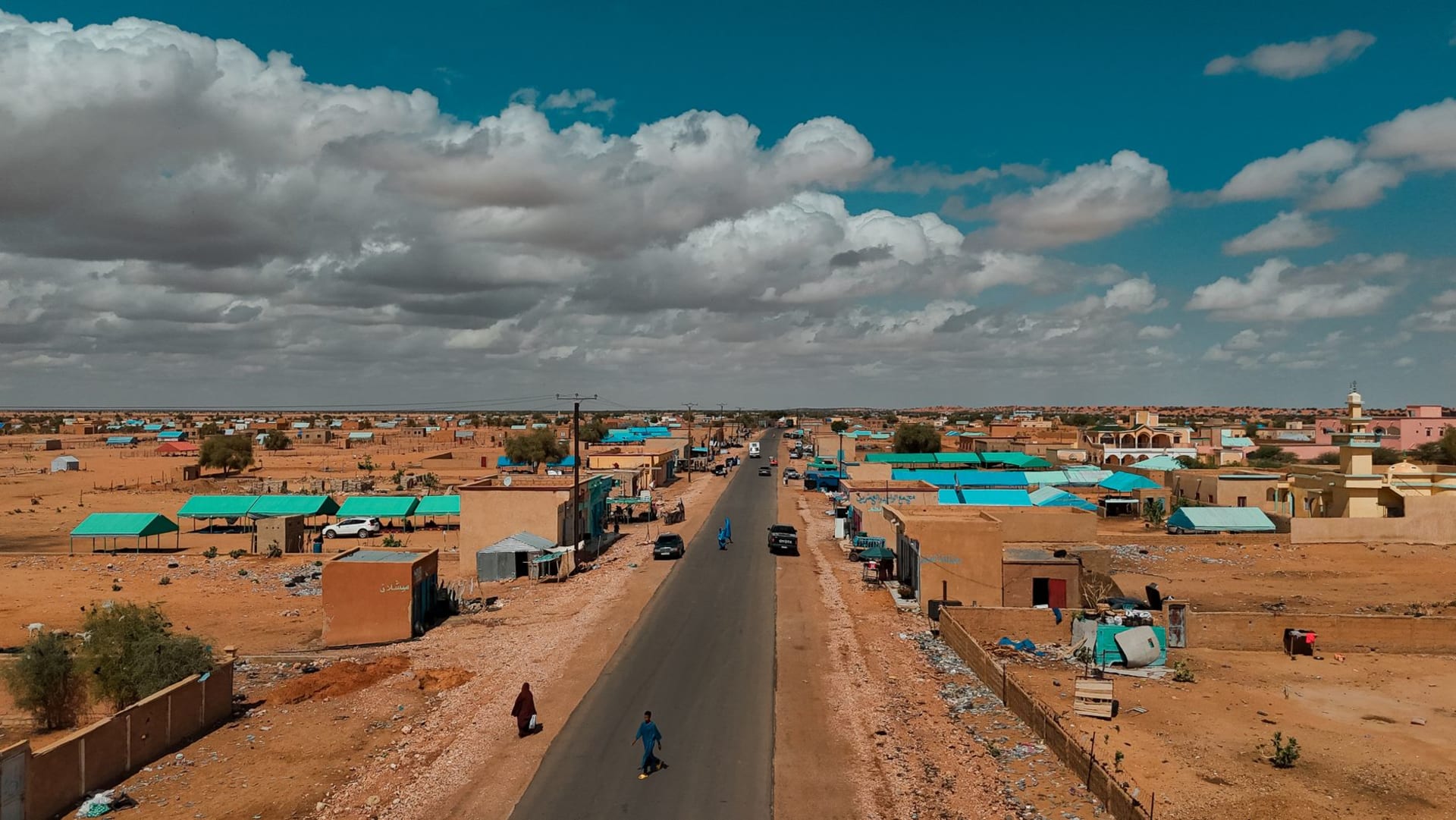
Néma arrived without announcing itself — a water tower, then a mosque, then a sprawl of low buildings that resolved into a market, a military post, a taxi station. It sits at an elevation just high enough to catch occasional breezes and feels, after the barren crossing, like a small triumph. The market operates daily but reaches its full expression on Monday, when traders from across eastern Mauritania and the border regions of Mali and Senegal converge. I arrived on a Tuesday, which meant the Monday market was still dissolving — sellers packing up their remaining goods, animals being loaded into trucks, a general atmosphere of productive exhaustion that is one of the better states for any large market to be in, if you want to actually talk to people.

What I noticed first was the demographic mix. Mauritanian Moors in white boubous sat beside Malian Bambara traders in narrow-striped fabric; Peul women with elaborate gold jewelry moved through the same spaces as Soninke merchants from the river regions to the south. The languages overlapping — Hassaniya Arabic, Bambara, Fulfulde, Wolof — created a sound environment that announced itself as a crossroads before you had any other evidence. Néma is where Mauritania’s Arab-Berber north meets its sub-Saharan neighbors, and the market makes that visible in a way that no political description can fully communicate.
I ate lunch at a stall run by a woman from Mali who had been in Néma for twelve years. The food was Malian: rice with a groundnut sauce that had slow-cooked into something almost sweet, a piece of grilled chicken on top, hot pepper sauce on the side that she issued with a pointed look that I interpreted correctly as a warning. It was the best thing I ate in Néma and possibly the meal that did most to recalibrate my sense of where I was — not in the Sahara anymore, not entirely, but in a place where the Sahara’s habits of hospitality had softened and expanded into something more lush, more layered.

The town itself is not conventionally interesting but rewards an evening walk. The military presence is discreet but visible — Néma is close to the Malian border and has been affected by regional security concerns — and there are UN vehicles and NGO trucks that you don’t see further west. But the evening gathering in the main square, where men drink tea and women walk with children and the call to prayer echoes from multiple mosques at slightly different times, has the quality of a place that is itself regardless of what surrounds it. Néma has been at the end of the road for a long time, and it has made its own peace with that position.
When to go: November through February for bearable temperatures. The Route de l’Espoir is paved its entire length but long stretches have been damaged by flash floods and heavy trucks, so a reliable vehicle matters. The border with Mali to the east is not currently safe to cross and the security situation in the region should be checked before travel — this is a part of West Africa where conditions change quickly.