Atar
"I thought Atar was just a place to pass through. Three days later I was still sitting in the same tea shop, and I didn't feel like I'd wasted anything."
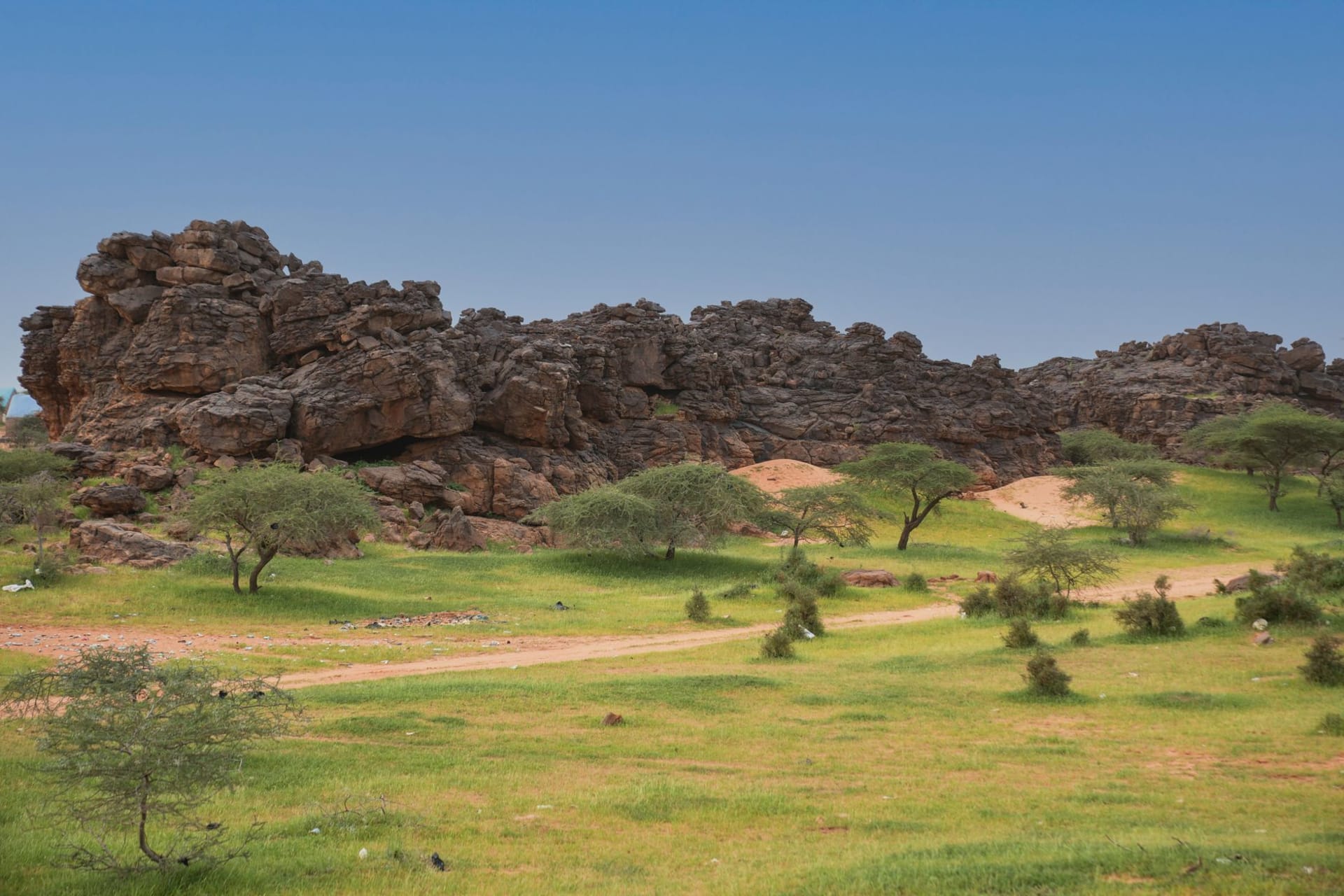
Atar earns its reputation as a transit hub — nearly everyone who enters the Adrar region passes through here on their way somewhere more dramatic — but that framing does the town a disservice. It is the kind of place where you plan to spend one night and wake up three days later not quite sure how that happened, your notebooks full of conversations with people who found you, not the other way around. The town sits in a wide valley beneath the Adrar plateau, which forms a wall of dark sandstone on the horizon, and in the early morning when the light catches the plateau face and the palm groves along the seasonal riverbed are still catching dew, Atar has a quiet handsomeness that the heat of midday erases completely.
The market is the town’s heart, and it rewards an early start. Tuareg men in indigo blue robes sell camel saddles alongside merchants from the south with mobile phone parts and counterfeit batteries. The date sellers operate from wooden platforms stacked with varieties I had never tasted: Timedokel, Bou Ithran, dates that range from the translucent sweetness of fresh fruit to the dense, almost savory concentration of those that have dried for months in the desert air. I spent an embarrassing amount of time at one stall, the seller patient as a geologist while I worked through samples, finally buying a kilogram of three different types wrapped in newspaper and eating them across the next two days like a connoisseur slowly losing his mind.

The tea ceremony is where Atar slows time to something close to a stop. The ritual here is the same as across Mauritania — three glasses, each poured from height to create the foam that signals proper preparation, the first bitter, the second sweet, the third almost dessert-like — but in Atar I encountered it in its most unhurried form. The guesthouse where I stayed had a courtyard with low cushioned benches, and in the late afternoon the owner and a rotating cast of neighbors would gather there and the tea equipment would appear and nothing would happen quickly for the next two hours. Conversations moved through French and Hassaniya Arabic and sometimes a language I couldn’t identify at all. Topics: the rainy season that had failed again, the state of the road to Chinguetti, a dispute about a camel, the theological correctness of a specific imam’s recent statement. I contributed almost nothing and was made to feel entirely welcome.
The Adrar plateau, accessible by a road that climbs out of town through a series of rocky switchbacks, offers a sudden expansion of scale. The top is a plateau of bare stone and gravel, largely flat, stretching toward horizons that are impossibly distant. In the late afternoon, shadow pools in the ravines and the stone goes from beige to copper to a deep red that looks almost volcanic. I drove up with a man from the guesthouse and we sat at the edge of the plateau for an hour saying very little, watching the town below disappear into dusk, and then the temperature dropped ten degrees in what felt like minutes and we drove back down with the heater on.

Atar has two or three restaurants serving simple food: rice, goat, fish if the truck from the coast arrived recently. There is no tourist restaurant, no menu in French, no concession to the visitor’s expectations. You eat what is available, you eat it at the hour it appears, and it is usually very good because it was made with the intention of feeding the people who live here, not the people who are passing through.
When to go: November through March. Atar functions as the base for day and multi-day trips to Chinguetti, Ouadane, and the Terjit oasis, and all of those are best attempted in cool conditions. The guesthouses in Atar can organize vehicles and guides; negotiate the price clearly before departing and confirm what is included.