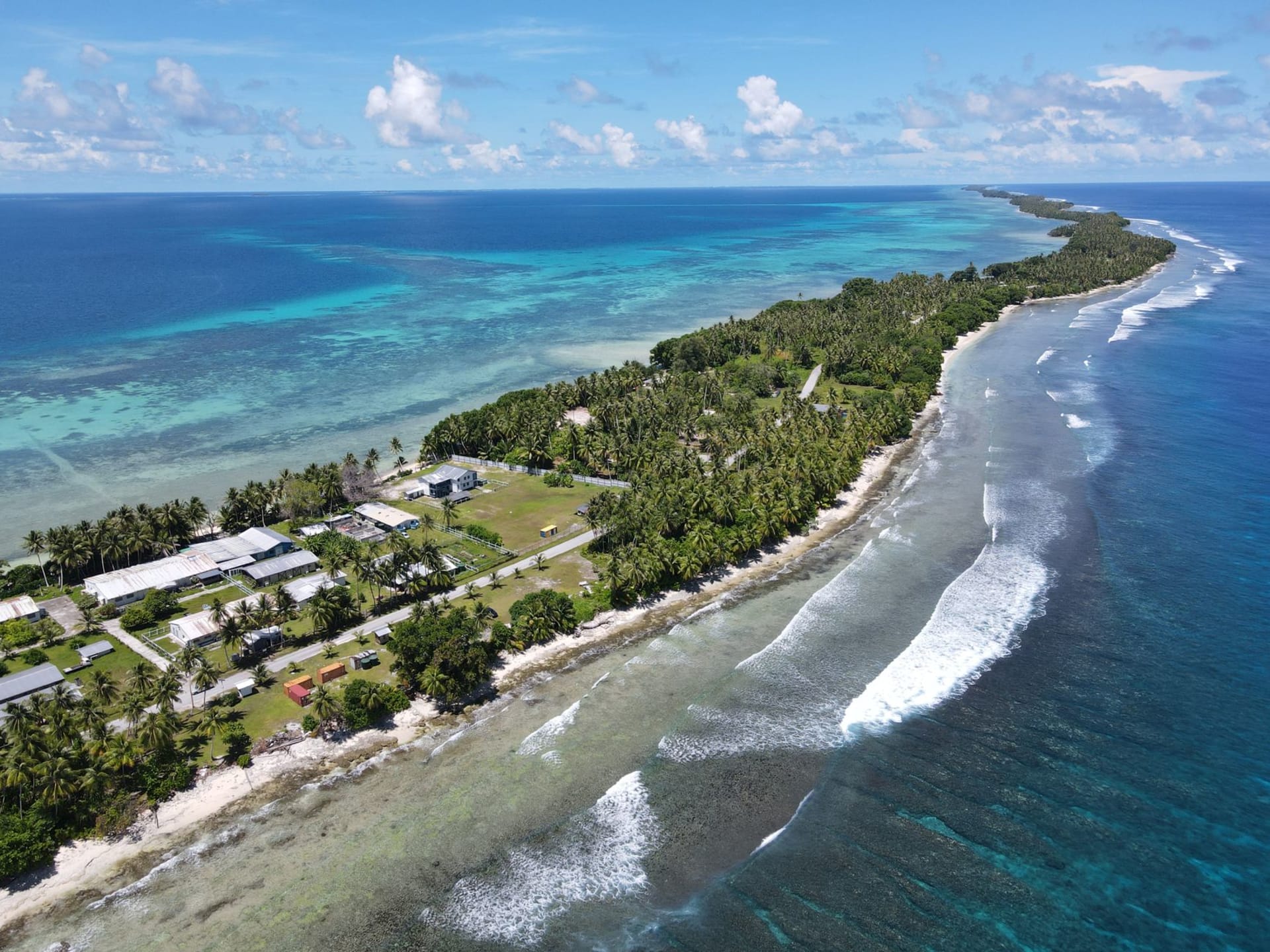
Ebeye
"The Americans live on the large island. The Marshallese live on the small one. The ferry runs between them twice a day."
Nobody puts Ebeye on a travel list. I went because I had been reading about it for years and needed to understand something I couldn’t get from articles alone — what it actually feels like to stand in a place this compressed. Ebeye is 36 hectares. It holds somewhere between 12,000 and 15,000 people. That is a density comparable to parts of Dhaka or Lagos, except that Ebeye is a speck in the Pacific Ocean, and ten minutes away by ferry, on a much larger island called Kwajalein, approximately 1,200 Americans live at the Ronald Reagan Ballistic Missile Defense Test Site with access to a bowling alley, a golf course, two swimming pools, and a mini-golf course. The Marshallese are not allowed to stay overnight on Kwajalein. They come by ferry to work, then come back.

The first thing that hits you on Ebeye is the smell — cooking fish and diesel and something sweet from the bakery near the dock, and underneath all of it the particular warm-water smell of overcrowded island plumbing. The lanes between houses are narrow enough that two people cannot pass comfortably. Corrugated metal roofs overhang the lanes, creating a patchwork of shade that makes the whole island feel like a series of low corridors. Children are everywhere, barefoot, playing with improvised toys or chasing each other through gaps between buildings. The energy is not grim exactly — people are laughing, music comes from open windows, a group of teenage boys has commandeered a stretch of wall for an involved conversation — but the density presses on you physically, the way extreme altitude does.
The reason all of this exists is the military base next door. Kwajalein Island was captured from the Japanese in February 1944 in a battle that killed nearly all 8,000 defenders. The US military has been there since. The Compact of Free Association gives the US rights to the base in exchange for various provisions to the Marshallese government. What it has produced at the human level is a community of Marshallese workers who have left traditional atolls for wage employment and are now stuck in a kind of suspended state on an island not big enough to hold them. A man named Lani who worked at the base as a grounds crew manager told me that he’d worked there for 22 years and had been inside the bowling alley exactly once, for a company Christmas party.

I don’t want to make Ebeye sound like a place of pure misery, because it is not. There is a vitality here that comes from density itself — the way ideas and music and gossip move through such a compressed community with an immediacy that open spaces never produce. The food stalls near the main dock serve excellent grilled reef fish and fresh coconut for breakfast. A women’s cooperative makes beautiful woven pandanus bags. The lagoon at the island’s edge is still that extraordinary Marshall Islands blue, and children swim in it every afternoon. But the context is always there, inescapable — the ferry to the golf course running twice a day, the Americans invisible behind their perimeter on the bigger island, the question of fairness sitting in the air like the heat.
When to go: Ebeye is accessible by flight from Majuro (via Kwajalein airport, which requires US military clearance for the atoll — check current entry requirements well in advance). Accommodation is limited to a small number of guesthouses. Visit with time to sit with what you see rather than processing it from a moving vehicle.