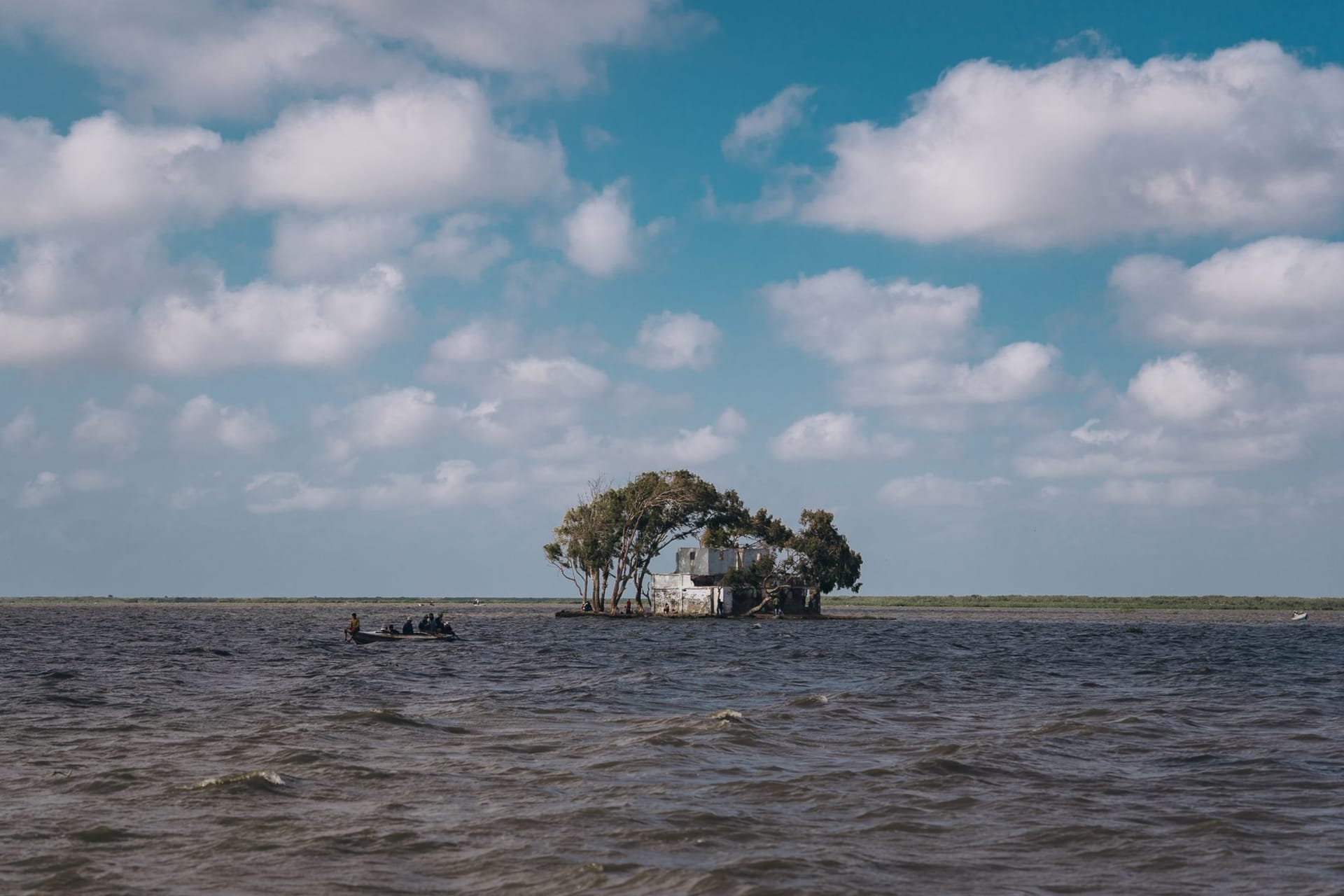
Lago Arari
"You think it's a lake until the season changes and it becomes a different continent."
The Island’s Hidden Interior
Most travelers to Marajó hug the eastern coast — Soure, Salvaterra, Joanes, the beaches — and never venture into the interior where the island’s true character lives. Lake Arari is the gravitational center of that interior: a freshwater lake that in the dry season covers roughly 1,000 square kilometers and in the wet season spreads across nearly three times that area, merging with the surrounding floodplain until the distinction between lake and land becomes mostly theoretical.
I reached it by boat from Santa Cruz do Arari — a slow chug through channels lined with buriti palms and floating mats of Victoria amazonica, the giant lily pads that look improbable until they’re under your hull. The lake opened up ahead of us and I understood why the people living around it call it simply “the lake” with the kind of article that implies there is only one.
The Lily Pads
Victoria amazonica — the Amazonian giant water lily — is one of those plants that seems like a fiction until you see it. The pads are circular and up to three meters across, with upturned rims and undersides that are red and covered in spines. They float in clusters in the calmer channels feeding into Lake Arari and at certain times of year cover large areas of still water. The flowers open white at night and close pink the next day — a cycle that happens exactly once per flower, after which pollination is complete.
I knew the facts before I came. What I wasn’t prepared for was the scale, or the sound — a quiet groaning and creaking as the pads rise and fall with boat wake, like a room full of old chairs.
Birds in Impractical Numbers
The wetlands around Lago Arari are a serious ornithological destination. The counts here for migratory and resident species are extraordinary — jabiru storks nest in the buriti palms, roseate spoonbills feed in the shallows in flocks large enough to color the horizon pink, and the hoatzin (a prehistoric-looking bird that sounds like it’s being murdered when disturbed) is common enough to stop being exciting by the second day.
The aquatic vegetation hosts sungrebes, purple gallinules, and a variety of herons that I never quite managed to distinguish correctly. A birding guide based in Santa Cruz offers half-day boat trips into the lake margins. Whether you’re a dedicated birder or merely someone who doesn’t mind looking at extraordinary things, the trip is worthwhile.
The Seasonality of Everything
What makes Lago Arari genuinely remarkable is how completely it transforms the landscape between seasons. In the wet season (roughly January to June), the lake’s waters spread across the campo and the buffalo are driven to high ground — the fazendas become islands, the roads disappear, and the whole interior of Marajó becomes an archipelago. Local ranchers move their herds by boat.
In dry season, the lake retreats and the mudflats exposed around its perimeter are among the richest wildlife habitats on the island. Caimans bask in the sun on the bank. Pink river dolphins hunt in the deeper channels. Capybaras — the world’s largest rodents, built like overweight labrador retrievers — graze in herds on the wet grass at the waterline.
Getting On the Lake
There’s no tourist infrastructure on Lago Arari beyond what’s available from Santa Cruz or Cachoeira do Arari. You negotiate a boat and a time and you go. The negotiation is straightforward and the prices are reasonable. Bring a hat, water, sunscreen, and ideally binoculars. The lake has no shade once you’re away from the margins.
When to go: August and September offer the most favorable combination of accessible water, retreating floodplain, and concentrated wildlife. Late July shows the beginning of the retreat — landscape in transition is its own kind of spectacle. The wet season is navigable by experienced boatmen but requires more time and planning. Avoid the peak flooding months (March-April) unless you’re specifically interested in the flooded campo landscape.