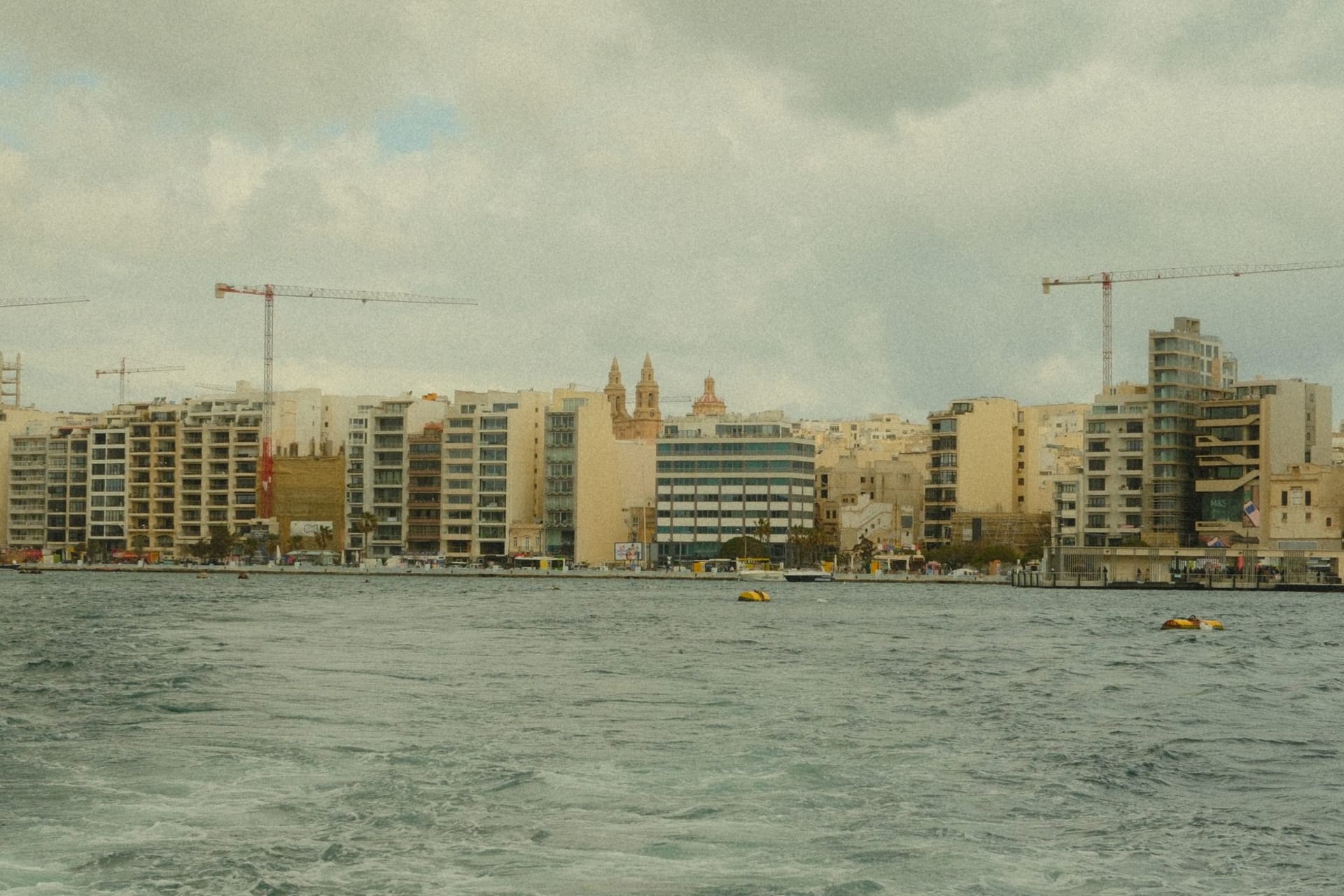
Sliema
"Valletta is where you go to feel history. Sliema is where you go to feel the evening."
Sliema doesn’t have Valletta’s drama or Mdina’s silence, and it makes no attempt at either. It’s a modern town with a long seafront walk, a grid of streets with cafes and pharmacies and clothing shops, and a ferry jetty that connects it to Valletta every thirty minutes. What it has, and what I keep coming back to, is an ease — the particular ease of a place built for living in rather than visiting. The fact that visitors come anyway is something Sliema has absorbed without fundamentally changing.
The Waterfront Walk
The Sliema promenade — the Ix-Xatt — runs for about three kilometers along the rocky seafront, wide enough for strollers and cyclists and old men walking very slowly side by side. The swimming here is off flat limestone rocks rather than beach; there are ladders down to the sea and small platforms where people stretch out on towels. The water is clean. Families do this in the evening instead of going to a park, which makes sense in a country where the park might be a harbor.
I walked the full length one morning starting at six, when the city hadn’t quite woken and the sea was the gray-green of early light. By seven, people were already in the water. By eight, the first cafe tables were going out. There’s something clarifying about a place that uses its waterfront this practically.
Eating and the Street Grid
The main shopping street, Tower Road, is where you want to eat if you’re staying nearby. The Maltese take their pastry seriously: imqaret are deep-fried date pastries that arrive piping hot from a hole-in-the-wall stand and are not as sweet as they sound, just dense and fragrant with anise. I ate three before I understood what I was doing. The sit-down restaurants along the seafront skew expensive and tourist-facing; walk one block inland and the calculus changes immediately — smaller rooms, better food, menus written on chalkboards in a mixture of Maltese and Italian.
The Ferry Crossing
The short hop from Sliema to Valletta is one of my favorite things to do in Malta, and it costs almost nothing. You stand on the open deck for five minutes and watch both cities from the water — Sliema’s low modern waterfront falling away behind you, Valletta’s bastions growing large ahead, the Grand Harbour opening to the south. It resets your sense of scale. Everything looks more serious from the water. I took the ferry back and forth three times in a day once, not because I needed to be anywhere but because the crossing was that good.
Staying in Sliema
As a base, Sliema is practical in ways Valletta isn’t: more accommodation options, a supermarket that sells things you’d actually want to cook with, easier logistics. Valletta’s old town streets are beautiful but narrow and hilly; Sliema is flat and walkable in a different way. Lia preferred it for staying, and she was right — the ferry to Valletta makes the old city accessible without having to live inside its intensity. We’d return to the apartment with fish we’d bought from a truck parked near the waterfront and cook dinner with the windows open to the harbor smell of salt and diesel.
When to go: Sliema works year-round as a base. Summer evenings on the promenade are an event in themselves — the whole city seems to be walking there between six and nine. In winter the seafront empties and the town is quieter but not closed; cafes stay open, the ferry runs, and Valletta is just as beautiful across the water without the summer crowds.