Mellieha
"Malta does limestone cliffs and history very well. It does one real beach, here, at the northern tip."
Malta is not primarily a beach country. It has dramatic coastline, rocky coves, and sea that shifts between green and blue depending on depth, but sandy beaches are rare and most of them are short. Mellieha is the exception — Ghadira Bay stretches for nearly a kilometer in a long sheltered arc, shallow enough to walk out a hundred meters and still only be waist-deep, and wide enough in peak summer to absorb a genuinely large number of people without feeling unbearable. It’s also, by Maltese standards, remote: the northern tip of the island, close to the ferry that crosses to Gozo, with a different pace than Valletta or Sliema.
The Town Above
Mellieha the town sits on a ridge above the beach, accessible by a steep road that most people drive and I walked once, arriving at the top sweating through my shirt at 9am. The reward is the Sanctuary of Our Lady of Mellieha, carved into the living rock of the hilltop — one of the oldest Marian shrines in the world, still actively visited, still hung with the votive offerings (crutches, wedding dresses, photographs, model ships) that people have left here since the medieval period. The combination of cave chapel and collected human gratitude produces a particular atmosphere I find hard to describe: very old, very sincere, smelling of candle wax and stone.
The main street has the slow commerce of a town that doesn’t rush — bakeries, a few restaurants, a hardware shop that seems to sell one of everything. I ate pastizzi from a place with no chairs, standing at a counter watching a woman shape them by hand: the ricotta ones, soft and mild; the mushy-pea ones, which sound worse than they are.
The Beach Itself
Ghadira is family-oriented in the way that only sandy, shallow, calm bays can be. The water is clear but not the dramatic blue of the south — it runs green-turquoise over the sand, honest beach water rather than postcard water. There’s shade at the north end where the tamarisk trees grow close to the dunes, and a protected wetland behind the beach where wading birds stop during spring and autumn migration. I did not expect a bird hide at the edge of a beach in Malta. I am glad it exists.
The Red Tower and the Headlands
North of Mellieha, the island narrows to a thin corridor of land called Marfa Ridge. The Red Tower — a squat, deep-red fortification built by the Knights in 1649 — sits at the highest point and offers the clearest view in Malta: Gozo across the channel to the north, Comino in between, and the full length of Malta stretching south. The tower is usually open and the walk from the road takes fifteen minutes. From here you can also see the ferry port at Cirkewwa, where the Gozo ferry loads, and the flat cap of land that becomes the beach below.
Practical Notes
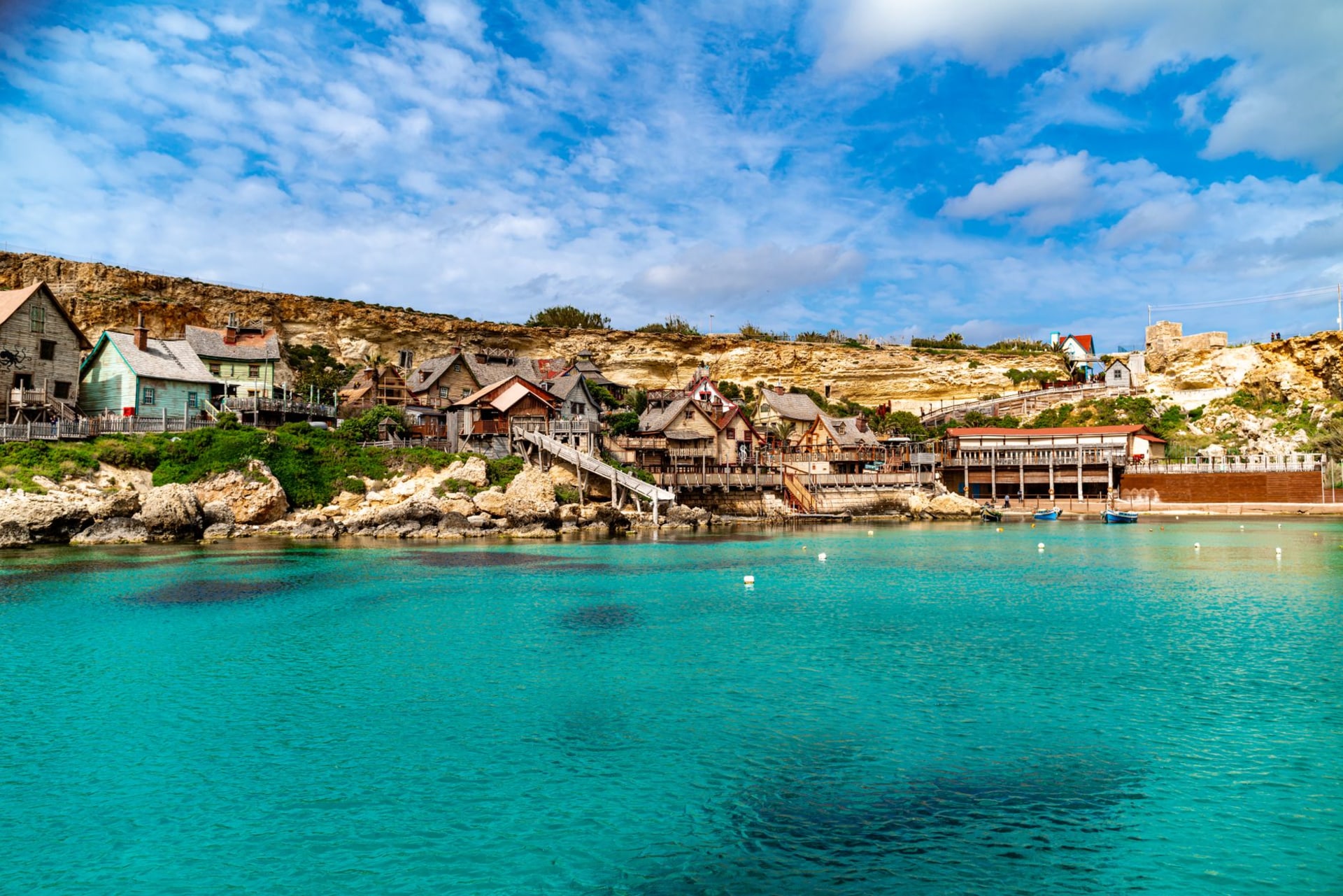
The northern bus routes from Valletta take about an hour and serve both the beach and the town. In summer the beach fills by 10am; in shoulder season you can have long stretches of it to yourself. The Popeye Village — a film set from the 1980 musical that has somehow become a tourist attraction — is nearby and entirely optional.
When to go: May through October for swimming; June and September are ideal, avoiding the packed August crush. Spring is excellent for the wetland birdwatching and for walking the Marfa headlands without the heat. The sanctuary is worth visiting in any season.