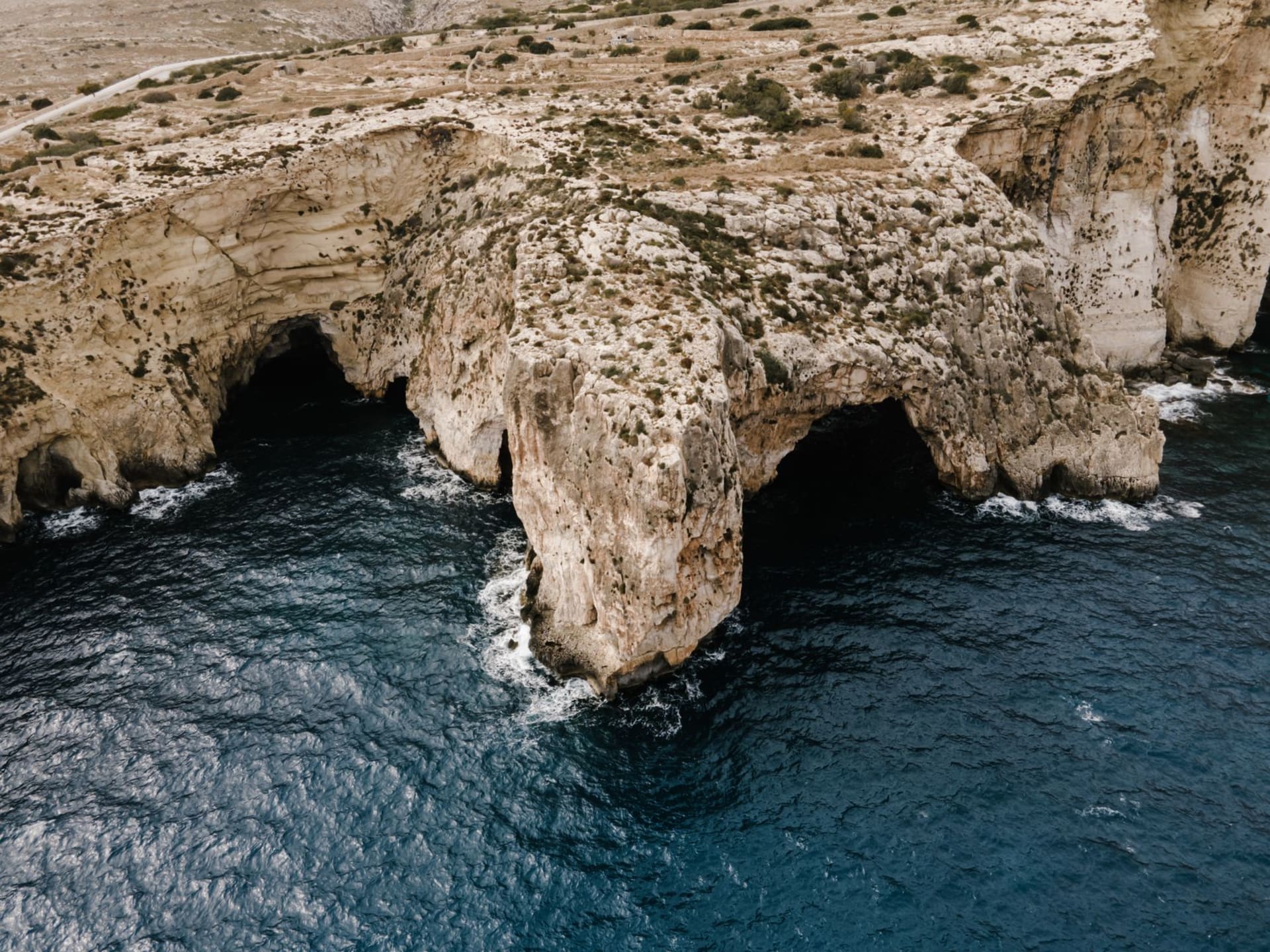
Blue Grotto
"The color doesn't look real — but then you're inside it, and it's the only thing that does."
I’ve been skeptical of places whose entire reputation rests on a single visual effect. Blue Grotto is one of those places. It’s a system of six caves carved into the limestone cliffs on Malta’s southwest coast, and the thing everyone tells you is that the water is an impossible shade of blue. I’d seen photos. I thought I understood what I was in for.
I didn’t.
Getting There
The road from Valletta to Wied iż-Żurrieq — the small cove where you board the boats — takes about forty minutes by bus and winds through the centre of the island past fields, chapels, and roundabouts with statues of saints. The cove itself is tiny: a handful of houses, a boathouse, a row of men selling boat tickets from plastic chairs. The boats are small — maybe eight passengers — and the ride into the caves takes around twenty minutes depending on sea conditions. The sea has to be calm enough; they don’t go if swells are running. This is worth checking before you make the trip.
Inside the Caves
The light enters the caves from below, filtered up through the shallow water and refracted off white sand on the seabed. The result is a luminescence that comes up from underneath — the water doesn’t just look blue, it seems to be generating light. In the deepest cave the walls glow faintly even where the direct sun doesn’t reach. I kept thinking there must be some trick of it, some angle or time of day where it looked ordinary. There isn’t.
The boatman narrated in English and Italian simultaneously and with approximately equal enthusiasm, pointing out shapes in the rock formations: the Hawk’s Cave, the Cathedral, the Finger. The names were optimistic. But the caves themselves needed no selling. I sat in the bow and watched the water change color — teal to cobalt to a blue with no name — and felt the particular pleasure of seeing something you had expected be better than you’d prepared for.
The Cliffs Above
There’s a viewing point at road level that most day-trippers use if the sea is rough and the boats aren’t running. It’s worth stopping here even if you do take the boat — the cliffs drop sheer to the water, and from above you can see the full arc of the coastline heading west toward Filfla, the small uninhabited island that Malta uses as a target for military exercises. The sign explaining this is very matter-of-fact about the ordinance situation. The island looks peaceful from here. I chose to believe it.
Practical Geometry
Morning light works best — the sun enters the caves most directly before noon, which is when the color peaks. Afternoons are still worth it but the effect is subtler. The boat ride is short enough that you can combine this with a stop at Hagar Qim, the Neolithic temples a few kilometers inland along the same clifftop road. The temples are a different kind of impossible — four thousand years old, cut from limestone blocks with no mortar, still standing in near-complete form — and they make a strange complement to the caves. Both of them are things that shouldn’t exist but do.
When to go: May through October for reliable boat access; summer seas are calmest. Arrive before 10am in summer to beat the tour groups and get the best cave light. If the boats are cancelled due to swell, the clifftop view is still genuinely worth the trip — and pair it with Hagar Qim temples while you’re on that road.