Ribeira Brava
"The Saturday market was so specific to this one place that I couldn't have been anywhere else on Earth."
I came to Ribeira Brava on a Saturday morning because someone at the Funchal market told me I should, and that remains the most reliable form of travel recommendation I know of. The town sits where a deep ravine — Ribeira Brava means wild stream, and the stream in question has carved a serious valley into the southern hills over several millennia — meets the coast. On market day the promenade fills with produce vendors and people who have come down from the villages above and the energy is not performance but function, which is the only kind of market energy I fully trust.

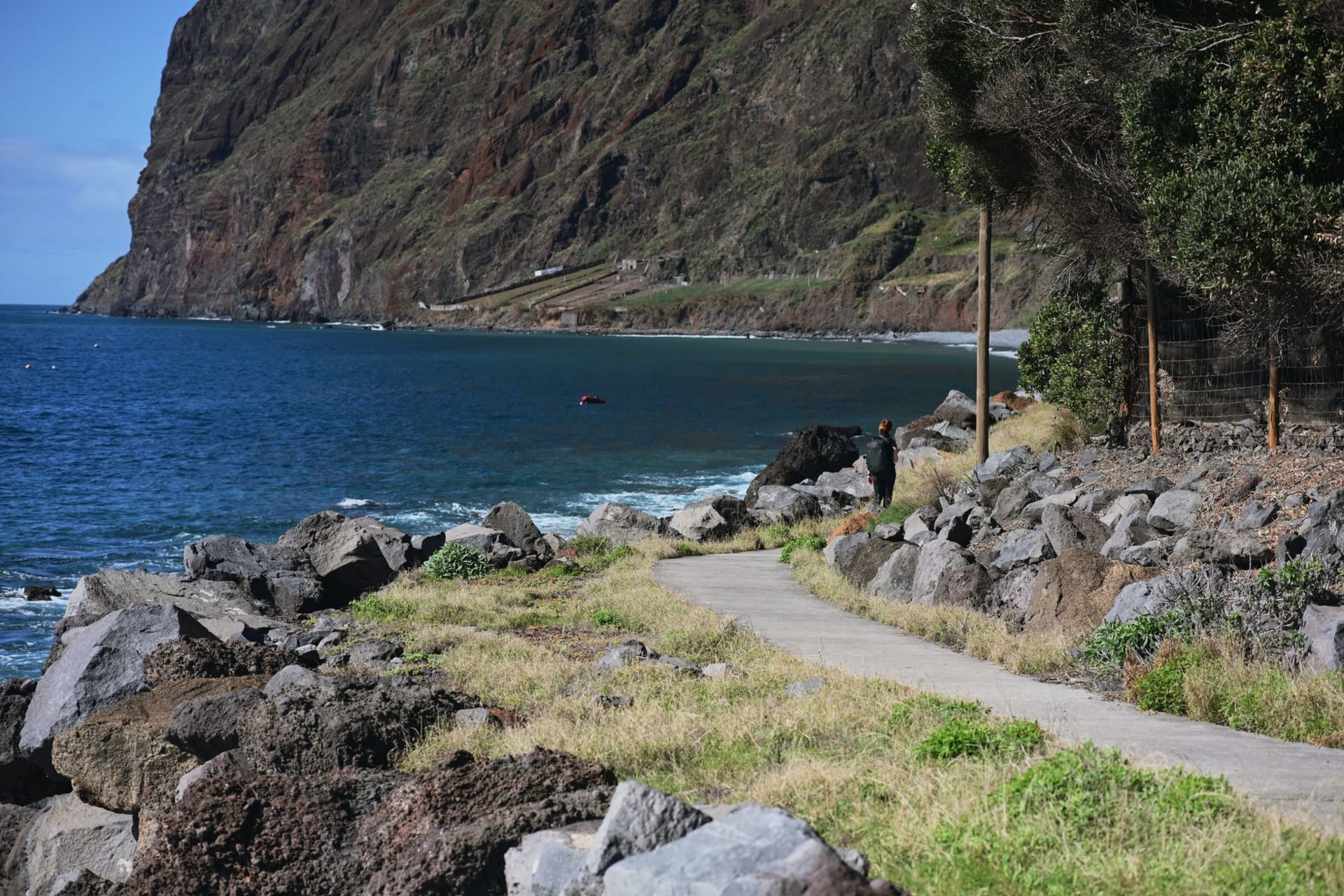
The church of São Bento, which dates from the sixteenth century, has Manueline detail on the doorway that you only fully appreciate if you stop and look rather than photograph. The font inside is reportedly original to the early construction. What struck me more, though, was the fortified tower on the seafront — the Torre de Ribeira Brava — standing at the edge of a black pebble beach where older men fish from the rocks with long rods and the Atlantic occasionally sends spray over the promenade wall in a way that is more playful than threatening. The tower no longer fortifies anything particular. It has become something more like a punctuation mark in the landscape, a reminder that this coast was once worth defending and is now simply beautiful.
The inland valley, accessible by road from the town centre, runs north through terraced vineyards and banana plantations and then abruptly into wilder terrain as it gains altitude. The ER104 follows it toward Serra de Água and eventually crests over to the north coast via Encumeada, a mountain pass that sits habitually inside cloud and has a viewpoint on each side where the view is theoretically spectacular and actually, most of the time, completely obscured by the same cloud that makes it feel dramatic. I have driven through Encumeada three times and seen the actual view once. That ratio seems approximately correct for mountain passes in the Atlantic.

The food in Ribeira Brava runs to the reliable rather than the revelatory: espada with banana at the harbour restaurants, grilled limpets arriving on a charcoal-blackened plate still sizzling, the local table wines — produced from the inland vineyards in the valley — cheaper here than in Funchal and, I thought, better for it. The Saturday market sells bags of dried Madeiran herbs that smell like thyme and rosemary concentrated by volcanic soil. I bought two bags and both lasted the trip home. The vendor charged me less than I expected and seemed unbothered by the transaction in a way that felt like honesty rather than indifference.
When to go: Saturday mornings for the market, and arrive early — the best produce goes fast and the promenade is liveliest before ten. The town works year-round and makes a reasonable base for the Encumeada pass area and the levada do Norte, which traces the valley’s mid-altitude in a walk that feels remote despite being close to the road. Spring flowers on the hillsides above the valley between March and May are extraordinary.