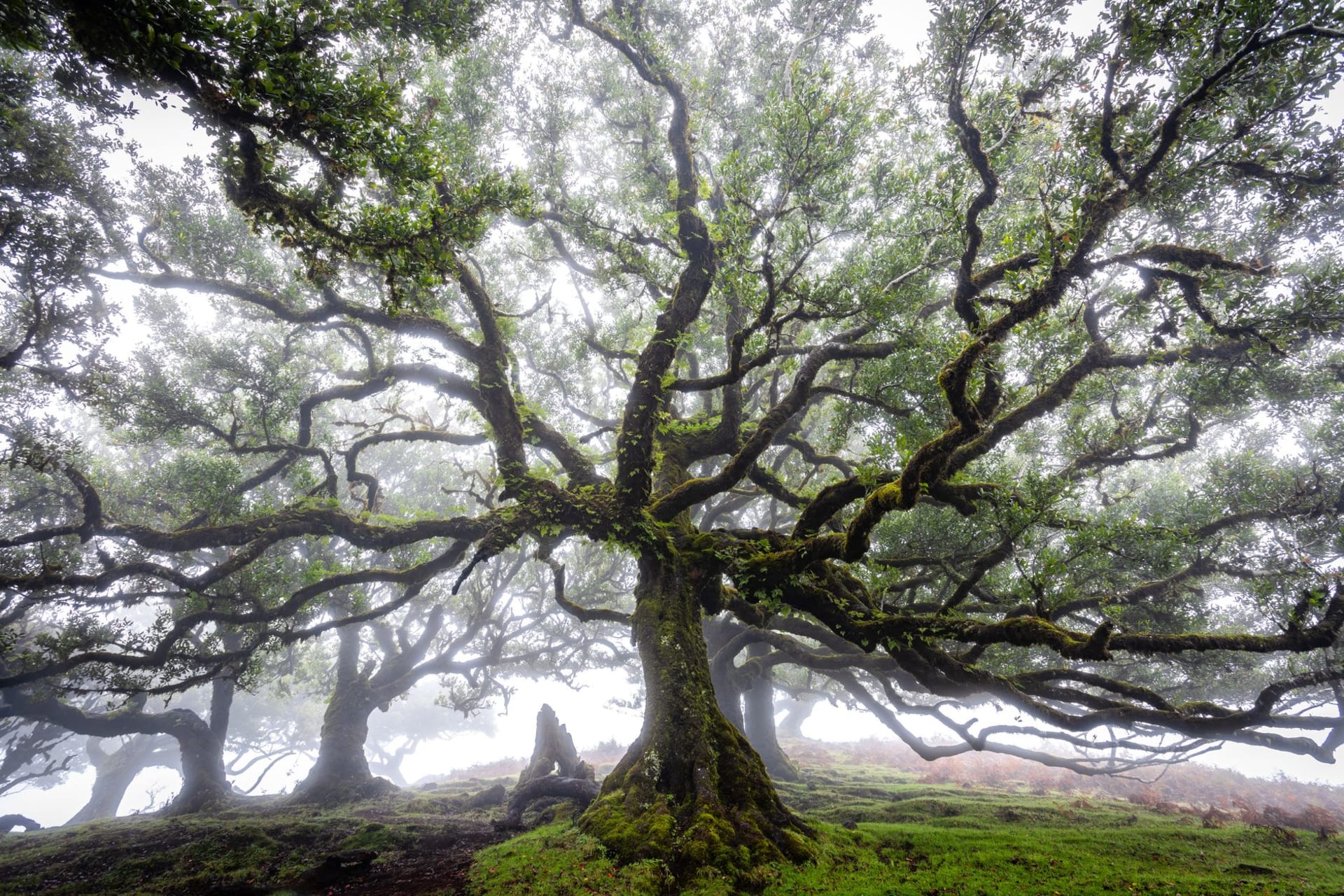
Fanal
"I stayed past dusk without meaning to, and the forest became something else entirely — older, quieter, less interested in me."
The plateau road to Fanal climbs through multiple climate zones in about thirty minutes. You leave the coast at sea level, pass through the zone of banana terraces and bougainvillea, enter cloud forest where the road narrows and the canopy closes, and then suddenly break out onto the Paul da Serra plateau where the air is cold and the landscape opens into moorland that feels almost lunar. Fanal is the next thing after that — a stand of ancient til and laurel trees in a clearing on the plateau’s edge, and arriving there on a misty morning is an experience I would struggle to improve upon regardless of what came before it.

The trees at Fanal are old in a way that communicates itself physically. The til trees here have trunks that have gone completely silver-grey with age, twisted into shapes that suggest the trees have been here long enough to have developed opinions about the weather. Everything — ground, trunks, lower branches, the exposed roots — is covered in moss so thick and so deeply green it has a texture you can read from twenty metres. The light on a misty morning diffuses through the canopy and creates a green-filtered quality to the air itself, like being inside a glass aquarium except the glass is the atmosphere.
I stayed longer than I meant to. I had planned an easy circular walk, perhaps an hour, and instead found myself sitting against one of the older tils at midday listening to the wind move through the canopy and the occasional drip of condensation from the branches. The Laurissilva — the laurel forest that covers the high interior of Madeira’s northwest — is a UNESCO World Heritage Site because it represents the most extensive surviving example of a forest ecosystem that once blanketed much of southern Europe before the Pleistocene ice ages stripped it away. Walking through Fanal feels less like tourism and more like witnessing something that should have ended two million years ago and simply didn’t.

Bring layers. The plateau sits consistently ten to fifteen degrees cooler than the coast, the mist can soak your clothes without technically raining, and in winter the conditions can shift from atmospheric to genuinely cold within an hour. The parking area at Fanal is small and fills on weekends with photographers who’ve timed their visits for the blue hour. On a Tuesday morning in March I had the place to myself for the first ninety minutes, and that silence — the kind where the only sounds are your own footsteps and water dripping — is worth planning around.
When to go: October through March brings the most atmospheric mist and fog, which is the condition that makes Fanal look exactly like itself. Avoid midday in summer when the light is harsh and the clearing can feel crowded with day-trippers from Funchal. If you’re driving from the south coast, the ER209 over the plateau passes directly through Fanal on its way to Seixal — it’s not a detour, it’s on the route.