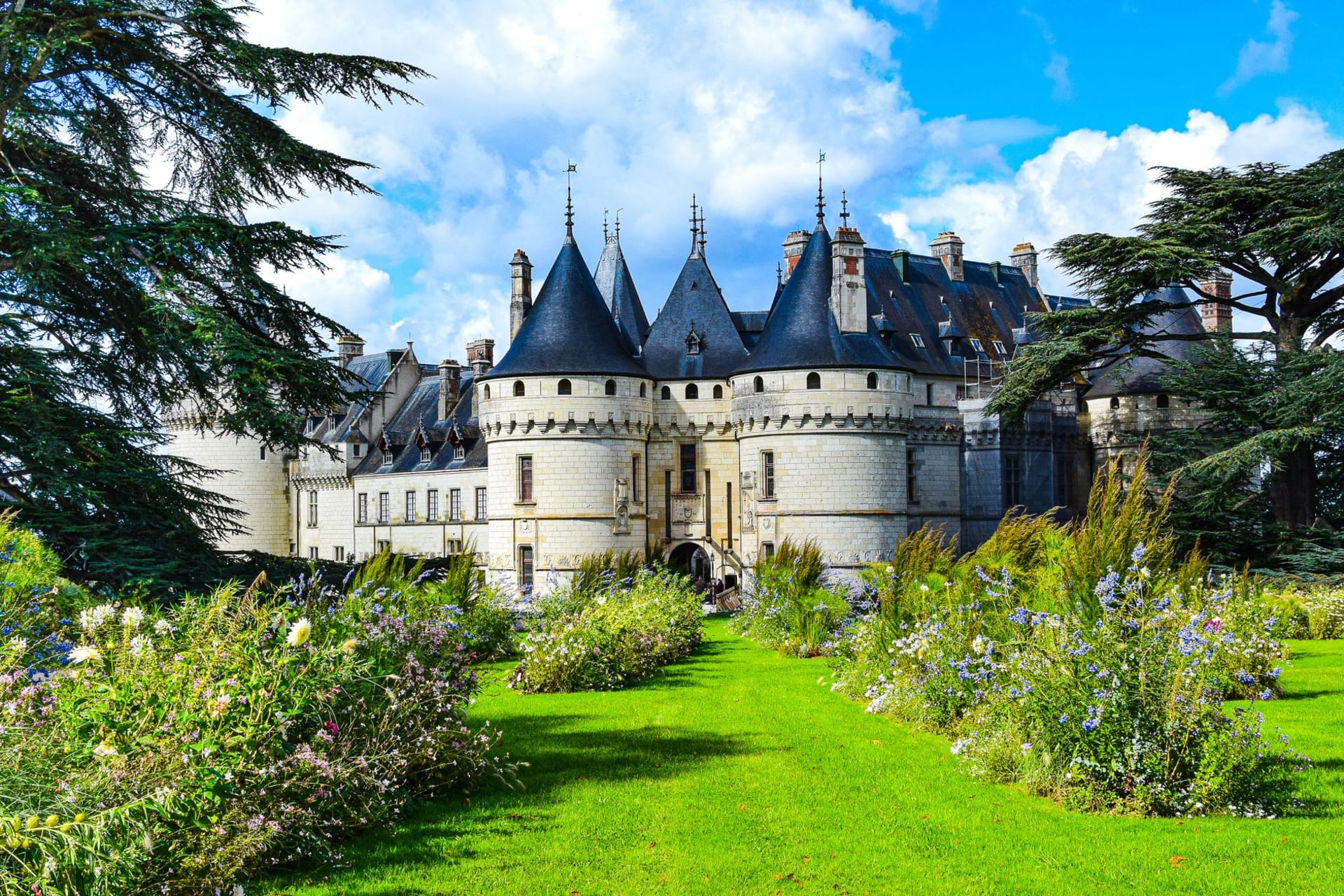
Saumur
"Saumur taught me that the Loire's most interesting parts are the ones you can't see from the surface."
I arrived in Saumur on the late afternoon train from Angers and stepped out into a town that seemed to operate on two levels simultaneously. Above: a perfectly reasonable Loire city, white limestone buildings, a market square, the château on its cliff above the confluence of the Loire and Thouet rivers. Below, or rather inside the cliff — carved into the tufa over nine centuries of patient excavation — an entire parallel civilization of caves that has been used at various times for wine, mushrooms, housing, troglodyte churches, cavalry stables, and at least one underground restaurant I visited later in the week that seated forty people thirty meters inside a hillside.
The château sits above the town with the particular confidence of buildings that occupy the correct position on the landscape. Seen from the opposite bank at dusk, with the Loire and Thouet rivers meeting below and the white towers catching the last light, it is one of the most composed views in the Loire Valley. Close up, it is a working museum of medieval military architecture: the original fortress expanded under Louis I of Anjou in the fourteenth century, the towers converted into a pleasant residence in the fifteenth, then a prison, then an artillery barracks, and now a museum of decorative arts and the horse — the horse, because Saumur has one of the most serious equestrian institutions in the world.

The Cadre Noir is a national equestrian academy that has trained cavalry officers and later competition riders since 1828. The riding school — an enormous nineteenth-century structure near the town center — operates daily, and if you time your visit right you can watch the morning training: horses and riders working through the haute école movements, the passage, the piaffe, the levade, in a large indoor arena with the methodical intensity of a serious athletic institution that has had two hundred years to refine its methods. I watched an hour of training through the gallery windows and found it as absorbing as any sport I’ve watched — the controlled power of it, the precision, the way horse and rider move as a single system.
But it is the caves that Saumur keeps returning to. The mushroom museum — the Musée du Champignon — operates in a series of tufa galleries above the town where Paris mushrooms have been grown commercially since the late eighteenth century. The damp, cool chambers, the white mycelium on the walls, the trays of mushrooms in every stage of development: it is either oddly beautiful or mildly disturbing and possibly both. More compelling is the sparkling wine cave, where Saumur-Mousseux is produced using the traditional method — secondary fermentation in the bottle, extended aging on the lees — in galleries that go a kilometer back into the cliff. The temperature is constant at twelve degrees, the bottles are everywhere, and the smell is that particular mix of limestone and yeast that only wine caves have.

I tasted the sparkling wine at the end of the cave tour, still standing in the cellar, the stone cold at my back. Saumur-Mousseux is made from Chenin Blanc primarily, and it has a flinty, lean quality that the bigger Champagne houses would charge four times as much for. The crémant brut I drank from a plastic tasting cup in a cave thirty meters underground tasted better than it had any right to, which is the reward for having visited the right places in the wrong order.
When to go: Saumur works in any season — the cave visits are year-round, the château is open except in winter when hours shorten, the Cadre Noir performs occasional public shows (check the schedule in advance). June sees an important horse show that fills the town. September and October bring the wine harvest in the surrounding Saumur and Saumur-Champigny appellations — the reds from Cabernet Franc are excellent and almost entirely unknown outside the region.