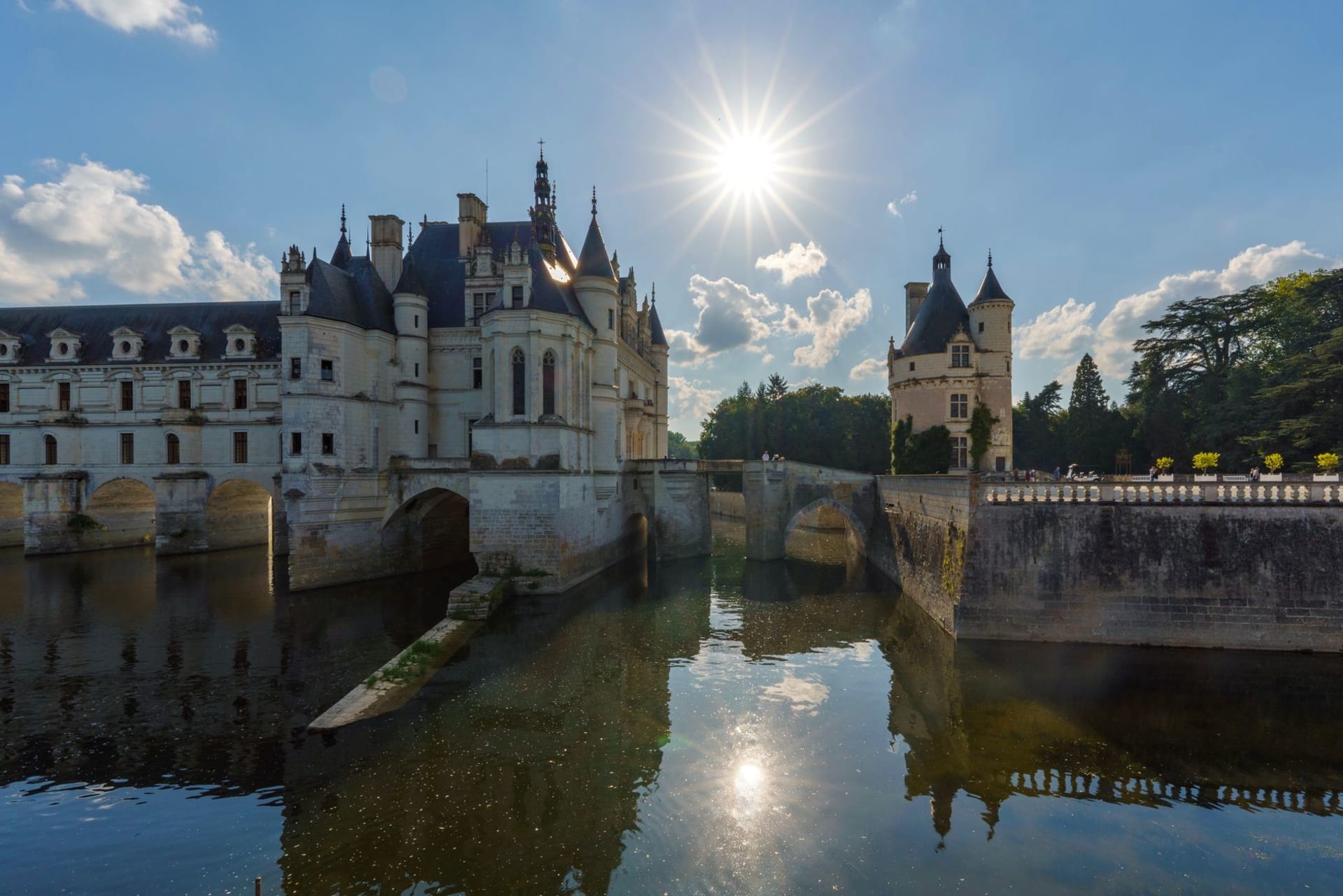
I have a weakness for Chenonceau that I will not pretend to be objective about. Of all the Loire châteaux — and after a week of touring them, they do start to blur into a single endless tapestry of turrets — this is the one that stopped me dead. It does not sit beside the River Cher in the usual fashion. It strides directly across it, a long gallery resting on five stone arches, so that the water flows beneath the ballroom and the whole structure seems to float. Lia, who claims to be immune to my architectural enthusiasms, went quiet for a full minute, which from her is the equivalent of a standing ovation.
The Women’s Château
Chenonceau is sometimes called le château des dames, and the nickname is earned. It was a woman, Katherine Briçonnet, who oversaw its early construction. It was Diane de Poitiers, mistress of Henri II, who built the arched bridge over the Cher and laid out the gardens. And it was Catherine de’ Medici, Henri’s widow, who promptly evicted Diane the moment the king died, took the château for herself, and added the magnificent two-storey gallery on top of the bridge. There is a satisfying ruthlessness to the whole story, and you feel it walking the floors — this was a place run by people who understood power and did not flinch from using it.
The interior rewards slow attention. The kitchens are tucked into the piers of the bridge, down at water level, so the cooks once worked with the river sliding past below their windows. Upstairs, the long checkerboard gallery is flooded with light from windows on both sides, and during the First World War it served as a military hospital, with hundreds of wounded soldiers carried across the very arches Diane de Poitiers had commissioned four centuries earlier.

The Gardens and the Quiet Hour
Outside, the two formal gardens face off across the entrance courtyard — Diane’s on one side, Catherine’s on the other, a horticultural rivalry frozen in boxwood and bloom. I preferred Catherine’s: smaller, more intimate, with a central fountain and a view back to the château across the moat. We went in late afternoon when the tour buses had largely emptied out, and for a glorious half hour the place was nearly ours. A heron stood motionless in the shallows of the Cher. The light turned the white stone the colour of warm cream.

There is a flower workshop on the grounds where the château’s own gardeners cut and arrange the bouquets that decorate every room — Chenonceau apparently goes through enormous quantities of fresh flowers, and they grow most of them themselves. It is the kind of detail that tells you the place is genuinely loved and not merely preserved.
When to go: Late spring and early autumn for the gardens at their best and the crowds at their thinnest. Arrive at opening or in the final two hours of the day; the midday coach crush is real. Combine it with a slow lunch in the nearby village and you have one of the finest days the Loire can offer.