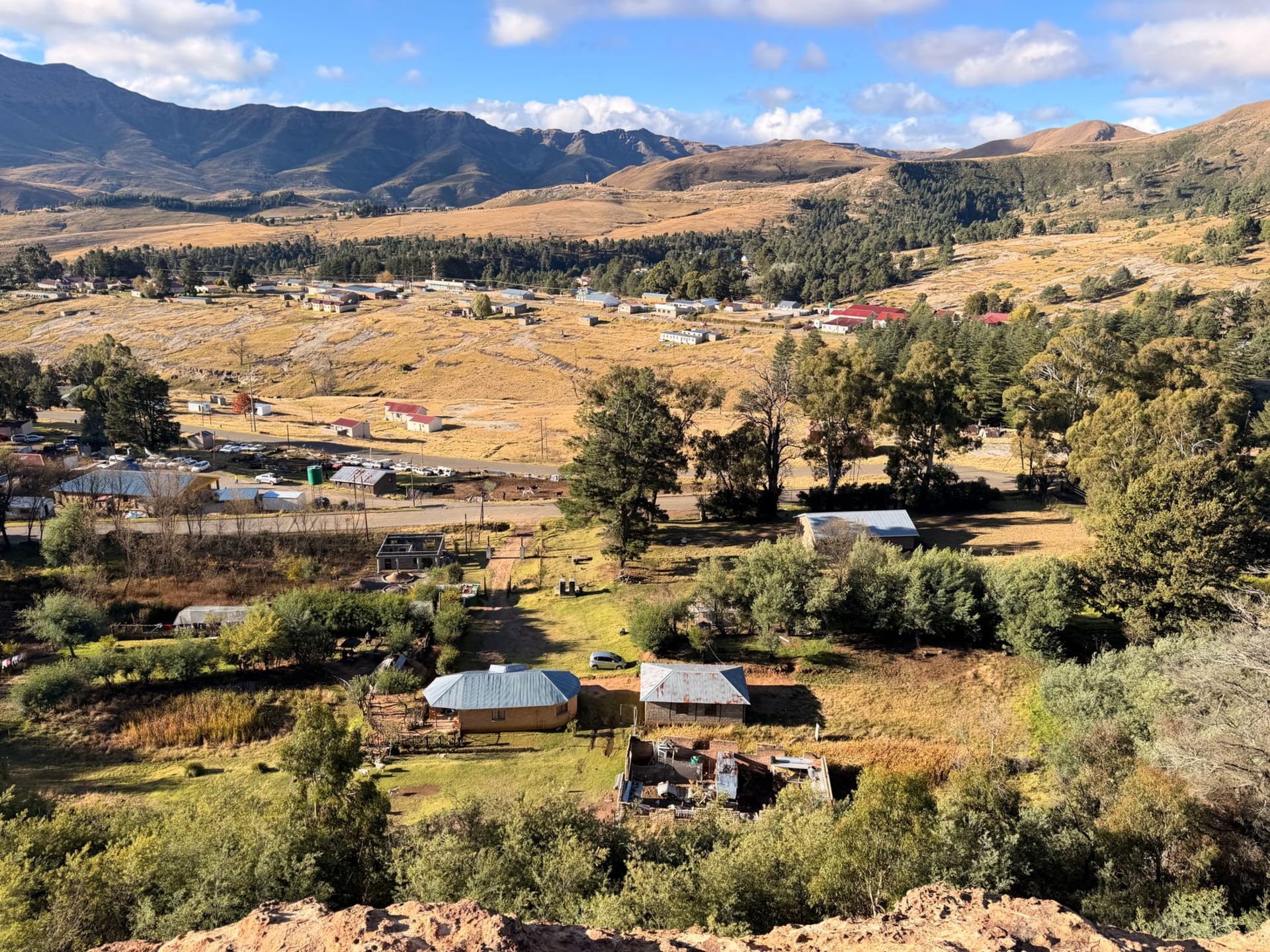
Teyateyaneng
"She was weaving a map of her village — the huts, the cattle track, the mountain behind — from memory, and her hands never slowed."
Teyateyaneng is not really on the way to anywhere. It sits in the western lowlands, north of Maseru, at a junction the maps label with confidence but which feels, on the ground, more like a suggestion than a destination. Everyone calls it TY, which is both practical and affectionate, and the town exists in the comfortable way of places that have never needed to perform themselves for visitors because visitors have never quite arrived in sufficient numbers to require a performance.
I went specifically for the weaving, which I had read about in the context of Lesotho’s craft tradition and which I expected to be a co-operative with a small shop and some polite demonstration. What I found at Helang Basali — the women’s weaving cooperative that has been operating here since the 1970s — was something more alive than that. Twelve women were working when I arrived mid-morning, each at a different stage of a tapestry, the room full of the soft rhythmic knock of shuttles and the smell of wool. There was no artifice here — no performance of traditional craft for a foreign eye. They were working to a deadline.

A woman named Mamello showed me the tapestry she was partway through — a scene of highland village life: rondavels on a hillside, cattle being driven down a track, a woman bending to a cooking fire, mountains filling the upper third of the image. She was working from no drawing or pattern, just from what she knew, her hands moving between threads with a fluency that made it look less like work and more like thought made physical. I asked how long it would take. She considered this seriously, counted something silently, and said three weeks for this size.
The town’s Wednesday market spills into the streets around the cooperative — produce from nearby farms, clothing from South Africa, the kind of informal commerce that rural Lesotho does as naturally as breathing. I bought a bag of dried peaches from an elderly man who was so old he seemed to predate the idea of markets, and ate them walking back to my car, the peach sweetness mixing with the highland dust in the air. TY is the kind of place that gives you what you came for and then gives you something else on top of it, something you couldn’t have anticipated.

I bought a tapestry, which required more deliberation than I usually bring to decisions. The ones depicting landscapes I liked the most — the particular shade of brown-gold the weavers use for highland grasslands, the way distance is rendered in fading layers of colour. I rolled it up in newspaper and carried it on my lap for the rest of the journey because the idea of it being crushed in a bag felt wrong, which tells you something about what craft can do to a person when it’s made with that kind of attention.
When to go: Teyateyaneng functions year-round and the cooperative is open most weekdays. Wednesday mornings for the market, which peaks by around ten in the morning and winds down by early afternoon. Avoid arriving on Sundays when most of the town rests. The cooperative produces to order for international clients and may have fewer finished pieces during heavy production periods — call ahead if you’re set on buying.