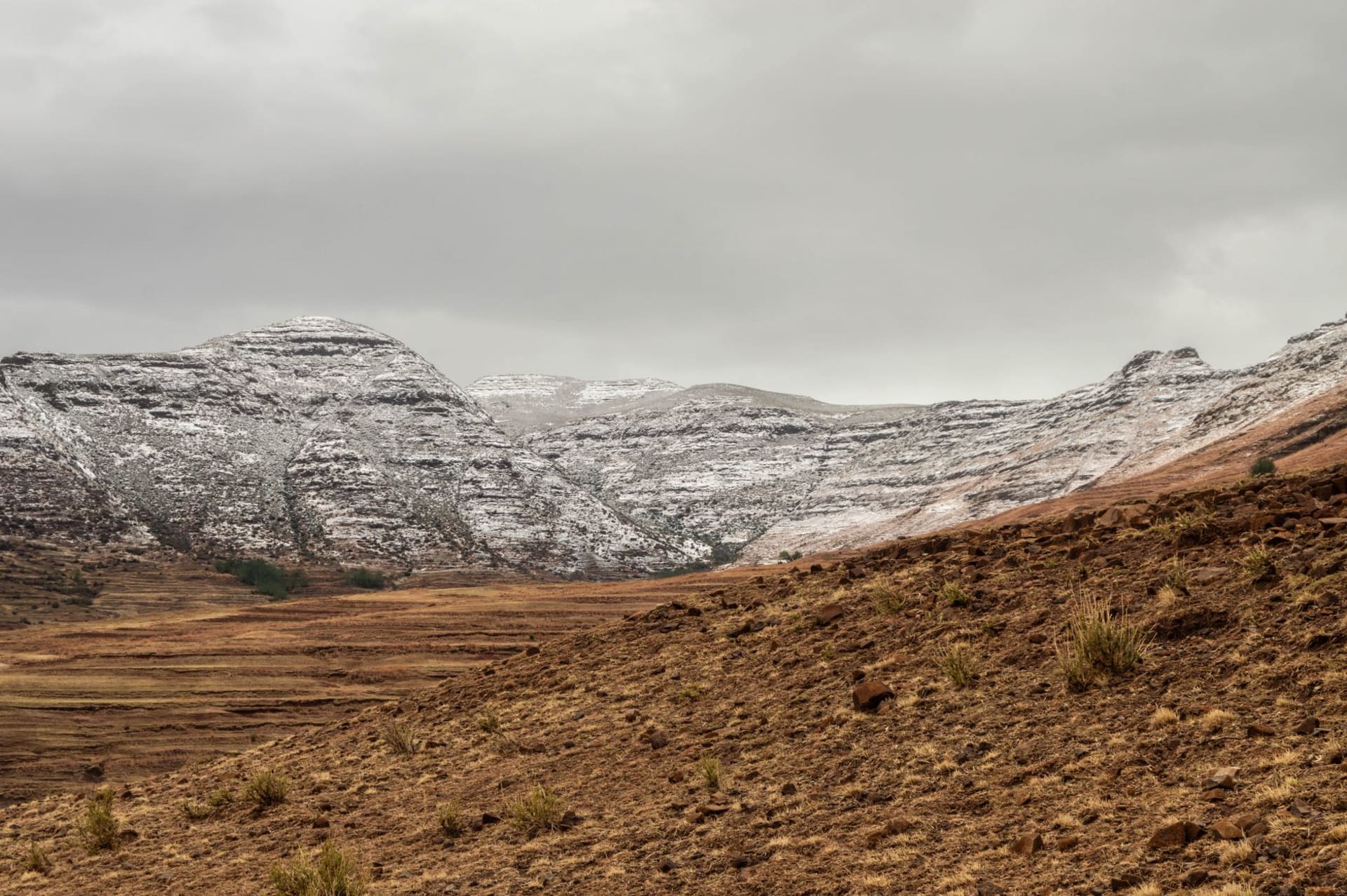
Semonkong
"The falls don't roar — they hiss, a deep sustained sound like the mountain itself exhaling."
The road to Semonkong is an education in patience. Four hours from Maseru on corrugated gravel that rattles your fillings loose and sends your bag migrating from one side of the seat to the other — and then, before you see anything, you hear it. A sound like white noise turned up past the point of comfort, filling the air from a direction you cannot immediately identify. It’s only when you walk to the edge of the gorge that the Maletsunyane Falls reveal themselves: 192 metres of water dropping off a basalt cliff face into a gorge so deep the bottom is half-hidden in its own mist.
I stood there for a long time without moving. There are moments in travel when language offers you nothing useful, when description would be a kind of impertinence. This was one of them. The falls in late afternoon light, with the spray catching and scattering whatever sun reached down into the gorge — that specific quality of light and sound together — I’ve attempted to describe it since and failed each time.

The village of Semonkong — its name means “Place of Smoke” in Sesotho, the smoke being the permanent mist column rising from the falls — is a scattering of rondavels and a small lodge run by a South African family who have been here long enough to have gone local in every meaningful sense. The dining room serves pap and stew by candlelight when the generator gives out, which it does with a reliability that starts to feel intentional. I ate dinner with a group of South African hikers who’d walked in from the plateau, three days across the grasslands, and they had the slightly unhinged look of people who’ve had too much silence and space and aren’t quite ready to talk yet.
The walk down into the gorge requires about an hour of steep descent on a path that becomes a scramble near the bottom, where a rope bridge sways across the river. I crossed it twice because I wasn’t certain the first time whether the swaying was normal. It is normal. Below the falls, the scale becomes different — you look up at the cliff face and the water falling past it and you feel appropriately small. Some visitors abseil the full 204 metres beside the falls, which operators here advertise as one of the longest commercial abseils in the world. I watched a group doing it from across the gorge and found I was entirely content to be a spectator.

Mornings in Semonkong start cold regardless of season. I walked the plateau at dawn with three children who materialized from somewhere and served as a collective guide without being asked, pointing out a lammergeier — bearded vulture, wingspan like a small plane — riding thermals above the gorge. They argued among themselves, in Sesotho, about which direction it was heading, and I had nothing to contribute except a sustained observation of the bird’s absolute indifference to all of us.
When to go: April and May offer the highest water volume after summer rains — the falls run thick and the gorge fills with noise. June through August brings cold that turns the spray to ice crystals along the cliff edge, which is spectacular and very cold. The lodge is open year-round. Avoid January and February if possible — summer storms can make the descent path to the gorge dangerous.