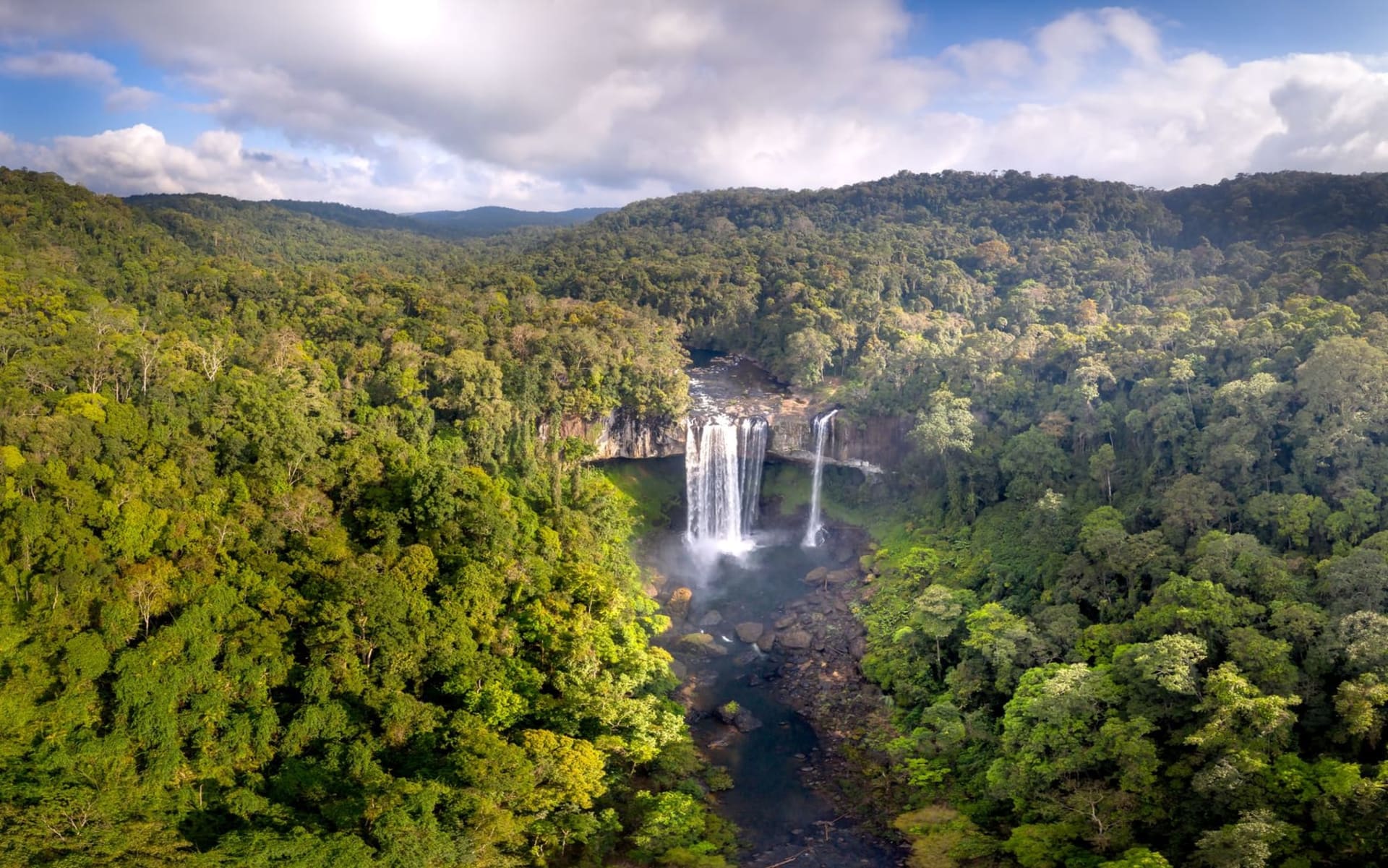
Champasak
"Wat Phou was here before Angkor, and its silence feels proportional to all those additional centuries."
A pre-Angkor Khmer mountain temple overlooking the Mekong delta, older and quieter than Angkor Wat.
We crossed the Mekong on a flat wooden ferry that seemed to have no schedule beyond the boatman’s indifference to urgency. Champasak town appeared on the west bank — a single paved road running parallel to the river, a few colonial-era shophouses with their shutters peeling, and a drowsiness that felt structural rather than circumstantial. Lia said it felt like arriving somewhere that had decided, long ago, it had nothing left to prove.
The Climb to Wat Phou
The temple is three kilometers south of town, and the approach matters as much as the destination. The ceremonial avenue — flanked by the remnants of two low rectangular barays, ancient reservoirs that once reflected the sky — runs straight toward the mountain like a formal declaration of intent. The Khmers who built this complex in the fifth century were already treating Lingaparvata mountain as sacred before the first stone was laid at Angkor. You feel that priority in the bones of the place.
The climb up the laterite causeway passes through two pavilions whose sandstone lintels are still carved with scenes from the Ramayana, worn by twelve centuries of monsoon but recognizable if you stand close and let your eyes adjust. The air thickens with humidity and the smell of frangipani from trees that have been growing here for centuries and appear entirely unbothered by the fact. At the upper sanctuary, where a Shiva lingam still receives daily offerings of flowers and incense from the village below, I sat for a long time on a broken balustrade and watched a monk sweep the platform with a broom made of bound palm fronds. The only other sounds were cicadas and distant water.
The Discovery I Didn’t Expect
What surprised me was the crocodile stone. I’d read nothing about it — it’s a flat rock carved in the rough shape of a crocodile behind the main sanctuary, used for what archaeologists politely call ritual sacrifice and locals describe with a cheerful directness that suggests they find the scholarly squeamishness amusing. The path to it is unmarked and overgrown just enough to make you feel you’ve found it yourself. Lia spotted a small offering of marigolds on its back and wondered, quietly, how recently they’d been left.
Back in town that evening we ate khao piak sen — thick rice noodles in a pork broth clouded with galangal and lemongrass — at a family restaurant on the river road with no English menu and a television showing Thai soap operas. The owner pointed at two items on the handwritten board and we nodded. Both were correct choices.
Staying and Moving Slowly
Champasak rewards slowness. The handful of guesthouses along the main road are simple and inexpensive, with hammocks on the river-facing terraces and cold Beerlao arriving without being asked. The Mekong at dusk turns the color of old brass. Across the water, the hills of Cambodia begin — Champasak sits at the edge of the four-thousand-island region of southern Laos, where the river braids itself into something enormous and unhurried, which is the only appropriate way to experience this part of the world.
When to go: November through February, when the dry season keeps the temple paths clear and the heat stays at a bearable thirty degrees. Avoid April and May — the stones radiate the kind of heat that makes archaeological appreciation genuinely difficult.