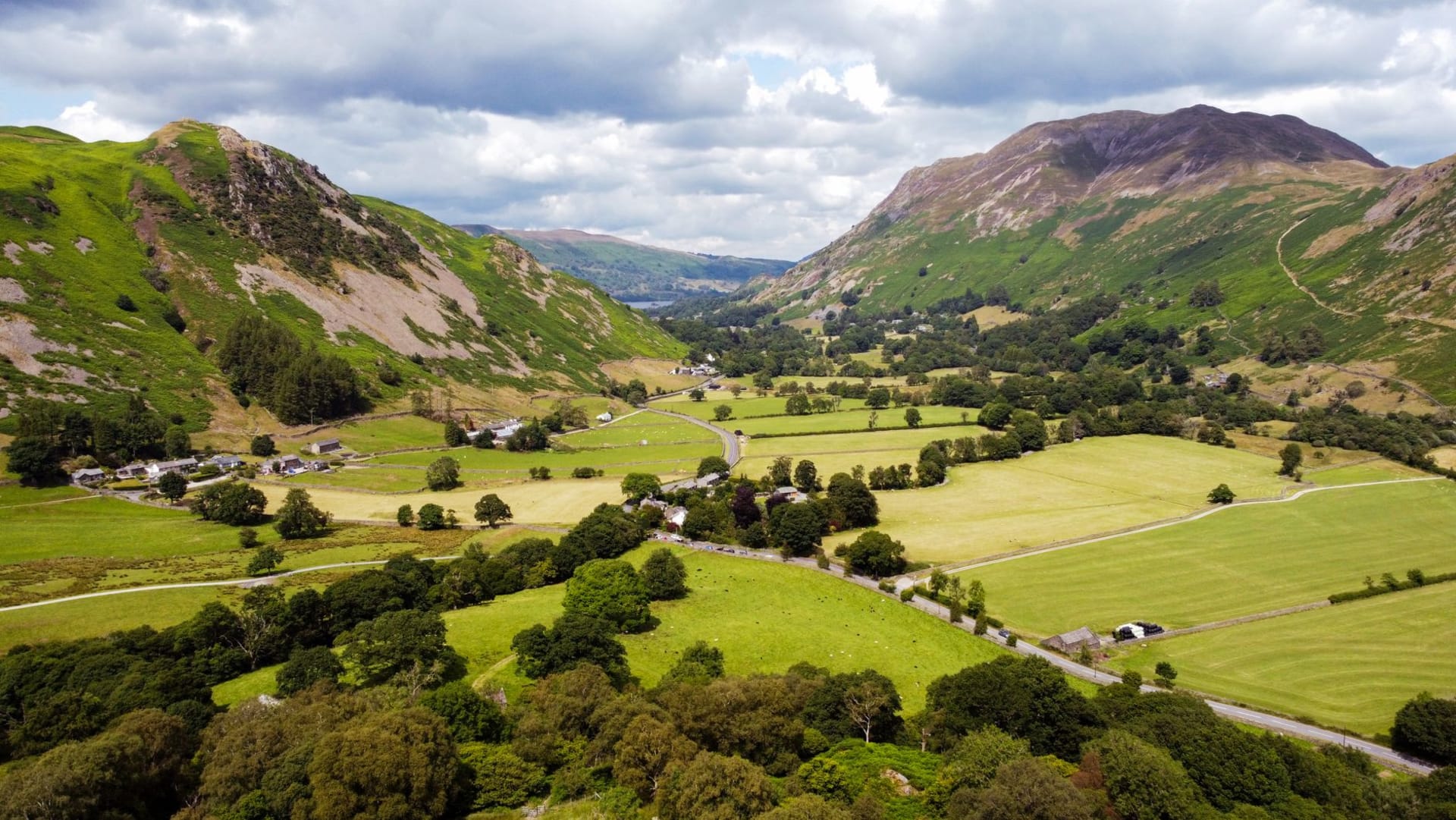
Langdale
"The Langdale Pikes look like mountains drawn by someone who wanted you to know exactly where you were going."
The Langdale Pikes are visible from thirty miles away on a clear day. Harrison Stickle and Pike o’Stickle — the two main summits of the group — rise from the head of Great Langdale in a profile so distinctive that it reads as a kind of logo for the Lake District: sharp, emphatic, unmistakeable. I had been in the Lakes for three days before I finally drove up the B5343 through Chapel Stile and into the Great Langdale valley, and when the Pikes appeared at the end of the valley road, framed by the converging fellsides, I pulled over at the New Dungeon Ghyll Hotel car park not because I was staying there but because stopping felt mandatory.
The valley has been inhabited since the Neolithic period — the crags of Pike o’Stickle hold a prehistoric stone axe factory, one of the most important Neolithic industrial sites in Britain, where the volcanic rock was quarried and shaped into axe heads that have been found as far away as Essex. The axes were traded across Britain, which means that people were coming to this valley with purpose for at least six thousand years before Wainwright wrote about it. This puts Wainwright in a certain perspective.

The walk to Stickle Tarn and the Pikes is the classic Langdale day. The path leaves from the New Dungeon Ghyll pub car park, climbs steeply up Stickle Gill — a stream that in wet weather becomes something more serious, tumbling down in falls and pools — and arrives at Stickle Tarn, a reservoir-like lake directly beneath the vertical face of Pavey Ark. The route up to Harrison Stickle from the tarn involves a genuine scramble on the final slope, with views that open as you gain height until the entire Langdale valley is spread below you, the farms and the beck and the road looking like a relief model. The Pikes in cloud are magnificent. The Pikes in sun are almost violent in their clarity.
The valley floor has farms and dry-stone walls and the Great Langdale Beck running through meadows that are very green even in October. The Old Dungeon Ghyll Hotel at the valley head is one of the great walkers’ pubs in England — a low-ceilinged, slate-floored establishment that has been serving the mountain community since 1685, and whose Hikers Bar feels unchanged since about 1973. The walls are covered in photographs of climbers on the surrounding crags, mostly in black and white, mostly depicting people doing things in poor visibility with minimal safety equipment. The beer is cask, cold rooms are available, and the bar fills by six with people who have genuinely earned their pints.

Crinkle Crags and Bowfell, the two great mountains at the valley head, are longer propositions than the Pikes — full-day walks that involve over a thousand metres of ascent and serious terrain. Crinkle Crags in particular is famous for the Bad Step, a vertical rock section that catches out walkers who did not read the guidebook carefully enough. I watched someone in trail runners and a light pack attempt it on a wet day, thought about offering advice, decided against it, watched them find their way across with admirable improvisation. The Lake District teaches these lessons gently enough that you usually learn from them.
When to go: September for the best visibility on the Pikes and the Bowfell ridge. May and June for the fellside flowers — the Langdale valley has notable populations of Alpine plants in the high corries. The Old Dungeon Ghyll is open year-round and runs a New Year celebration that apparently goes some way into January 1st, though I have no direct evidence of this.