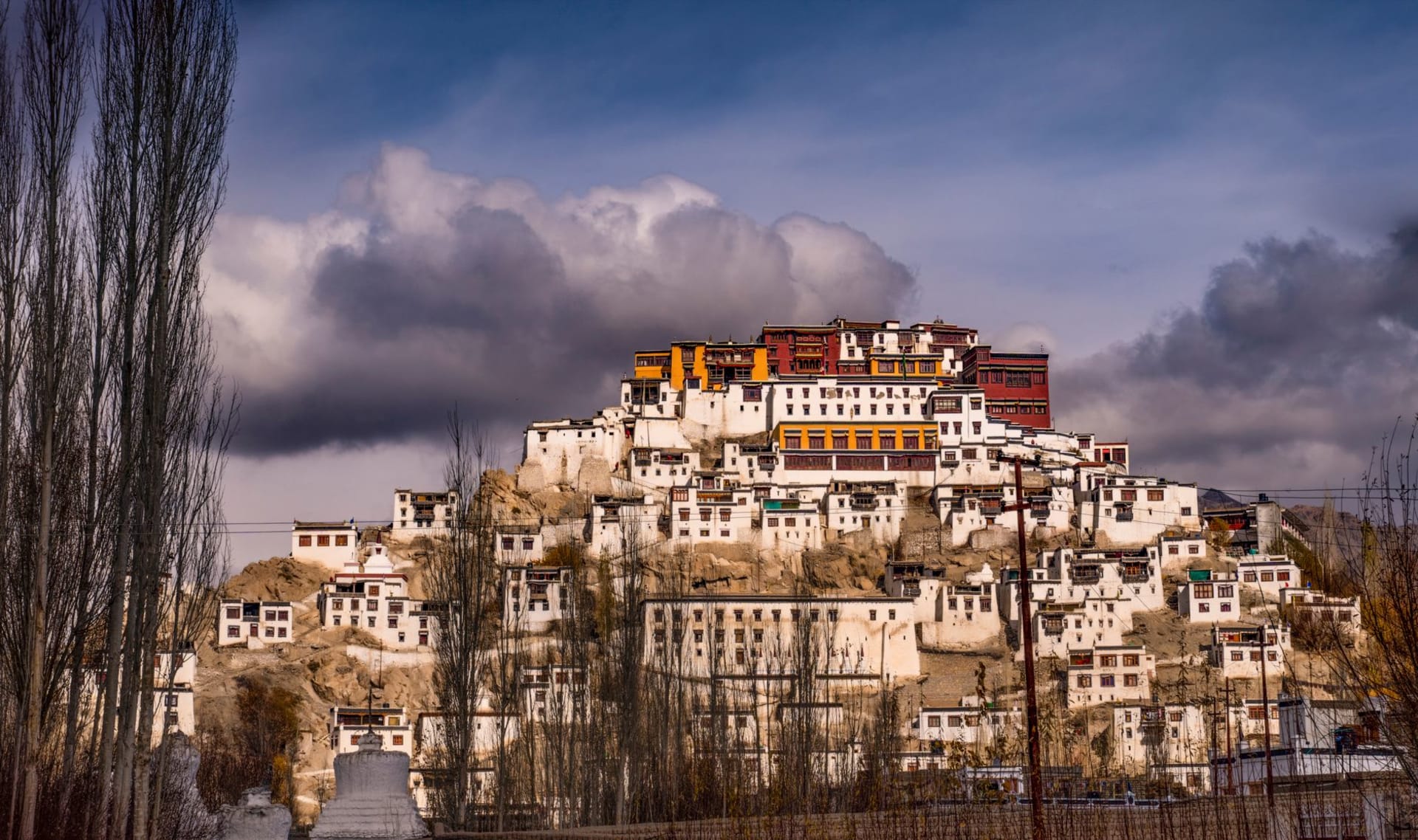
Thiksey Monastery
"At sunrise, the monks began chanting before the light reached the valley floor. The sound arrived first."
I set the alarm for five-fifteen, which in Ladakh in July means darkness and cold and a kind of reluctance that dissipates the moment you step outside and realise the sky is doing something extraordinary. The walk from the guesthouse to the monastery gate takes twelve minutes along a lane between poplar trees, and by the time I arrived the monks were already at prayer in the main hall, a sound that reached me before I reached them — low, rhythmic, several voices tuned to a frequency that seems to come from inside the chest rather than from outside it. I sat in the corridor and listened for half an hour before anyone acknowledged my presence, which is exactly the right amount of time.
Thiksey is the monastery that photographs as Lhasa. Its twelve storeys climb the hill in the unmistakable Tibetan style — white base, ochre upper stories, dark red trim, prayer flags strung from the highest point to wooden poles in the courtyard below — and the resemblance to the Potala Palace is not coincidental. Founded in the 15th century by disciples of Tsongkhapa, it belongs to the Gelugpa school of Tibetan Buddhism, the same lineage as the Dalai Lama. The current monks — around sixty of them — range in age from small boys in oversized robes to elderly men whose faces have the particular quality of people who have spent decades doing the same thing with complete conviction.

The butter lamps deserve a paragraph of their own. The main prayer hall is lined with them — small clay dishes filled with clarified yak butter, wicks burning with a flame that barely moves in the still air but collectively produces a warmth and a light that is unlike any other kind of illumination. The smell is animal and slightly sour and entirely distinctive, a smell that for me has come to mean the interior of sacred Tibetan spaces, the same way incense means Catholic churches. An older monk replenished them as I watched, moving along the row with a thermos of liquid butter, filling each lamp with the methodical care of a gardener watering seedlings.
From the rooftop, accessed through a door the monks leave unlocked for visitors willing to find it, the view extends down the entire Indus Valley floor — fields of green in summer, the grey-brown river threading between gravel banks, a scattering of smaller monasteries and villages on the far slopes, and behind them the permanent snowfields of the Stok Kangri range. Thiksey sits precisely at the point where the valley widens, which gives the view its particular spatial generosity. I spent a long time up there, partly watching the light change and partly watching a young monk below in the courtyard teach a smaller child how to sound a conch shell. The child tried several times and produced only air. The older one demonstrated again, patiently. Eventually the shell sounded, briefly and imperfectly, and the child looked up toward the rooftop where I was standing as if wanting a witness to the moment.

The descent takes you through the monastery’s lower levels — a kitchen where large pots are being prepared for the midday meal, a storeroom of butter tea urns, a small museum of ceremonial objects — before depositing you back at the gate and the road and the business of being a visitor rather than a temporary witness. It is a transition that always feels slightly abrupt. Some places you leave gradually. Thiksey you leave all at once.
When to go: The monastery is accessible year-round, though the Indus Valley road can be icy in winter. Morning prayers begin around six a.m. and are the main reason to come early. The Thiksey Gustor Festival, held in November, is one of the region’s most visually striking ceremonies — masked dances performed in the courtyard over two days.