Leh
"The altitude hit me before the beauty did. By day three, I couldn't tell which one was making me lightheaded."
The first thing I remember about Leh is lying very still on a guesthouse rooftop, staring at a sky that seemed too blue to be real. I had just landed — 3,500 meters, and the air felt thin in a way that is almost polite about it, not aggressive, just quietly insistent that you slow down. My host had said exactly two words when I checked in: “Rest. Tomorrow.” I spent that first afternoon watching the shadows move across the Leh Palace walls and listening to a crow work its way through something on a nearby ledge. There was a steadiness to everything, a kind of mandatory patience the altitude imposes, and I found myself grateful for it.
By the second day, I was walking. The old bazaar runs along the main lane of the old city and is one of those streets that refuses to specialize — dried apricots piled next to titanium camping stoves next to rolls of Tibetan prayer flags next to sim cards. A monk in burgundy robes stood studying his phone outside a stall selling surplus Indian Army gear. A mule cart navigated through a group of Israeli backpackers comparing oxygen readings on their pulse oximeters. The market smells like cumin and engine oil and something faintly smoky that I later identified as yak butter burning in a lamp at a small shrine tucked into a wall.

Thukpa is what I ate every morning, sometimes twice. It is a Tibetan noodle soup — flat noodles, broth that carries depth from hours of simmering, whatever vegetables are in season, a poached egg floating on top if you are lucky. The small place I found near the mosque was run by a woman who communicated almost entirely through the precision of the bowls she set down: generous, steaming, exactly what the altitude-thinned body needs. The Tibetan flatbread that came alongside it — skyu, grilled and slightly charred at the edges — I ate with salty butter tea the first time out of politeness, and then out of genuine desire every time after.
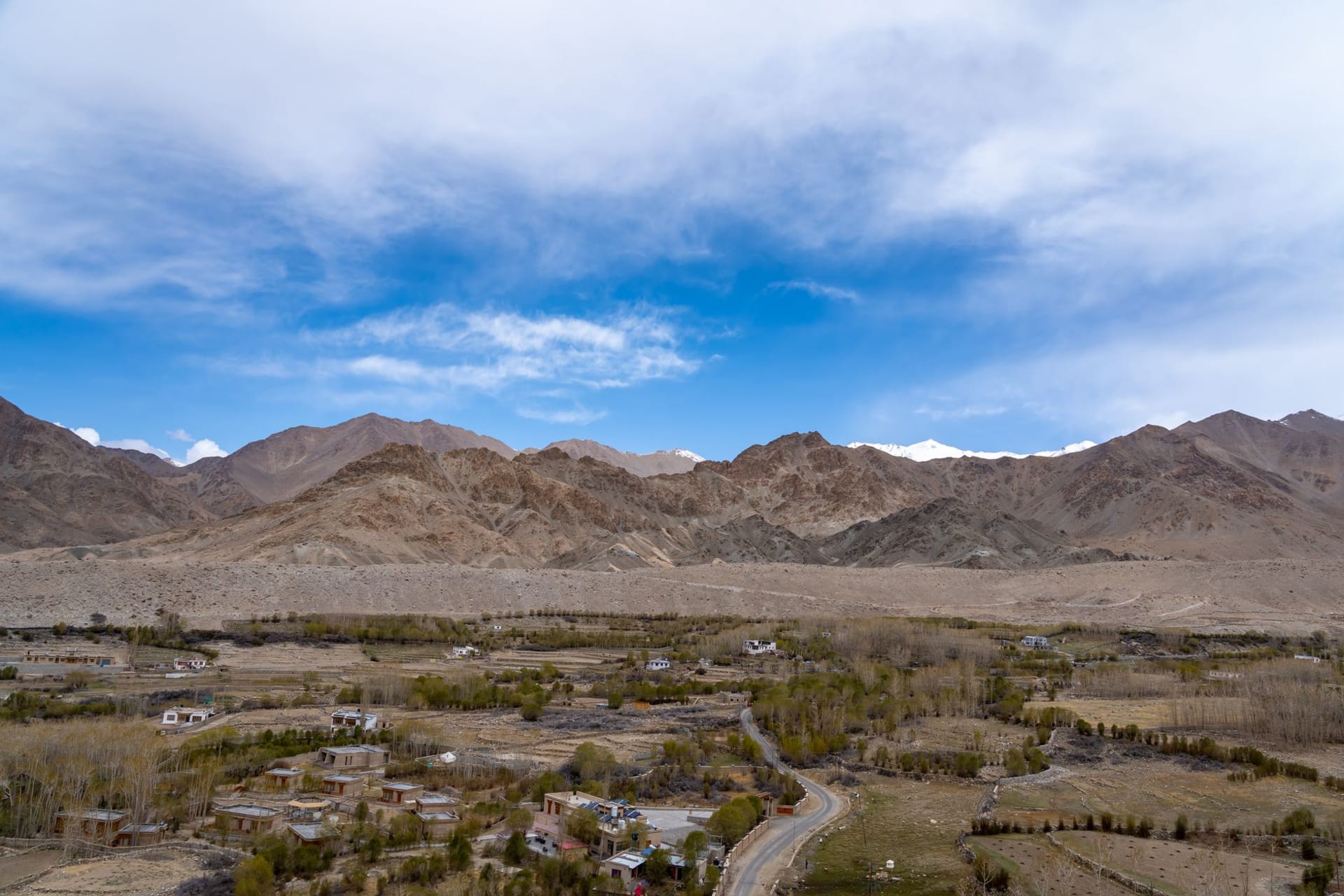
Leh Palace sits above the old town like a nine-story afterthought, half in ruin, the mud-brick walls crumbling in patches to reveal the timber skeleton beneath. Climb to its roof in the late afternoon and the light does something extraordinary — it falls at a low angle across the Indus Valley below, turning the poplar trees gold and the river silver, and the distant peaks above 6,000 meters catching a last flush of pink before the cold moves in. I stayed up there too long more than once, watching the shadows climb. There is a quiet grandeur to Leh that has nothing to do with the Instagram crowd that arrives in June and everything to do with what the place was before any of us got here: a waystation on the Silk Road, the place where merchants from Kashmir, Tibet, Central Asia, and China stopped, traded, and waited out the passes.

The Shanti Stupa sits on a hill above the western edge of town and is best reached at dawn, before the tourist jeeps start their runs. The whitewashed dome glows in the early light and the view from its base takes in the whole improbable sprawl: the old city below, the new construction spreading down the valley, the ring of barren mountains beyond, the Himalayan peaks on every compass point. Up there in the early morning cold, prayer wheels spinning, a single monk doing his circuits, it felt less like tourism and more like something else — attendance at a place that had been doing what it does long before I arrived.
When to go: June through September is the window. July and August bring the crowds and the Hemis Festival draws people from across Ladakh. June, if you can manage the drive up from Manali while snow still caps the passes, is the most vivid month — the apricots are ripening, the poplars are green, and the guesthouses are not yet full.