Lamayuru
"Lamayuru sits in the kind of landscape that makes you want to lower your voice, as if the rocks are listening."
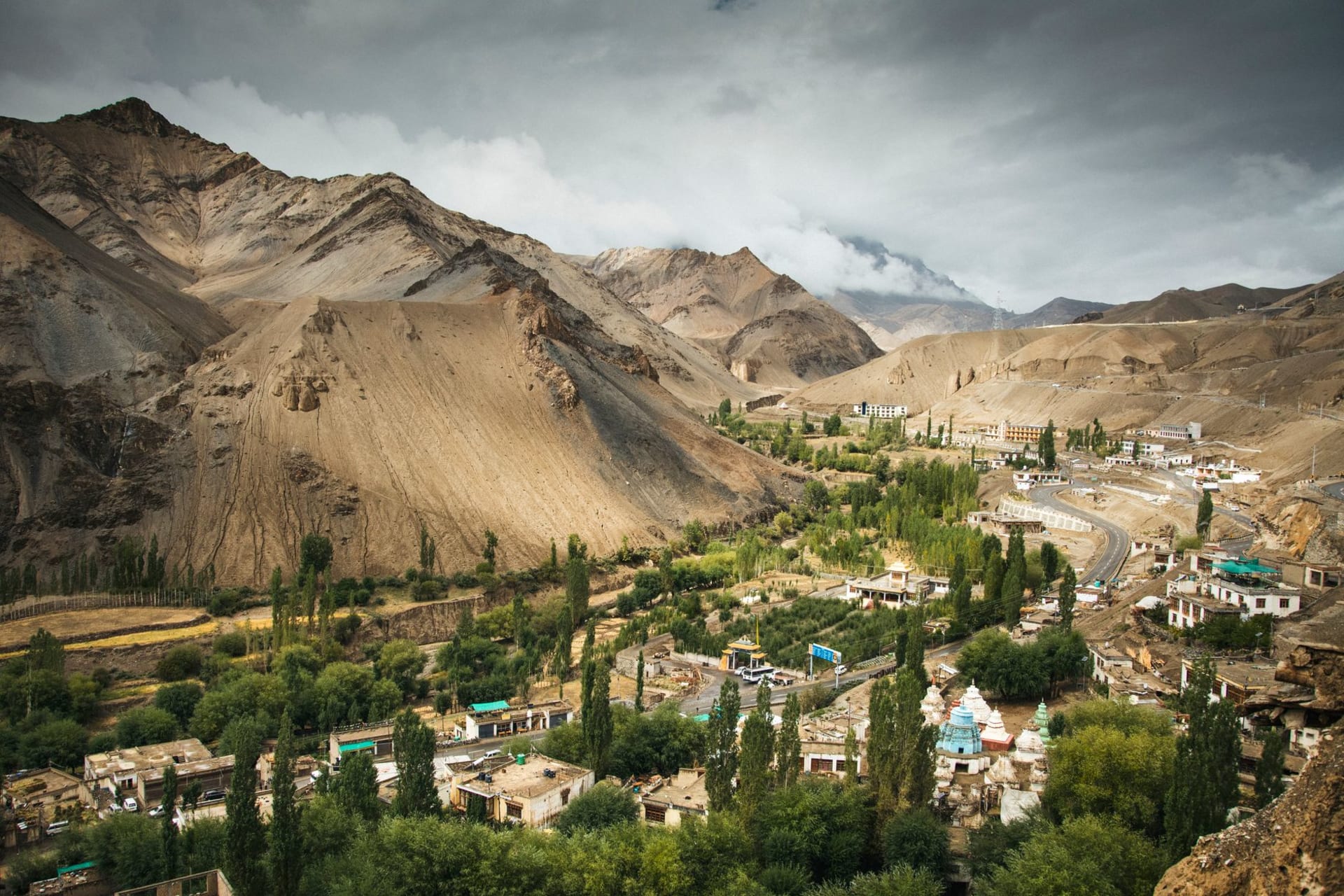
The moonland appears before the monastery. Driving west from Leh on the Srinagar highway, somewhere around the third hour, the rock formations begin to change — the solid ridges giving way to a landscape of pale, eroded clay formations that look like they have been modelled by a sculptor with a surrealist agenda: columns, spires, hollowed bowls, ridges that taper to a knife’s edge and seem to defy the weight they are holding up. Geologists call this kind of terrain “badlands.” I pulled the window down and said nothing for a long time. Then the road curved and the monastery appeared above the formations on a spur of harder rock, its white buildings stacked against the cliff, and the whole scene took on the quality of a place that should not exist but has decided, stubbornly and for a thousand years, to exist anyway.
Lamayuru is considered one of the oldest monasteries in Ladakh — some accounts trace it to the 10th or 11th century, its founding attributed to the same Rinchen Zangpo responsible for Alchi. The current complex is a working monastery of around 150 monks, and the combination of great age, dramatic setting, and active community gives it an authority that the more visited monasteries sometimes lack. There are no coaches parked outside when I arrived mid-morning. There were two German trekkers eating packed lunches on a stone wall, and a group of monks crossing the courtyard with the brisk efficiency of people who have somewhere else to be.

Inside the oldest shrine room — a low-ceilinged chamber cut into the cliff itself, smelling of butter lamps and old wood and something earthy that seems to come from the rock — there is a legend inscribed in Tibetan script about a lake that once filled the valley. The sage Naropa meditated here, the legend says, and drained the lake with his mind, leaving the valley for habitation. Looking at the eroded formations outside, you can almost believe it: the landscape does look like the bed of a drained sea, the clay columns its preserved sediment, the deep channels between them the paths of current that moved through when everything here was water.
The monks’ debating courtyard is where I spent an unexpected hour. Twice a week — or so I was told by a young monk who spoke careful English and seemed pleased to have someone to practice on — the student monks gather to debate Buddhist philosophy in the formal tradition: one monk questioning, another defending, the questioner slapping his hands together in a sharp clap to punctuate each point. I arrived by accident as a session was beginning and sat against the wall while the clapping and the rapid Tibetan exchanges built into a rhythm that was more musical than aggressive. The young monk translated fragments for me in whispers: “He is saying the nature of mind is like space.” “Now he is saying no, space has boundaries.” I understood perhaps a tenth of it and it was enough.

The light at dusk is Lamayuru’s particular speciality. When the sun drops behind the western ridges and the direct light goes, the clay formations turn a colour between ash and rose that lasts for maybe twenty minutes before the whole landscape fades to grey-blue. The monastery windows show warm lamp-light against this, small rectangles of gold. I sat on the hillside opposite with a cup of tea from a small stall near the gate and watched it happen, and it was precisely the kind of thing that makes you understand why someone, ten centuries ago, stopped at exactly this spot and decided this was where they would build.
When to go: May through October — the Srinagar–Leh highway on which Lamayuru sits stays open longer than the Manali road. June and September offer the clearest skies with manageable crowds. The Yuru Kabgyat festival, held in June or July depending on the Tibetan calendar, features two days of masked Cham dances in the courtyard and is one of Ladakh’s most atmospheric monastic events.