Mount Aso
"Standing at the crater rim with the wind ripping past, I understood for the first time that the ground beneath Japan is not sleeping."
The road from Kumamoto climbs through ordinary farmland and then, over one ridge, the scale changes completely. You are suddenly inside a caldera twenty-five kilometers across — one of the largest in the world — and what you thought were ordinary hills reveal themselves as the eroded walls of an ancient volcanic eruption that remade the geography of central Kyushu roughly ninety thousand years ago. The flat green floor of the caldera contains farms and rice paddies and the small city of Aso, and in the center, rising from this pastoral improbability, are the five volcanic peaks of the Aso massif, with Nakadake still actively venting sulfurous gas into whatever the wind is doing that morning.
I drove across the caldera floor on a clear day in late October, the grass an almost theatrical green after weeks of rain, black cattle grazing the slopes in the loose formations animals seem to adopt when they are not concerned about anything. The Kusasenri meadow sits at the base of Kishimadake at roughly one thousand meters, a wide bowl of pale grass around two shallow ponds that reflect the sky — on calm days the reflection is precise enough to be disorienting, as if the meadow is floating above itself. I stopped there and ate a rice ball from the shop at the base while a horse standing ten meters away regarded me with the specific indifference of an animal that has been photographed ten thousand times and developed a complete immunity to human attention.

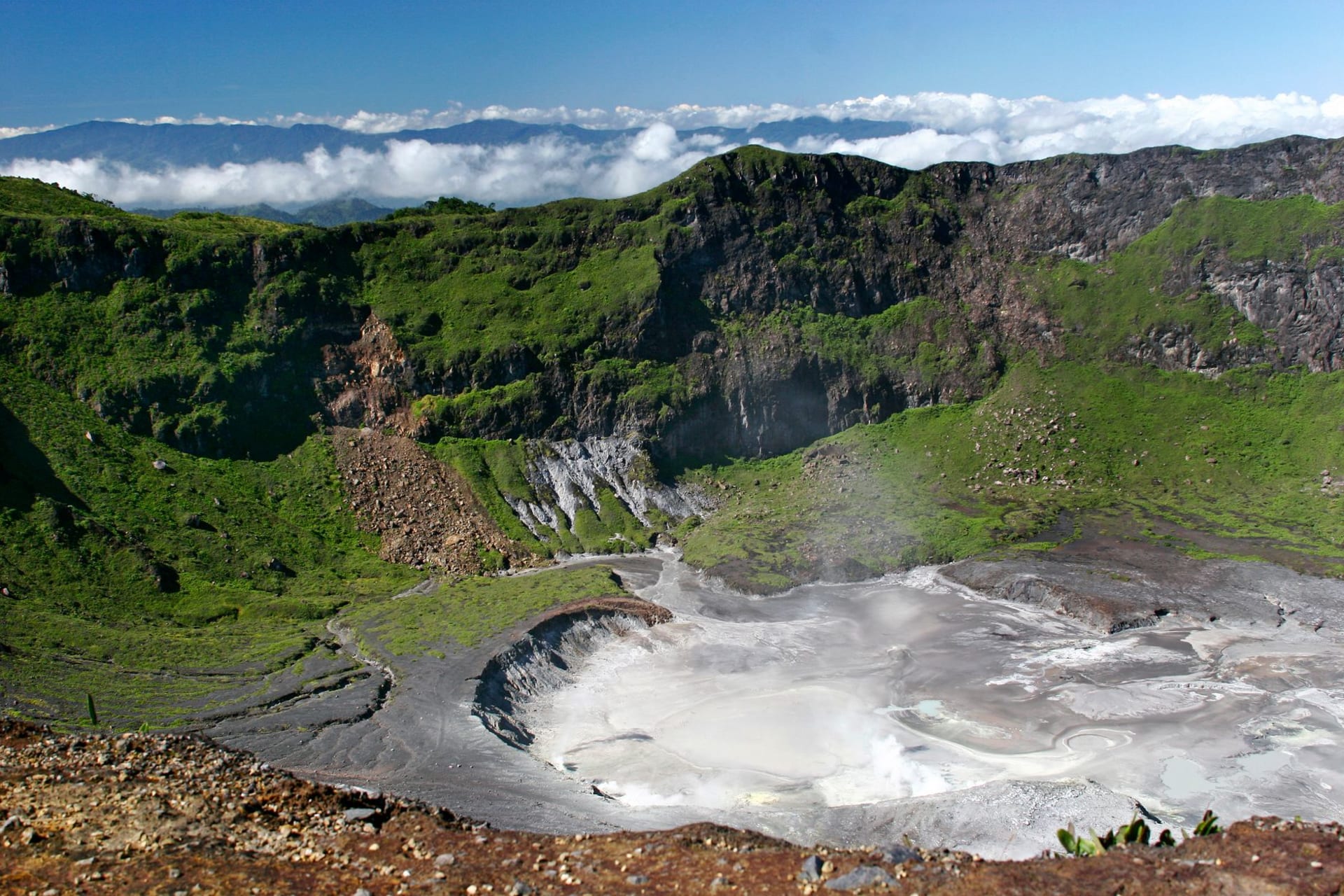
The access road to the Nakadake crater rim is one of those drives that requires your full concentration not because it is technically difficult but because the landscape is so insistent. The vegetation thins as you climb, giving way to rust-colored rock and patches of sulfurous yellow mineral deposit, and the smell arrives well before the crater itself — a sharp, reactive sulfur that catches in the back of the throat. When the volcano is quiet enough to allow access, you can walk to the edge of the main crater and look down at the crater lake, a churning turquoise-grey that shifts color as the gas venting from the walls mixes into the water. It is one of those rare views that feels genuinely dangerous even when you are perfectly safe, the kind of looking-down that activates something prehistoric in the nervous system.
The crater was closed the morning I drove up — the sulfur dioxide levels had spiked overnight — and I sat in the parking lot below the rim in the wind for an hour, watching the plume bend away to the north, the crater itself invisible through the cloud. I was disappointed and then realized that the closure was its own information, a reminder that this is not a theme park with a permanent schedule but an active geological process that does not consult the tourism calendar. The drive back down through the caldera, past the paddies and the farmhouses with their smoke-grey tile roofs, felt different in light of that fact.

The small town of Aso at the caldera floor has a handful of excellent restaurants serving beef from the caldera’s own cattle — the Aso red beef is a local breed raised on the volcanic grass, leaner than wagyu and more mineral in its flavor, served simply at places where the menu has not changed in twenty years.
When to go: Late October through November for clear skies and autumn color on the caldera walls. Spring brings vivid green to the caldera floor. The crater access road closes when volcanic activity increases — check the Japan Meteorological Agency’s volcanic alert level before visiting. Summer brings occasional cloud inversion, filling the caldera with fog that the peaks emerge from.