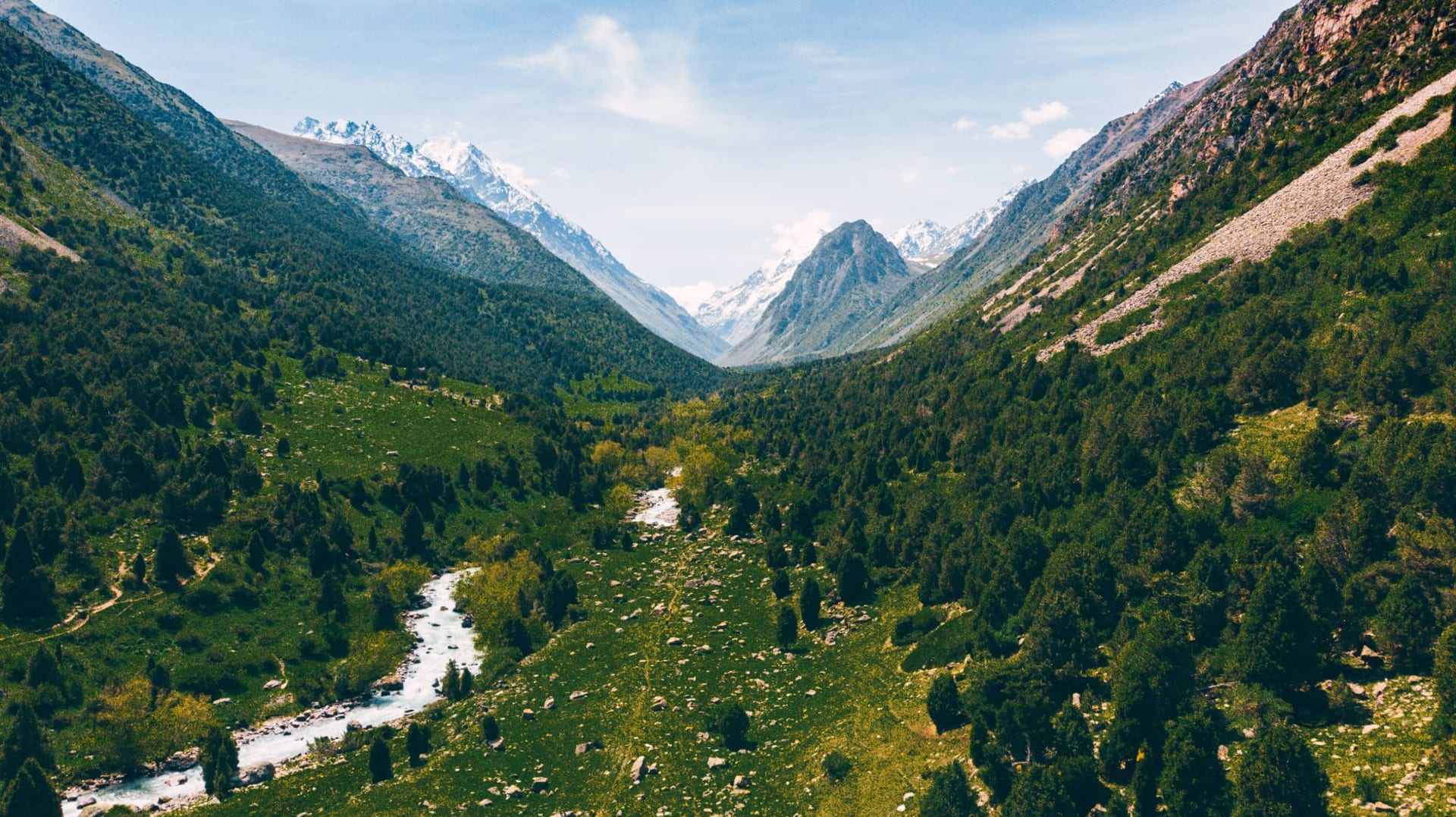
Ala Archa National Park
"I drove out of Bishkek in a taxi and was standing on a moraine in two hours. That kind of proximity feels almost dishonest."
The taxi driver who took me to Ala Archa National Park had never been inside it himself. He dropped me at the gate, pointed up the gorge, and drove away before I had finished paying him. This felt approximately right. The park begins almost immediately: a wooden bridge over a torrent of glacial grey-white water, then a path that climbs through a forest of Tian Shan spruce so dense the light comes down in columns. Forty kilometers from central Bishkek. It seemed impossible, the kind of proximity that other cities spend billions trying to manufacture.
The Ala Archa gorge is the easiest place in Kyrgyzstan to feel the country’s essential character — that particular combination of vertical terrain and total absence of infrastructure — without committing to a week of rough travel. The main trail follows the Ak-Sai river up toward the Ak-Sai glacier, gaining altitude steadily, and on a clear morning in July the upper valley looks like a textbook illustration of alpine topography: moraine, scree, tongue of blue-white ice, granite peaks with enough vertical relief to make your neck ache. I saw three experienced mountaineers heading up with full expedition packs and a family from Bishkek having a picnic on a flat rock ten minutes from the car park, and both uses seemed entirely valid.

There is an alpinlager — a Soviet-era climbers’ base — partway up the valley, a collection of modest concrete buildings that now functions as a guesthouse and logistics point for the serious mountaineers who come to attempt the peaks above. A notice board inside lists some of the routes, with grades and first-ascent dates going back to the 1930s. The whole Soviet mountaineering culture — disciplined, collective, almost military in its organization — left a deep mark on Central Asian climbing, and you still feel it here in the equipment, the record-keeping, the seriousness with which the sport is approached by the Kyrgyz climbers who use this hut at the start of each season.
The wildflowers in the meadows below the treeline surprise people who come expecting only rock and ice. In June, the lower meadows are full of blue and yellow alpine blooms — edelweiss grows here, which I had previously only known as a song — and the smell of wet turf and river spray and spruce trees creates a sensory combination that is impossible to disaggregate. I kept stopping to try to identify individual scents and failing, and eventually gave up and simply stood in it and let it be whatever it was.

The park is also home to snow leopards, though you will not see one. Their presence is enough — the knowledge that the upper slopes contain something that moves through this terrain with none of your effort and none of your noise.
When to go: The park is accessible year-round but the upper road washes out after heavy snow. May and June are excellent for flowers and the lower trails. July and August are the most reliable for clear skies and full glacier access. September brings cold air, autumn colour in the spruce stands, and the departure of the summer crowds, which were never very large to begin with.