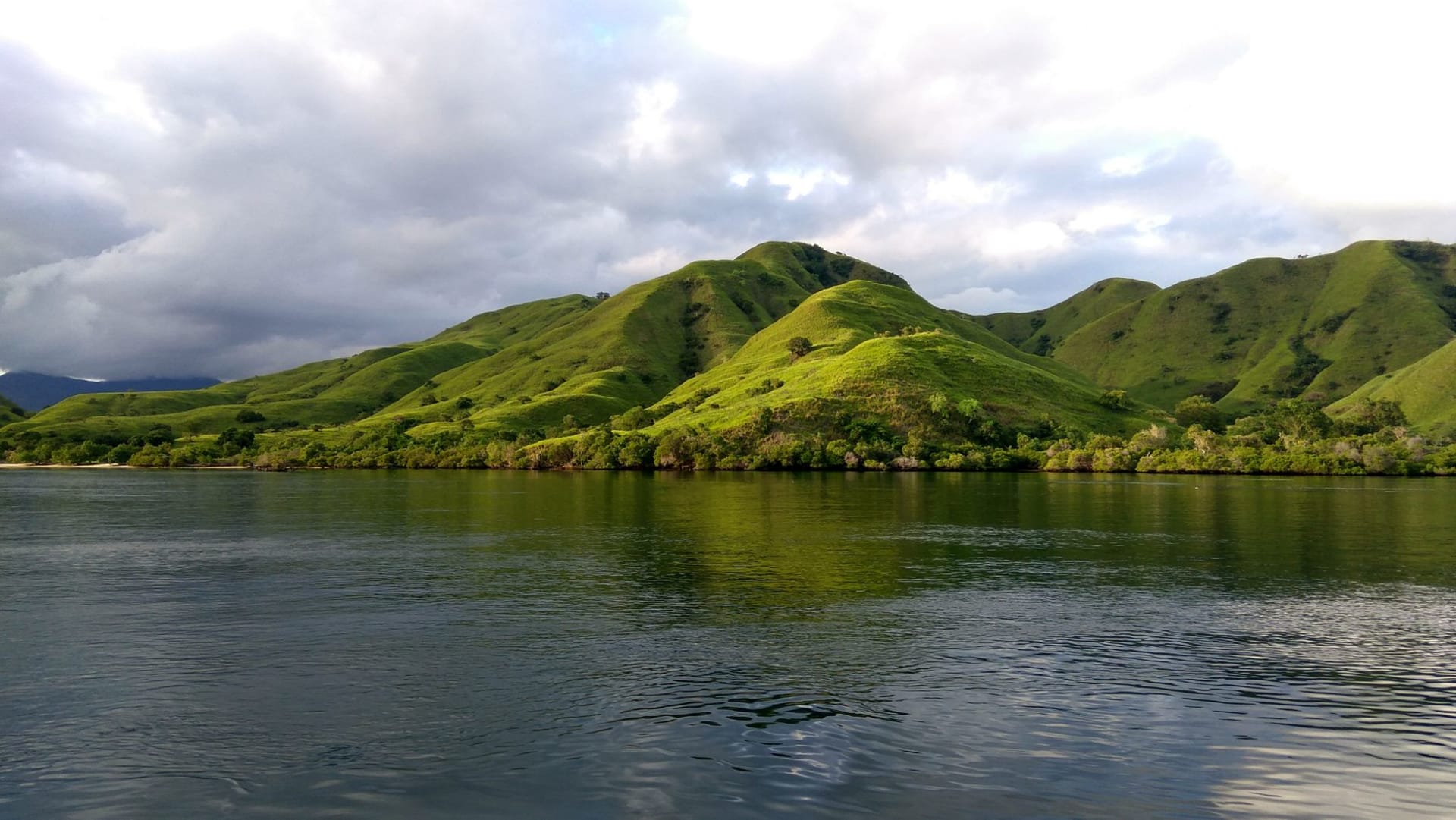
Manta Point
"The manta turned and looked at me. I have never felt so correctly sized."
The briefing before the Manta Point dive was different from the others. No current talk, no depth discussion, no instructions about buoyancy in surge. Instead the dive master said: do not chase them, do not reach for them, do not make sudden movements. If a manta approaches you, hold still. Then she paused and said, “They will approach you.” This was not a sales promise. It was a practical instruction.
We dropped into water that was unusually clear even by Komodo standards — fifteen meters of visibility at least, the light coming down from the surface in long pale columns. The cleaning station at Manta Point is a shallow reef area off the southern coast of Komodo Island where the current pushes plankton across a section of coral, and the mantas come to be cleaned by small wrasse fish that pick parasites from their skin. The mantas arrive, circle, descend to the cleaning station, loop back up, circle again. They have been doing this here for as long as anyone can remember. The reef fish do their work. The mantas wait their turn with an patience that seems almost courtly.
I saw the first one before it saw me — or at least before it oriented toward me. It came from the blue edge of visibility, a shape that took several seconds to resolve into something recognizable: the broad triangular wings, the cephalic fins curled forward, the vast pale underside with its distinctive spotted pattern. Wingspan perhaps four meters. Weight I did not want to estimate. It banked into a turn and circled the cleaning station at the same measured speed it presumably maintains through everything it does, and then it came toward me in the most direct way possible and slowed and looked.
Manta rays have large, laterally positioned eyes. When one is looking at you from close range, you know it. The eye is amber-colored and clear and it takes you in with an attention that doesn’t feel incurious. This one held its position in front of me for perhaps five seconds — which in this context is a long time — and then folded its wings slightly and banked away in the same unhurried motion, back to the circuit. My dive computer showed my breathing rate had dropped almost to nothing during those five seconds. I had been holding my breath without noticing.

By the end of the dive, I had counted seven individual mantas at the cleaning station, each distinguishable by the unique spot pattern on their undersides. Some dive operators photograph these patterns systematically and contribute the data to manta ray identification databases — the population at Manta Point has been partially catalogued, which means these animals have histories, individual records of sightings across years. The manta that looked at me has a file somewhere. It has been looked at and measured and named with a number. I find this strangely comforting.
We surfaced into afternoon light with the boat waiting and the islands of the park rising from the water in every direction, and I floated on my back for a minute before climbing the ladder. The sky was the particular shade of blue that the sea produces when you have been looking at it from underwater. Everything above the surface seemed slightly less real than what was below.
When to go: Manta rays are present at Manta Point year-round, but the largest aggregations occur during the northwest monsoon season from December to March when plankton blooms are richest. The seas can be rougher then; for calmer water combine manta sightings with the dry season runs from April to October, when smaller but reliable numbers are present. Snorkelers can access this site too — the mantas often circuit at five to eight meters depth.