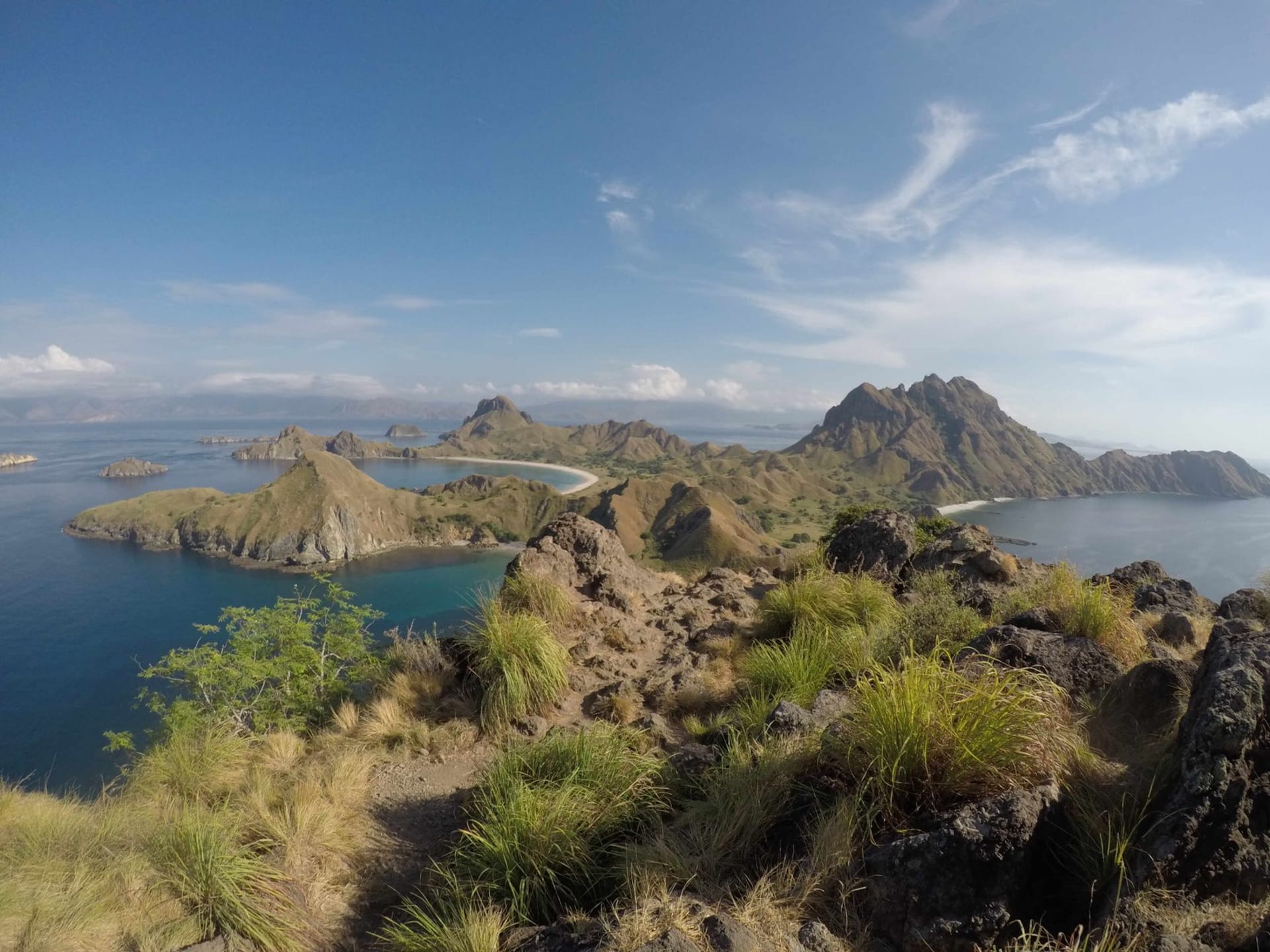
Batu Bolong
"The current at Batu Bolong doesn't ask permission — it takes you where it wants, and you're glad it did."
Batu Bolong means “hollow rock” in Indonesian, which describes the geological formation — a pinnacle of volcanic rock that rises from about forty meters depth to just below the surface, with a tunnel bored through its base where the current concentrates and accelerates into something that will pick you up and move you whether you intended to move or not. I went in on the north side and came out on the south side thirty minutes later having traveled approximately zero meters under my own power. The ocean had done all the work.
What the ocean does at Batu Bolong is extraordinary. The seamount sits in open water between Komodo Island and the smaller Gili Motang, exposed to the tidal currents that flow through the strait with the regularity and force of a river. Those currents bring cold, nutrient-rich water up from the deep, and the nutrients feed plankton, and the plankton feeds everything that lives on the rock. The result is a concentration of marine life that doesn’t make immediate sense — an impossible density on a structure small enough that you can swim its full circumference in a single dive.
The coral itself deserves a paragraph. Every centimeter of the rock’s surface that receives light is covered: table corals, brain corals, gorgonian sea fans the size of doors standing perpendicular to the current, catching the water flow like sails. The colors deepened as I descended — the pale pastels of shallow water giving way to deeper crimsons and purples at twenty meters, until at thirty meters the fans were almost black and the light had that particular quality of blue that makes underwater photography look like science fiction. I turned my dive light on a gorgonian fan at depth and the coral lit up red as if embarrassed at being seen.
The sharks find you at Batu Bolong without effort on either party’s part. Whitetip reef sharks rest in groups at the base of the pinnacle during the day, jostling for the same flat patch of sand. Grey reef sharks patrol the mid-water column above. Occasionally a hammerhead drifts through at depth — I saw one on my second dive, a great hammerhead that appeared out of the blue at perhaps twenty-five meters, took two lazy sweeps of the space below us, and disappeared without urgency. My dive master had seen it too; she gave a brief thumbs-up that meant something between “did you see that?” and “yes, this is normal here.”
The surface interval between dives at Batu Bolong is usually spent drifting in the current while the boat repositions, eating snacks and talking about what just happened. The dive groups from different boats occupy an informal camaraderie on the water between dives — comparing sightings, describing the hammerhead’s size with increasingly wide arms. By the second dive, strangers have become the kind of acquaintances that exist only in compressed, intense contexts. By the third, you are exchanging email addresses.
When to go: May through October gives the best visibility and most manageable currents. Advanced certification is essential — this is not a site for beginners, and the current can surge unexpectedly. Experienced dive operators in Labuan Bajo run this site daily; book through them rather than ad hoc, as local knowledge about entry points and current timing is genuinely important here.