Marakei
"Marakei has no center — just a ring, a lagoon, and the understanding that everything curves back."
Marakei is one of those places you reach by making a series of decisions that each feel manageable in isolation and collectively imply commitment. From Tarawa, there is an intermittent domestic flight — on a plane small enough that the baggage limit applies to your own body mass in a way that feels personal — or an even less reliable boat service. I chose the flight. The landing strip on Marakei is a strip of packed coral beside a lagoon, and as we taxied to a stop a small group of children materialized from the palms and stood watching with the patient curiosity of people who see aircraft infrequently enough that the arrival still constitutes an event.
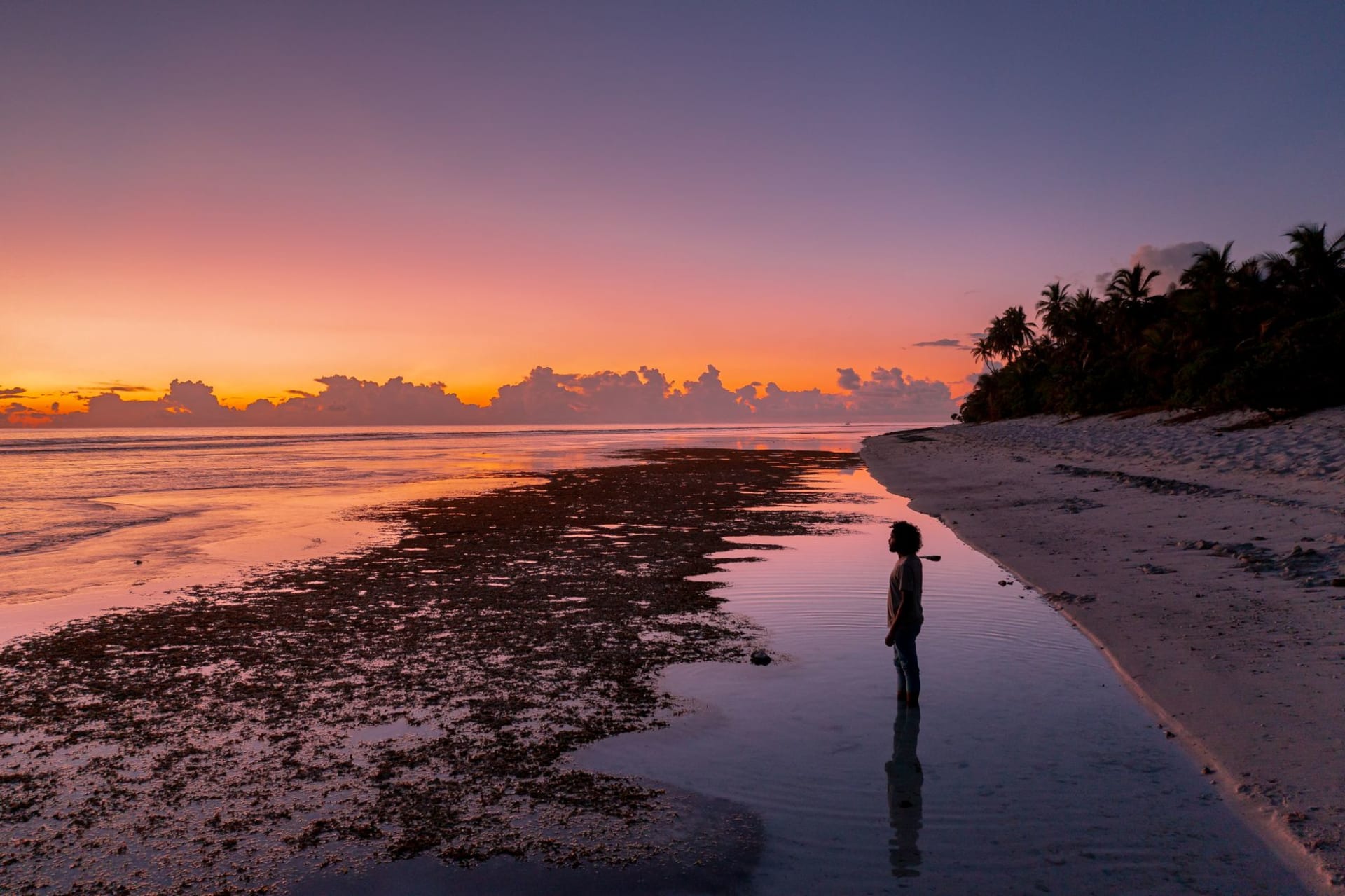
The atoll is almost perfectly circular, which is unusual even among atolls — most are irregular, elongated, buckled by geology and time. Marakei forms a near-complete ring around a sheltered lagoon, and the villages are distributed around the inner edge of this ring with no connecting road other than the sand and coral path that runs the circumference. Walking it takes most of a day at a relaxed pace, passing through village after village where the houses are open-walled and the maneaba sits in every settlement like a sentence that has been repeated so many times it has become structural.

The women of Marakei weave, and they weave seriously. Pandanus leaves are collected, dried, and processed into strands of a fineness that is difficult to believe if you have only seen the raw material. Mats, baskets, and hats emerge from this process over hours of work that I watched one afternoon in a shade shelter behind one family’s house. The eldest woman worked without looking at her hands, continuing a conversation about island news while her fingers moved with an automatism that forty years of practice produces. The mat she was making would take several more days, and when finished would be used for a ceremony marking a family event she did not fully explain to me, but whose importance was clear in the care she brought to the work.

Swimming off Marakei requires choosing sides: the lagoon is protected and warm, with water that barely moves and a sandy bottom that shelves gradually into depth; the ocean side of the reef is a different proposition entirely, with swells that arrive unbroken from thousands of miles north and a drop-off from the reef edge that has a physical presence you feel in your chest before you actually see it. I swam on the lagoon side both mornings and on the ocean side once, in the afternoon when the tide was coming in and a local man had judged it safe. The visibility was extraordinary — fifty meters at least — and the outer reef wall was covered in hard corals that have seen no dynamite fishing and very few divers.
When to go: April through October, when flight connections from Tarawa are most reliable and the sea state on the ocean side of the reef permits swimming. The circular walk around the atoll is best done in the early morning before heat peaks — bring more water than you think you need.