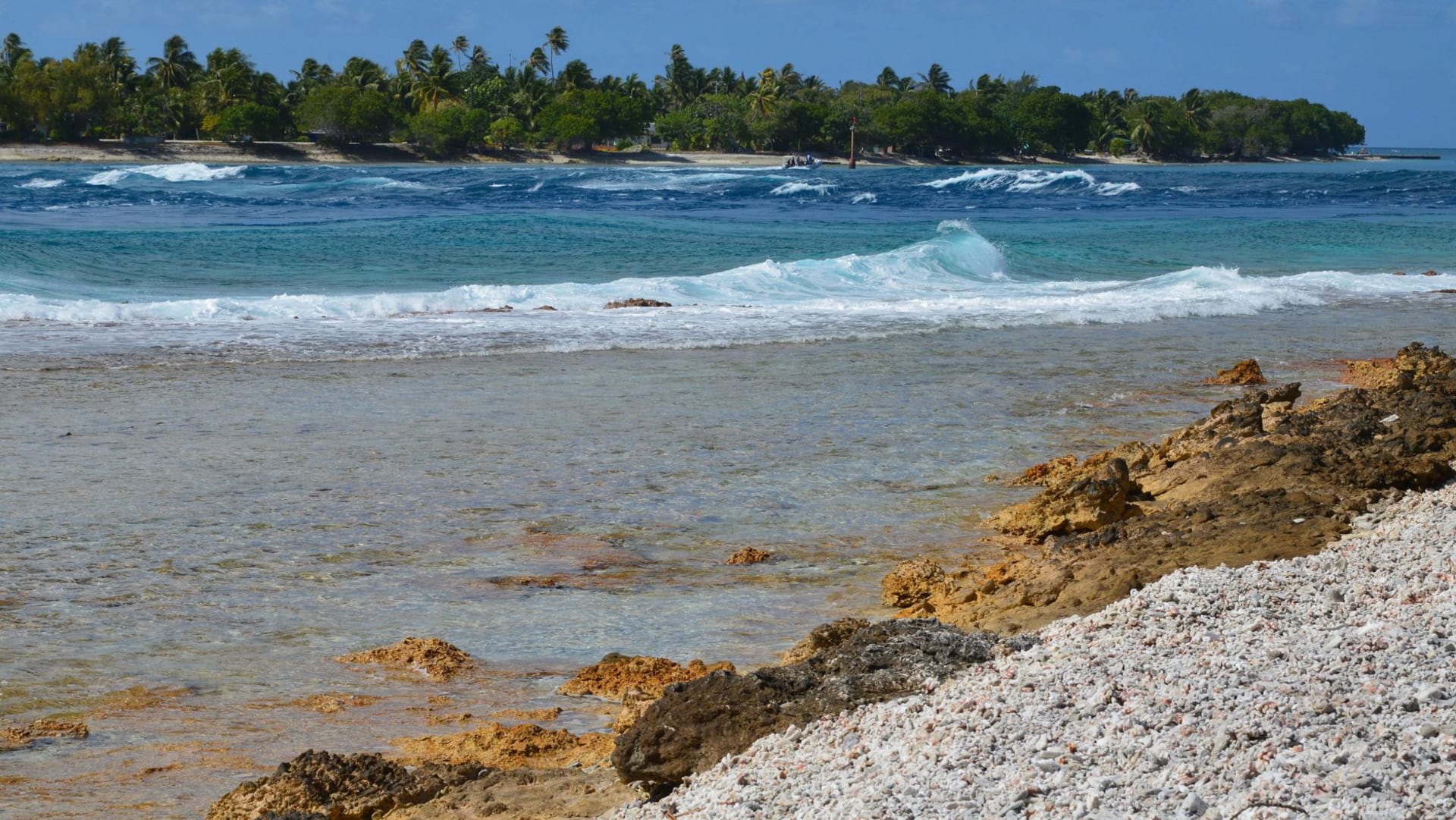
Abemama
"Stevenson wrote here under a lamp while the coconut crabs clattered outside. I understand why he stayed."
The boat to Abemama leaves Tarawa in the dark and arrives at dawn, which is either the worst or the best way to make a crossing depending on how you feel about discomfort. I chose a bench near the bow where the spray was worst but the stars were unobstructed, and spent four hours watching the Southern Cross sit low over the horizon while the engine throbbed underneath me. By the time the atoll’s palms resolved out of the grey pre-dawn, I had drunk all the water I’d brought and eaten the biscuits I’d meant to save, and I was deeply glad to see land.
Abemama is about 100 kilometers south of Tarawa and it carries a different quality of stillness. Robert Louis Stevenson arrived here in 1889 aboard the schooner Equator and stayed three months under the protection of the island’s king, Tem Binoka — a man Stevenson described as the last of the tyrants and portrayed with fascinated ambivalence in his Pacific diaries. There is a plaque somewhere near the village marking where Stevenson’s hut stood, though the plaque has seen better days and requires a local guide to locate. I found it on my second afternoon, half-obscured by a tangle of pandanus, and stood in front of it for longer than was probably justified. Something about the continuity felt real: the same heat, the same smell of coconut and brine, the same silence punctuated by the same birds.

The reef at Abemama is what people who dive seriously come here for, and after two days on the island I understood completely. The outer reef edge drops into water of an almost hallucinatory clarity — visibility running well past thirty meters on a calm morning — and the coral coverage is the best I saw in Kiribati. There are bumphead parrotfish here that move in schools through the shallower heads, grinding coral with a sound you can hear underwater. There are surgeonfish and Napoleon wrasse and things I couldn’t name moving through formations that have not been blasted or bleached or trawled, and the whole system operates with a completeness that reefs in more visited places have lost. I snorkeled for three hours on my first full day and barely covered a section of the outer flat.

Village life on Abemama runs on a schedule I had to unlearn my habits to follow. Fishing at dawn, the maneaba gathering at midday, rest through the worst of the afternoon heat, then the gentle hours from four o’clock when children play on the beach and elders talk under the palms. I was given a mat in a family’s open house and ate with them — taro and reef fish and a toddy made from the morning’s fermented palm sap that was sharper than it looked. The family’s eldest son spoke good English and wanted to talk about football, specifically Manchester City, which I was not expecting but which made the evening considerably more animated than I’d anticipated. The night was warm and full of insects and the reef could be heard from my mat, a constant low hiss that eventually merged with sleep.
When to go: April through October is ideal — calmer seas make the boat crossing more manageable and visibility on the reef is best. The overnight boat from Tarawa runs irregularly; confirm departure times on arrival in South Tarawa. Domestic flights serve Abemama with small aircraft — book as early as possible.