Kannur
"By three in the morning, I wasn't sure what I was watching — theater, religion, or something that predates both categories."
It was three in the morning when the theyyam began in earnest, and by that point I had been standing in the courtyard of a small kavus — a sacred grove — for four hours, watching the transformation. The performer, a man from the community of artists who have held this practice for generations, had been dressing for three hours before entering: layering the costume, the headdress that rose two meters above his head, the bells at his ankles, the white and red face paint applied in ritual sequence. When he finally moved into the circle of torchlight and the drumming shifted register, something changed in the air of that courtyard that I cannot entirely account for.
Theyyam is a ritual performance tradition of northern Kerala — of this Malabar coast specifically — and it is one of the most extraordinary things I have encountered anywhere. The performers channel specific deities, spirit heroes, and ancestors, and are believed, during the performance, to be those beings rather than men wearing costumes. The ceremonies happen in community shrines attached to family homes or temples, between October and May, in a calendar that moves through the villages of Kannur and Kasaragod districts according to cycles I am not equipped to fully explain. You do not see theyyam in a theater or a tourist attraction. You attend a ritual, as a guest, and you stand at the edge and try to understand what you are watching.

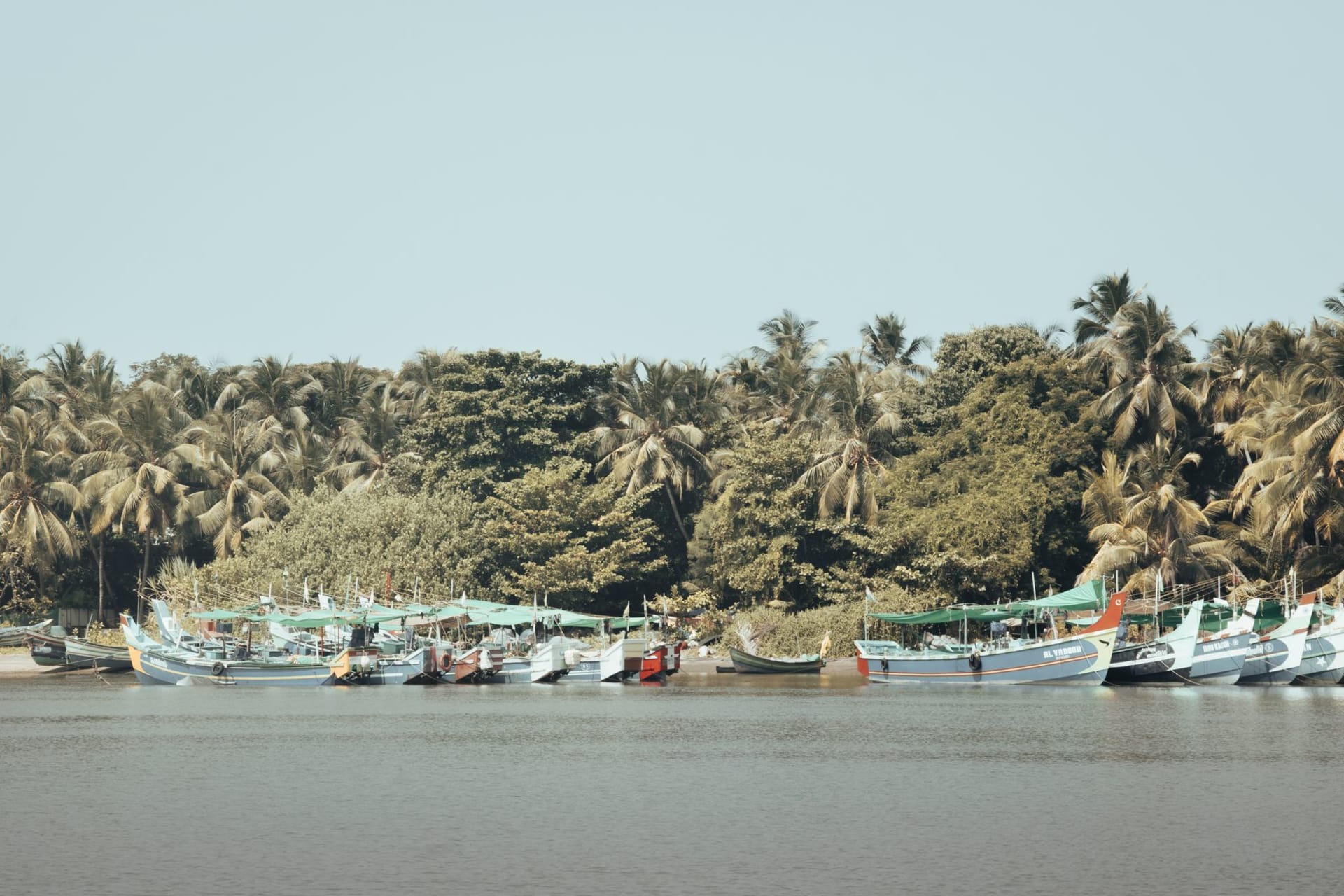
Kannur itself is a pleasant, undervisited northern Kerala town with a large port and a weaving history that makes it one of India’s most important handloom districts. The beedi workers and weavers here have a tradition of labor organizing going back to the 1940s — Communist Party imagery appears on walls alongside temple frescos with an equanimity that is very Kerala — and the town has a low-key political self-awareness that gives conversations at tea shops a different quality than in the more tourist-saturated south.
The coastline north of Kannur is full of beautiful, uncrowded beaches. Muzhappilangad is often cited as India’s longest drive-in beach — you can actually bring a vehicle onto four kilometers of hard sand — which sounds tacky in description and is somehow wonderful in practice on a quiet Tuesday morning when there is almost no one there and the sand is ribbed with tide patterns and the coconut palms lean over the road behind you.

The local food in Kannur traces the Malabar Coast’s Muslim trading history: the biryani here is distinct from southern Kerala biryani, lighter and more aromatic, made with short-grain kaima rice and a complex masala that suggests the spice routes very literally. The kallummakkaya — mussels cooked with black pepper and coconut milk — are sold at small beach shacks and pair improbably well with a cold glass of coconut water. I ate a meal at a toddy shop on the outskirts of town where mussels came with appam and a tamarind-based fish curry and cost the equivalent of two euros, and I thought: this is why people come to Kerala and never entirely leave.
When to go: October through May for theyyam performances — the specific schedule requires local guidance, ideally through your guesthouse. November to February for beach weather. If theyyam is your primary reason for coming, December or January has the densest schedule.