Alleppey
"On the second morning, I stopped wishing I was somewhere else. That's what Alleppey does."
I woke before sunrise on the houseboat and lay still, listening. There was no traffic, no alarm, no signal. Just water pressing gently against the hull, the rhythmic creak of the mooring rope, and somewhere close — impossibly close — the ragged call of a brainfever bird looping through the dark. The canal outside was black and perfectly flat, and when the first light came it arrived as a thin orange line above the coconut palms, the kind of dawn that arrives in stages, giving you time to prepare. I made tea on the small gas burner in the boat’s kitchen and sat at the prow wrapped in a lunghi while the world assembled itself around me. A kingfisher hit the water and was gone. A woman at the far bank stepped into a small wooden canoe and pushed off without looking up.
Alleppey — properly Alappuzha, though nobody calls it that — is the nerve centre of Kerala’s backwater system, a labyrinth of canals, lakes, and rivers covering nearly 900 kilometres of navigable water. The town itself is unremarkable: a market, a few wide roads, a beach that catches the afternoon wind. What matters is what lies to the south and east, where the canals narrow into passages barely wide enough for two boats, where the banks are so densely planted that the light turns green-gold before it reaches the water.

Life along the canals is not performance. The villages built on thin strips of land between water and water have their own rhythms entirely independent of tourism. Women wash clothes at concrete steps that descend directly into the canal. Children walk to school along paths so narrow that one wrong step means swimming. Toddy shops — small establishments that sell the fermented sap of the coconut palm — open before eight in the morning, and the men inside sit on low wooden benches with their drinks and argue quietly about things I cannot understand. On market days a boat pulls up at a floating grocer — a canoe piled with vegetables, fish packed in ice, green bananas — and the entire transaction happens across six inches of water.
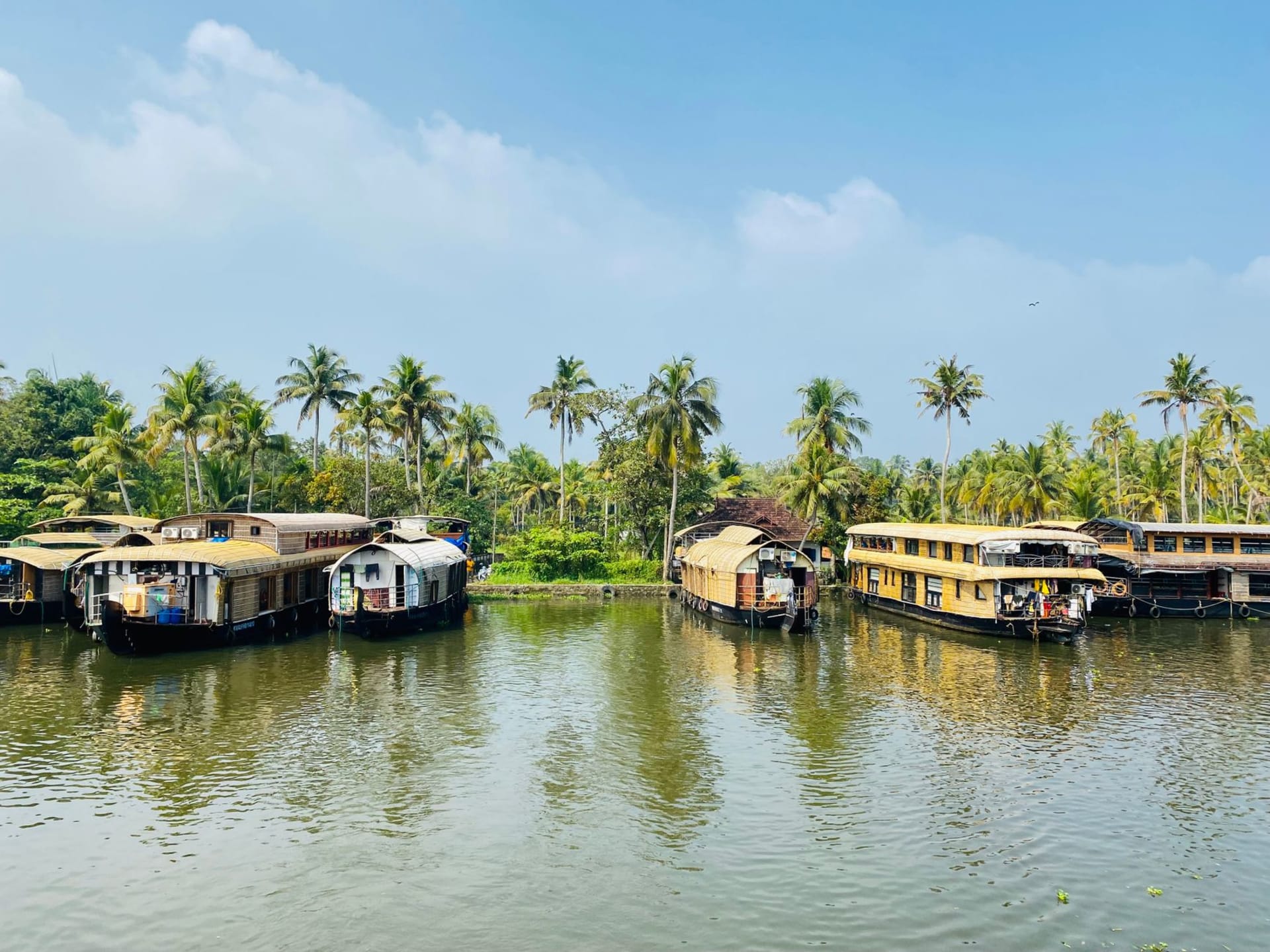
The kettuvallam, the traditional rice barge retrofitted with bedrooms, thatched roofs, and a cook who will make you whatever fish she bought that morning at Alleppey market, is both the best and the most problematic way to experience this. Best because you go slow enough to see it; problematic because the narrow canals can only absorb so many houseboats before the romance curdles into a traffic jam. My advice is this: book a boat, yes, but insist on routes that go into the smaller canals and avoid Vembanad Lake on weekends when the big boats cluster. Stay two nights, not one. The first day you’re still watching it like a film. The second day something loosens and you start to feel the pace rather than observe it.

August and September, when the Nehru Trophy Boat Race runs on Punnamada Lake, is the exception to every slowness I just described. The snake boats — long, low, impossibly narrow, crewed by a hundred men rowing in absolute unison — move at a speed that seems physically impossible for a wooden vessel. The crowd on the banks becomes a roar. It is loud and overwhelming and entirely wonderful, the kind of spectacle you remember for years.
When to go: October through February for calm water and clear mornings — the classic season. The monsoon (June–August) floods the canals beautifully and the green reaches a depth of colour that photographs cannot contain, but boat operations can be limited. Avoid April and May, when pre-monsoon heat sits heavily on the water and the air barely moves.