Alappuzha
"The backwaters don't show you Kerala — they slow you down until you finally start seeing it."
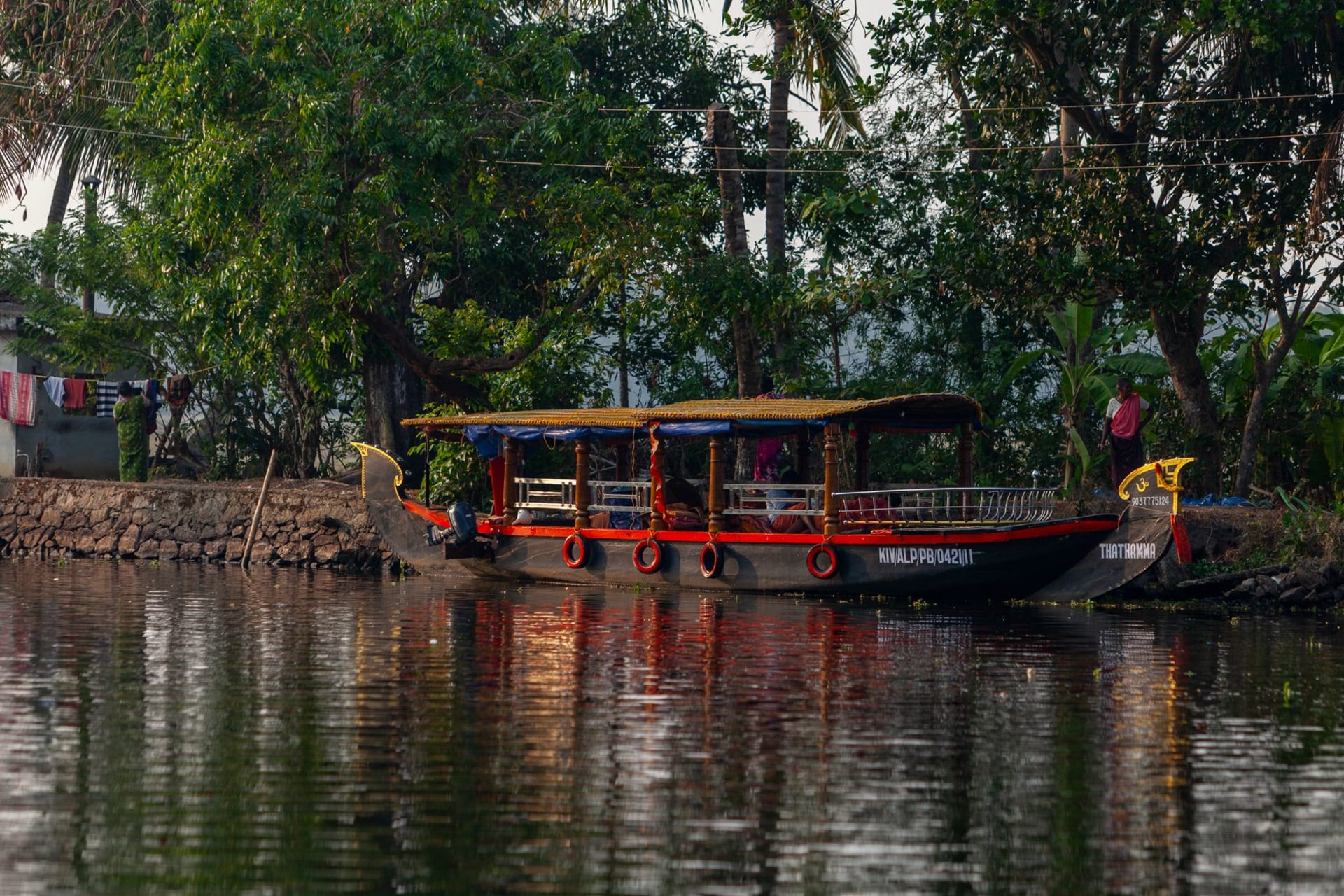
The man who poled my houseboat through the narrower channels had arms that looked carved from teak. He never spoke much — just moved the long bamboo pole with a rhythm that felt ancient, the boat advancing in near-silence except for the water slipping past the hull and, somewhere in the palm thicket to the right, a kingfisher making its short, decisive dive. Alappuzha had claimed me from the moment I arrived, and it wasn’t letting go.
The backwaters here are not what the word suggests. I’d imagined something stagnant, torpid. What I found was a living system of canals, lakes, lagoons, and paddy fields covering nearly a thousand square kilometers — a flooded universe parallel to the coast, separated from the Arabian Sea by a thin strip of land. Villages exist here where the road is the water. Children row themselves to school. Fishermen set their nets at dusk with the practiced indifference of men who have never needed to wonder whether this was a beautiful way to live.

I moored for a night near Punnamada Lake and walked into the village in the late afternoon. A woman was frying banana chips in an enormous wok of coconut oil outside her home, and the smell of it — slightly sweet, deeply savory — hung in the still air. There was a small toddy shop at the corner, the kind that serves only two things: fresh coconut toddy drawn that morning and dried fish with green chilli. I drank a glass that tasted somewhere between sour fruit juice and very young wine, and watched a rooster lord over the mud-packed yard next door, and thought about how far this place was from everywhere else I had ever been.
The town of Alappuzha itself — the one on dry land — is a faded, beautiful place. Its canals bisect the streets, crossed by small footbridges. The Dutch and British left their marks on the old godowns along the harbor front, and the fish market on the eastern edge of town runs so loudly and colorfully in the early morning that you have to stand at its edge just to absorb the noise — the slap of wet fish on concrete, calls in Malayalam rising and competing, gulls working their own angles overhead.

On my last evening I sat on the bow as the boat rounded back toward the mooring and watched the light fail over the paddy fields. The water turned orange, then pink, then the grey-blue of old pewter. The palms became silhouettes. A woman lit a kerosene lamp in a house at the bank’s edge and the yellow light fell on the water and seemed to lead somewhere important. I understood then why people talk about the backwaters the way they do. Not because it is scenic — though it is, impossibly — but because it slows time down to a pace you didn’t know you needed.
When to go: November through February is the sweet spot — cool evenings, workable humidity. The Nehru Trophy Snake Boat Race happens in August during the monsoon and is extraordinary if you can handle heat and rain. Avoid April and May, when the heat sits on the water like a lid.