Turkistan
"Three pilgrimages here equal one to Mecca — I heard this and felt the weight of what I was looking at shift entirely."
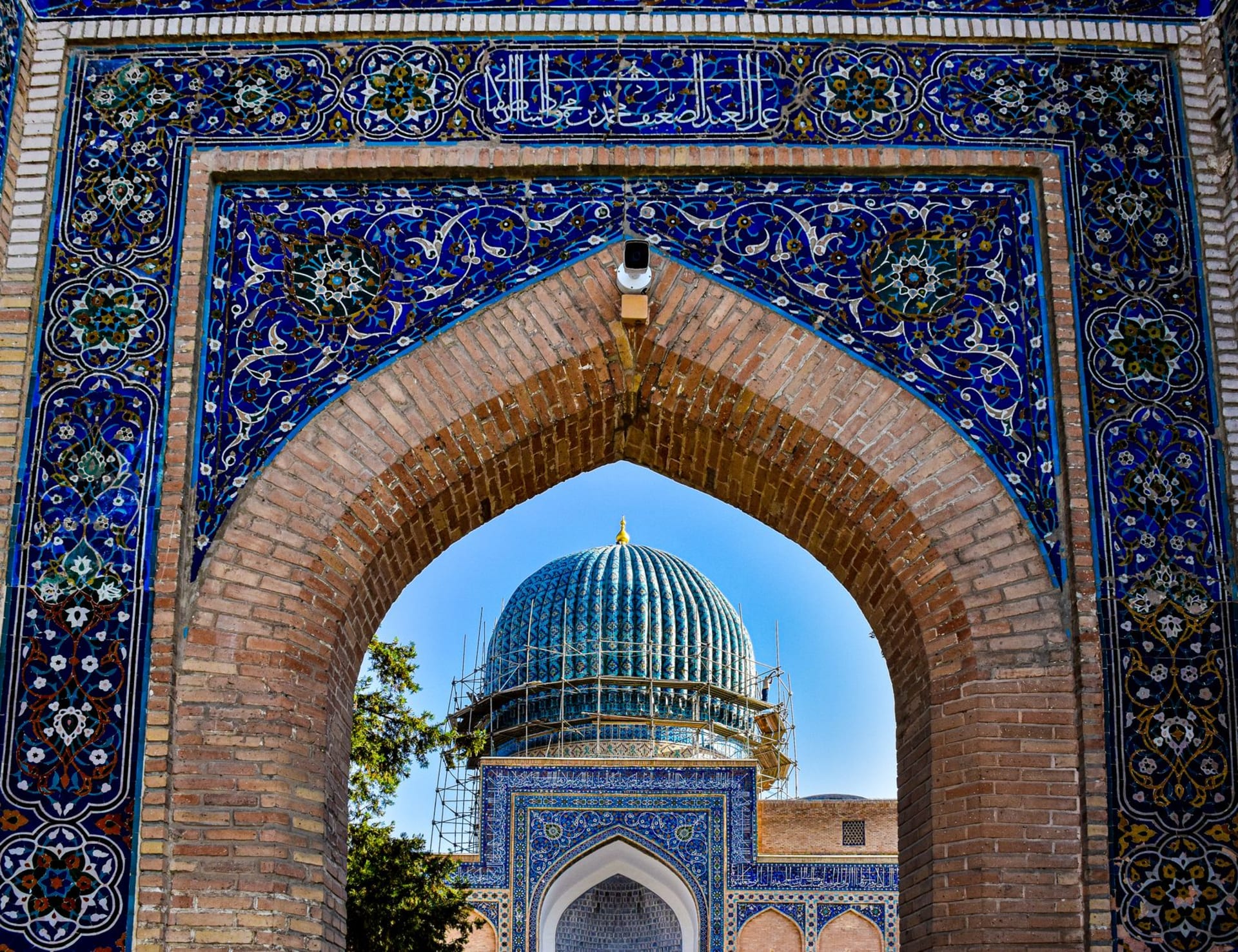
You see the dome from a long way off. Driving south from Shymkent through the flat scrublands of southern Kazakhstan, the Mausoleum of Khoja Ahmed Yasawi appears on the horizon as a soft turquoise mass, growing slowly larger and more extraordinary the closer you get, until you are standing beneath it and trying to reconcile the scale of the thing — a building that rises fifty meters above you, its Timurid brickwork and glazed tile work as precise and deliberate as anything I have seen in Samarkand or Bukhara — with the fact that most people outside Central Asia have never heard of it.
Khoja Ahmed Yasawi was a twelfth-century Sufi poet and mystic whose teachings spread across the Turkic world and gave philosophical grounding to the Islam practiced across this region. When he died in 1166 he was already venerated; over the following two centuries his tomb became a pilgrimage site significant enough that Timur — Tamerlane — commissioned this mausoleum in the 1390s as an act of both piety and political statement. The construction stopped when Timur died, leaving the western entrance slightly unfinished, which adds a particular kind of honesty to the building — the impression of something that was begun with absolute conviction and then left to history.
Inside, the main hall contains a bronze kazan — a ceremonial cauldron two meters across, cast in the fourteenth century and filled with water during certain festivals so pilgrims could drink from it. The kazan alone weighs two tons. The ceiling above it rises to the main dome, which is ribbed and painted and lets in light through a drum of small windows in a way that makes the whole interior feel both intimate and infinite. I stood in the kazan hall for a long time, and other visitors — Kazakhs, Uzbeks, Kyrgyz, a few older women in white scarves who had clearly come specifically to pray — moved around me with a quiet purposefulness that made the space feel very much alive.
The surrounding old city, Turkistan proper, has been undergoing ambitious reconstruction — perhaps too ambitious, some of it feeling new enough to squeak underfoot — but there are still corners of the ancient caravanserai district that carry genuine age, and the local bazaar has the dense, layered smell of a market that has been in the same place for centuries: dried apricots, mutton fat, something sweet being fried. I ate samsa — baked pastry filled with lamb and onion, still hot from the tandoor — sitting on a low wall near the market and watched a group of schoolchildren in matching uniforms have their photograph taken in front of the mausoleum, the dome gleaming behind them.
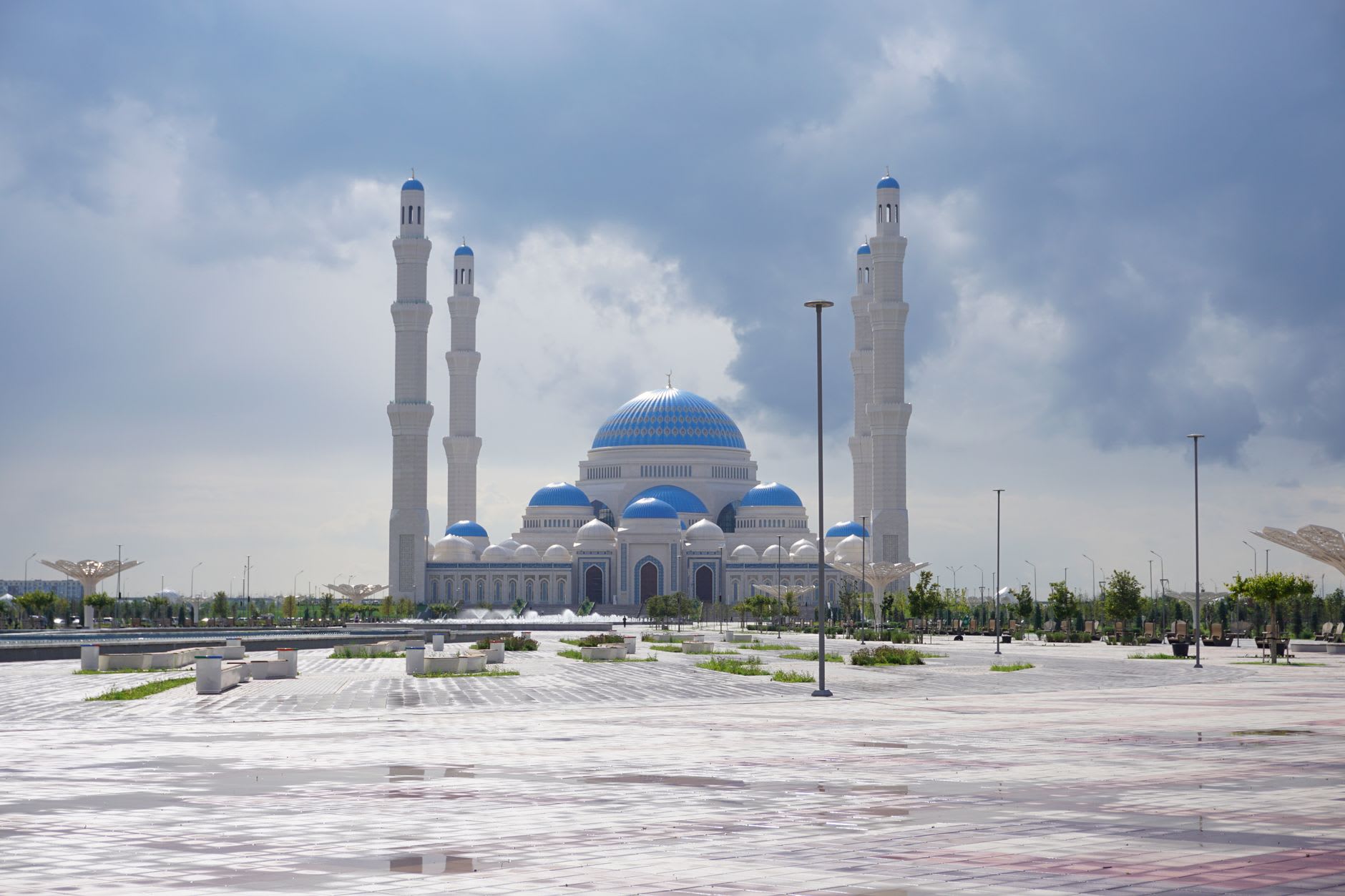
The city feels different from northern Kazakhstan, warmer in the literal and figurative sense — a southern place, connected to Uzbekistan and its culture and its long memory of the Silk Road. People speak Kazakh but shift easily into Uzbek; the food leans richer, the tea stronger, the pace of afternoon slower. It is a place that has absorbed a great deal of history without becoming a museum of it, which is rarer than it should be.
When to go: March through May and September through October are ideal. Southern Kazakhstan summers are genuinely ferocious — 40°C or above — and the mausoleum offers no shade. Winter brings cold but manageable temperatures and the site is far less crowded; there is something memorable about standing at the foot of that turquoise dome with snow on the ground and a completely empty plaza.