
Mangystau
"Nothing I'd read about Kazakhstan prepared me for Mangystau. Nothing about Mangystau prepares you for Mangystau."
Flying into Aktau from Almaty, the Caspian Sea below is so flat it looks like a rendering, and the moment the land begins you can see that it is not the land you know. White. Chalk-white and yellow-white and the specific grey-white of bone, carved into formations that don’t follow any desert logic I had developed in North Africa or the American Southwest. This is the Mangystau region — the western edge of Kazakhstan where the Ustyurt Plateau meets the Caspian and the land has been doing something complicated with wind and erosion for millions of years.
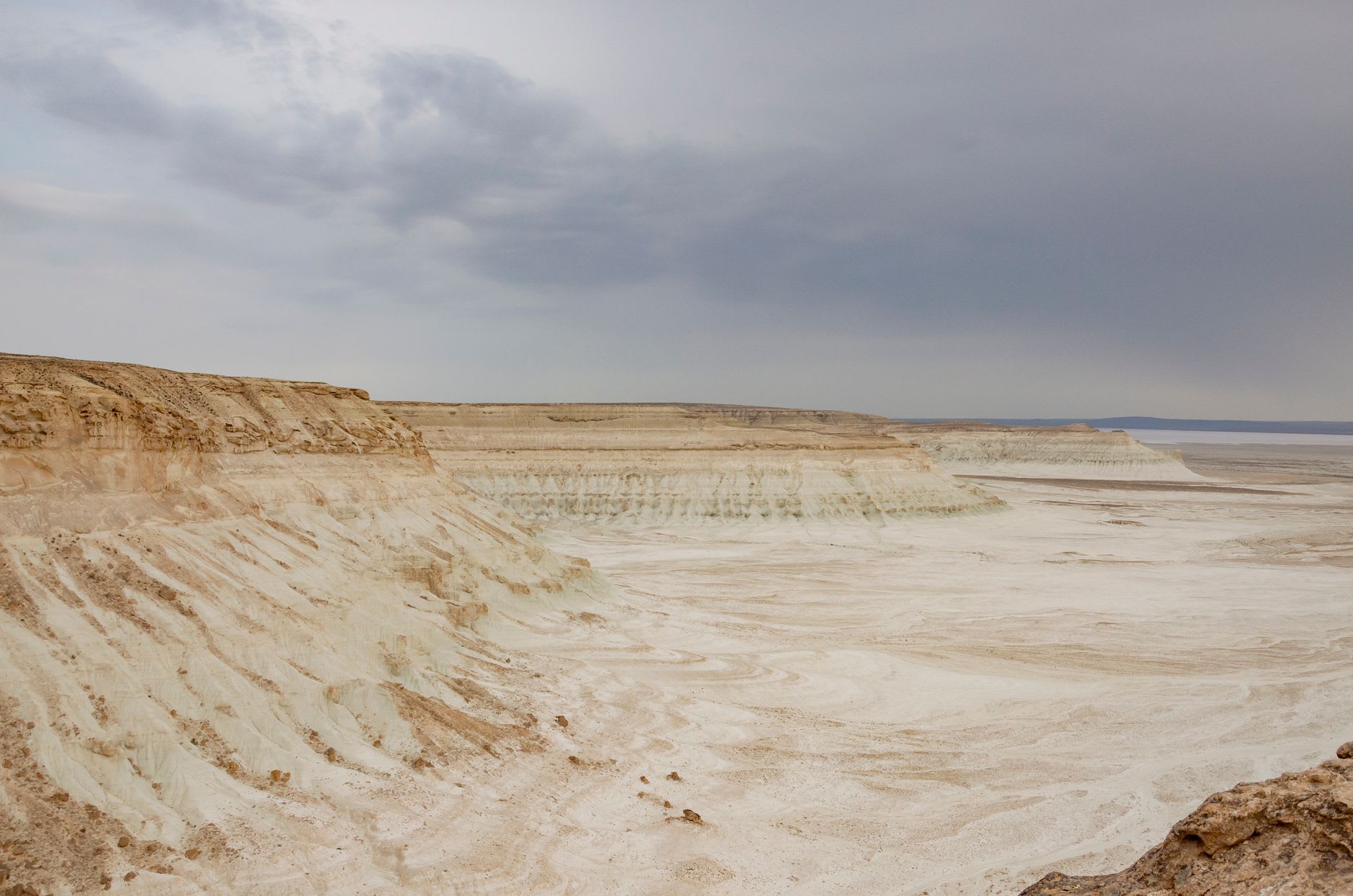
I hired a driver in Aktau, which is the only practical way to reach most of the landscape. The man’s name was Nurlan and he drove a Russian Niva 4WD with a cracked dashboard held together by a piece of yellow tape, a thermos of tea permanently between the seats, and a navigation system that consisted of himself. On the second day we drove out to Bozzhyra — a valley of white chalk towers that protrude from the plateau floor like the fingers of something enormous pressing upward from beneath. The scale defeats description. The towers are hundreds of meters tall and the valley they fill is thirty kilometers across and there is, in the middle afternoon, no other person anywhere visible.
But the underground mosques are what Mangystau does to you most directly. Shakpak-Ata is carved directly into a chalk cliff face — rooms hollowed by hand centuries ago, the walls incised with Arabic inscriptions and geometric patterns, the low doorways requiring a bow to enter. No electricity inside, no ticket booth, no conservation cordon. Nurlan lit a candle he had brought, and we moved through rooms that felt simultaneously ancient and maintained — there were fresh flowers left near the central prayer niche, the smell of incense recent enough to still be distinguishable from the chalk dust. People still pray here. It functions.
Beket-Ata, further into the interior, requires a descent of four hundred steps cut into the canyon wall, and when you arrive the pilgrims are there in numbers — whole families who have driven from Aktau and beyond, some having traveled several days. An old man was teaching a small boy how to perform ablutions at a stone basin. Women in white scarves prayed in a side chamber. I sat outside on a flat rock and ate bread and felt the complete inappropriateness of my notebook and put it away.
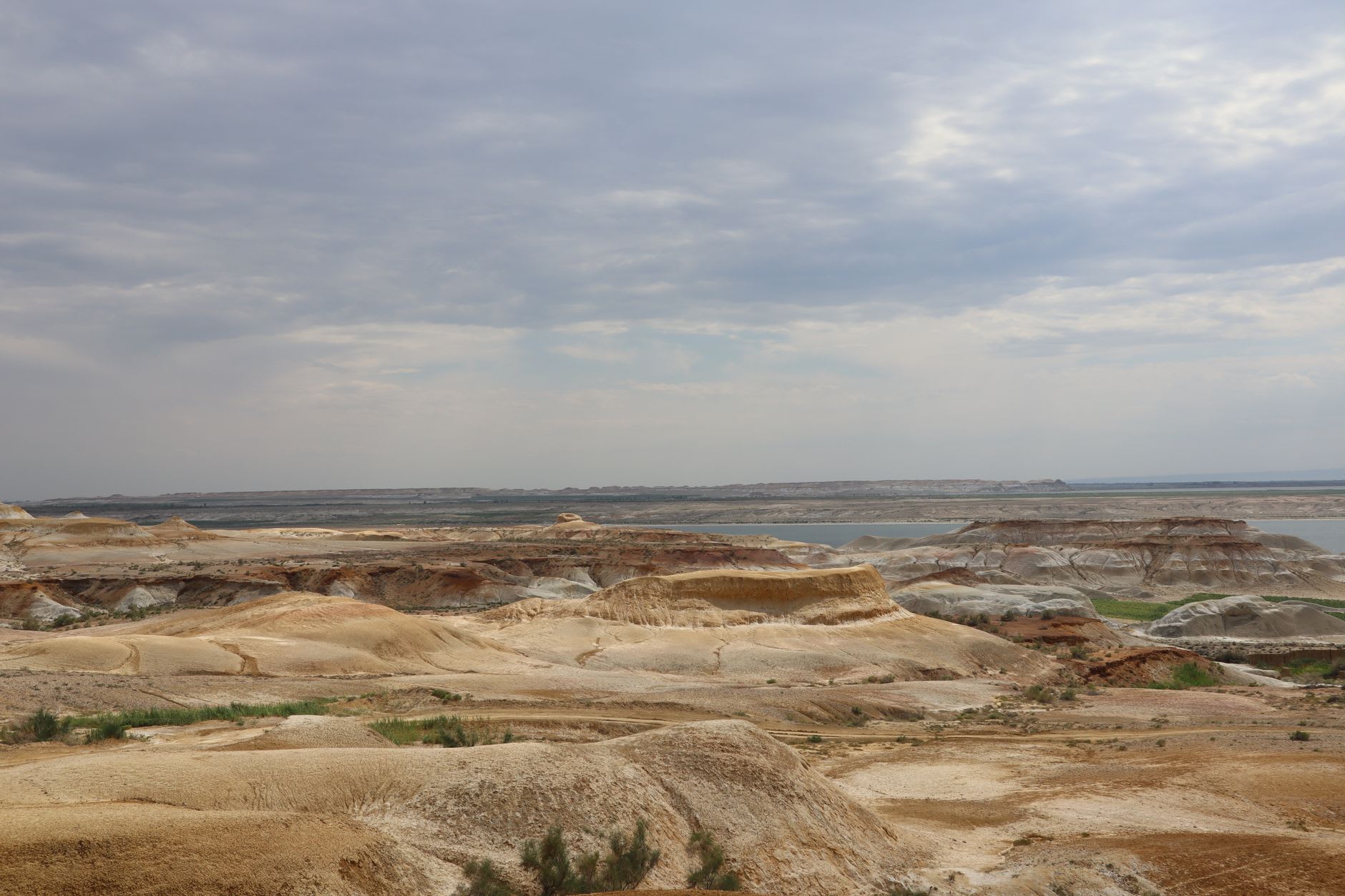
The plateau itself — the Ustyurt — is the thing that stays with you longest. At certain angles in the late afternoon, the chalk and the light combine into something that has no obvious frame of reference. The horizon is completely flat in every direction and the sky above it is enormous and the silence has a texture that I have stopped trying to adequately describe. Nurlan, who had driven here many times with many visitors, watched me staring and poured two cups of tea and handed me one without comment.
When to go: April to early June, or September to October. Summer in Mangystau is seriously hostile — 45°C on the plateau is not unusual and there is no shade. Water is scarce throughout; a driver who knows the region, their routes, and the water sources is not optional. Come with more water than you think you need and a plan for what happens if the Niva doesn’t start.