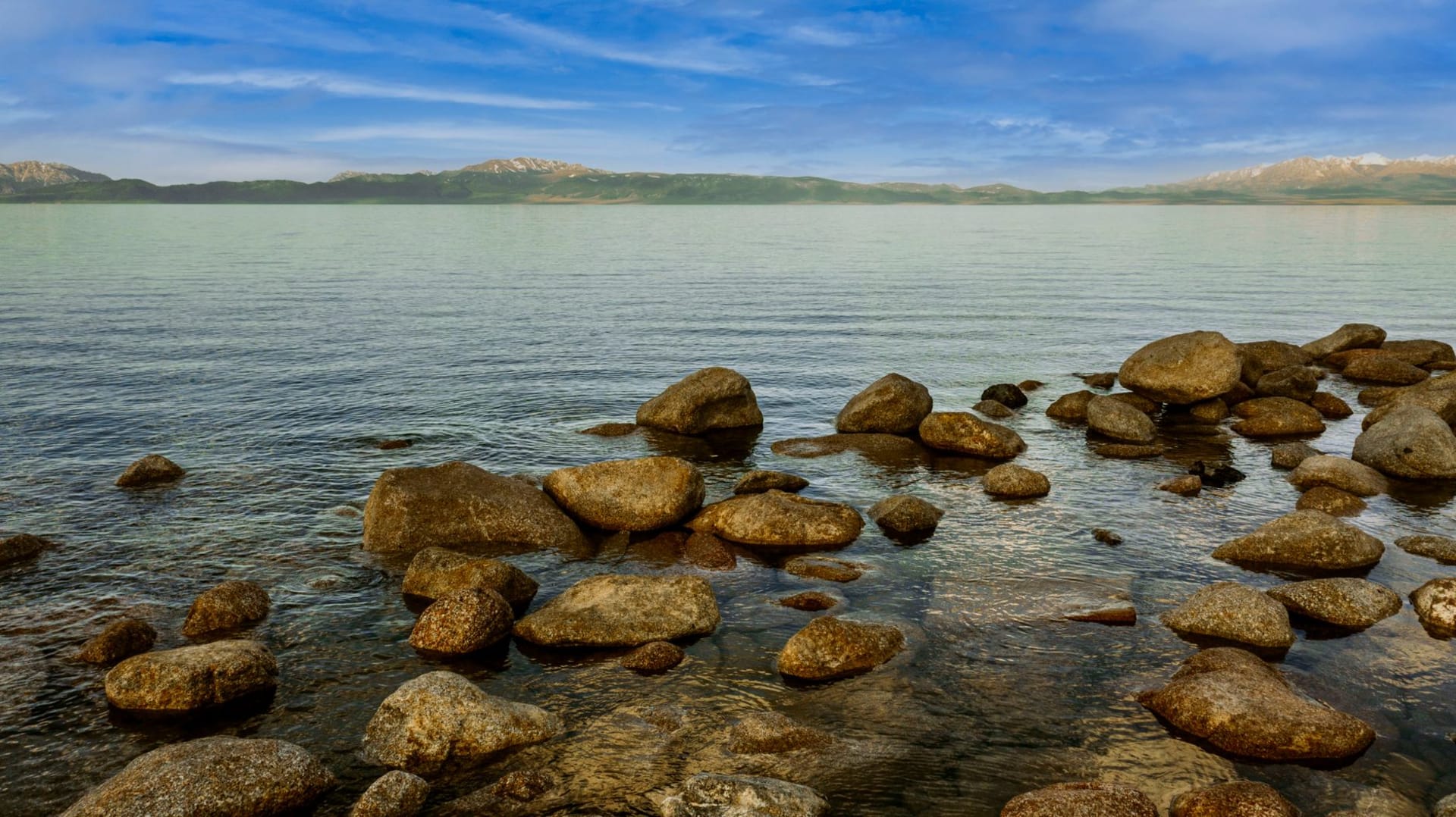
Lake Balkhash
"Fresh on the left, salt on the right, separated by a thin strait — even the lake can't make up its mind."
The bus from Almaty crosses three hundred kilometers of increasingly flat steppe before Lake Balkhash announces itself. It doesn’t appear gradually — the steppe is simply there and then, at a certain point on the road, you realize you are looking at an enormous body of water that extends to the horizon in both directions. After hours of pale grass and uniform sky, the effect is almost violent: a sea where there shouldn’t be a sea, blue and flat and slightly dazzling, its surface broken only by the occasional boat and the distant grey smudge of the copper smelter at the city of Balkhash on the southern shore.
The lake is one of the world’s geological anomalies. At 600 kilometers long and up to 70 kilometers wide, it is one of Central Asia’s largest lakes — but what makes it singular is a narrow strait called the Uzunaral that divides it roughly into two halves with different water chemistry. The eastern half is saltwater; the western half, fed by the Ili River, is fresh. The water on either side of the strait can differ visibly in color — clearer on the fresh side, slightly more opaque on the salt. I spent a morning on the shore trying to identify where one began and the other ended and failing, which seemed like the appropriate outcome.

The city of Balkhash itself — a Soviet industrial town built around the copper smelter, which has been operating since 1938 — is not conventionally beautiful, but it has the particular honesty of places that have never tried to be a tourist destination. I walked the main street on a Tuesday afternoon and found: a bread bakery with a queue of seven people, a market where a woman was selling lake fish she had clearly caught herself that morning, a hardware store with equipment in the windows that hadn’t moved in several years, and a small café where the tea was served in ceramic pots and the view from the window was the lake. I sat there for a long time. The lake outside was completely still. A fishing boat moved slowly from right to left and disappeared behind a headland.
The fish are worth pursuing. The western, freshwater end of Balkhash contains carp, pike-perch, and catfish. Local fishermen have been working these waters for centuries — the Kazakhs historically maintained fishing camps along the shore during the warmer months, part of a pastoral cycle that incorporated both steppe and water. The fish market near the harbor sells fresh catches in the morning and smoked fish that comes wrapped in newspaper that is already translucent with oil. I bought a piece of smoked pike-perch and ate it standing at the market with bread from the bakery, and it was one of those combinations of flavor and place that stays with you precisely because nothing about it was arranged.

The steppe around the lake carries flamingos in the marshy shallows of the southern shore during spring and autumn migration — tens of thousands of them, pink against the reed beds. The numbers vary by year and conditions but in good years the colonies are extraordinary. There are also pelicans, cormorants, and the particular desolate beauty of steppe wetland, which looks harsh from a distance and reveals its abundance only slowly.
When to go: May through June, or September. Summer is hot (38–42°C) and the lake becomes busy with Almaty residents escaping the city heat. Spring and autumn offer bearable temperatures, the best birdwatching, and a quieter version of the shore. The bus from Almaty takes four to five hours; a basic guesthouse in the city of Balkhash serves as a reasonable base.