
A capital conjured from empty steppe in twenty years, filled with buildings that look like architecture students were given no brief and limitless money.

The train from Almaty crosses roughly a thousand kilometers of steppe before the city appears. For the last hour of the journey — more, maybe — there is nothing. Pale grass, occasional power lines, a horizon so flat and continuous it starts to feel like a concept rather than a place. And then, suddenly and completely without warning, towers erupt from the ground. Glass and steel, gleaming, curvaceous, shaped like things from a science fiction film set: a golden egg balanced on a white stem, a translucent tent large enough to house a beach resort, a pyramid, an opera house that looks like it was designed to be seen from orbit. This is Astana. Nobody who arrives by train has a neutral reaction to it.
The city was the project of Nursultan Nazarbayev, Kazakhstan’s founding president, who moved the capital here from Almaty in 1997 for reasons that were partly practical and partly a statement about the country he intended to build. He brought Norman Foster to design the Palace of Peace and Reconciliation — a seventy-seven-meter glass pyramid that sits in the middle of the city like an object from a different civilization. He brought other architects with different visions and apparently very few constraints. The result is a city that makes no aesthetic sense and is, for precisely that reason, completely impossible to look away from.
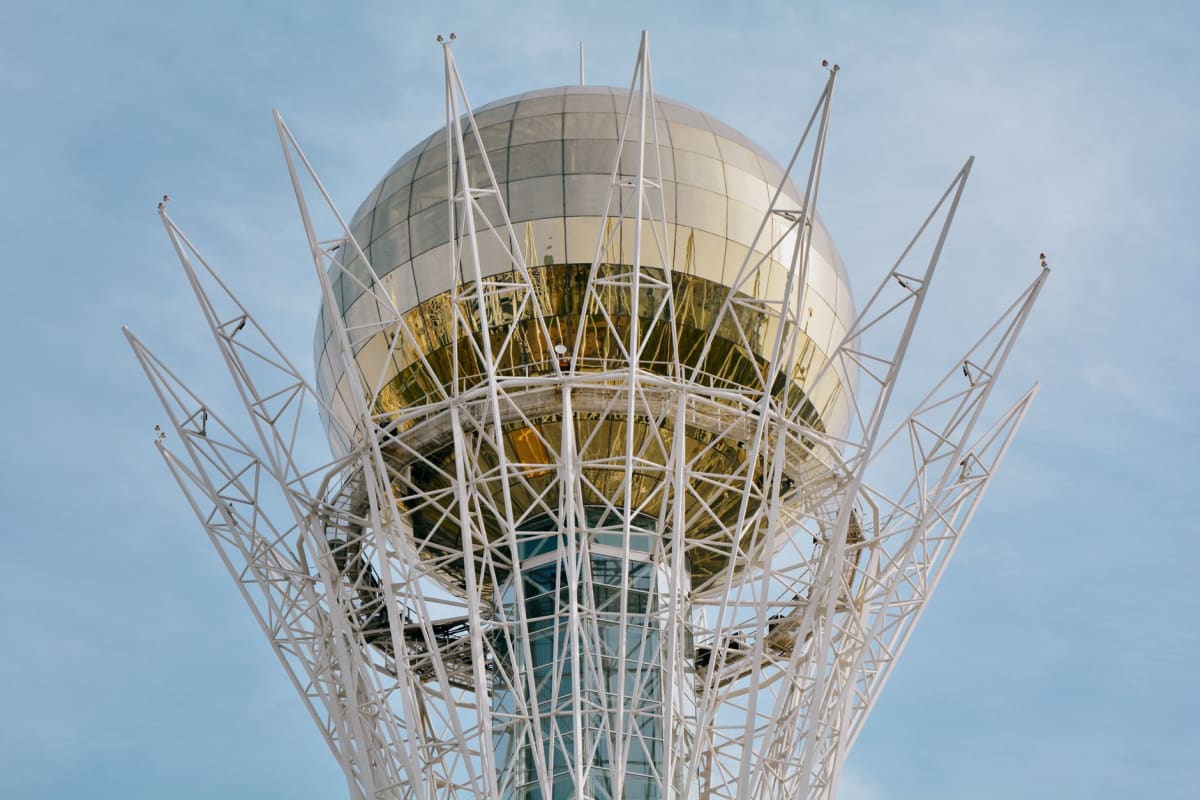
Bayterek Tower is the emblem — a hundred-meter column topped with a golden sphere that contains an observation deck and, at the very top, a gold handprint molded from Nazarbayev’s own palm pressed into a pedestal. The invitation to press your own hand into it and make a wish is either charming or unsettling depending on your relationship with personality cults. I pressed my hand in. The view from the sphere is the city laid out in its impossible entirety, the Khan Shatyr shopping mall below like a deflated football, the ministries and towers spreading out in all directions, and beyond them the steppe continuing forever, indifferent to the whole enterprise.
What the photographs don’t capture is the wind. Astana sits at roughly 350 meters elevation on the open steppe, with no topographic protection in any direction, and the wind here is a genuine civic force. In winter it drives temperatures to -30°C and below; in summer it scours the wide avenues with a particular kind of dry heat. On the day I walked the Left Bank — the planned district of monumental architecture — the wind was strong enough that I had to lean into it to stay upright, and the few trees planted along the boulevards were struggling visibly. The city is being built in spite of its geography, which gives it a certain heroic futility I found difficult not to admire.

The old town on the Right Bank is a different story: Soviet-era apartment blocks, markets, a city that existed before the grand project began and continues its ordinary life alongside it. I ate pelmeni in a cafeteria near the train station where the menu was handwritten and the soup was excellent and the television showed the news with the sound off. No one was discussing the architecture. They were discussing what people in cafeterias everywhere discuss: work, family, prices. The gap between the city Kazakhstan is building and the city Kazakhs actually live in is real and visible and interesting.
When to go: Late May through early June, or September. Summer can be hot (35°C+) and the wind makes it feel hotter. Winter is famously brutal and genuinely not for casual visitors — temperatures of -25°C to -35°C are normal, and the city shuts inward. The architecture, however, looks extraordinary in heavy snow.
Keep exploring
More from Kazakhstan
 kazakhstan
Baikonur Cosmodrome
A pilgrimage to the windswept steppe launch pad where Sputnik and Gagarin first left Earth, still firing rockets skyward today.
Explore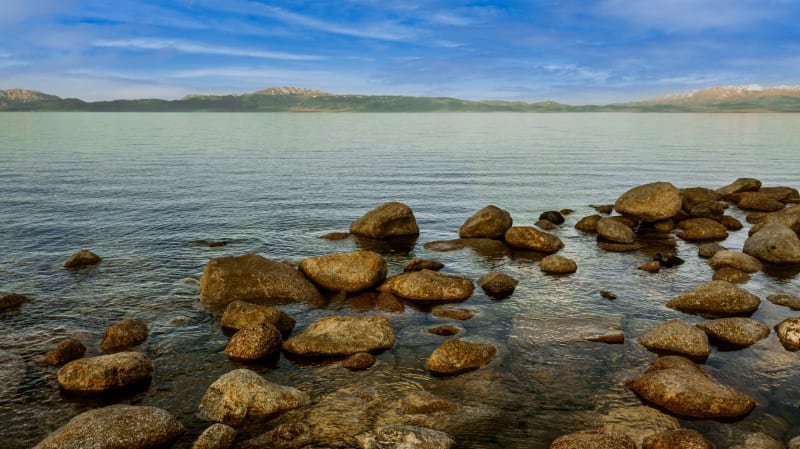 kazakhstan
Lake Balkhash
Half freshwater, half saltwater — a lake so vast it generates its own weather, split by a narrow strait and stranded improbably in the middle of the steppe.
Explore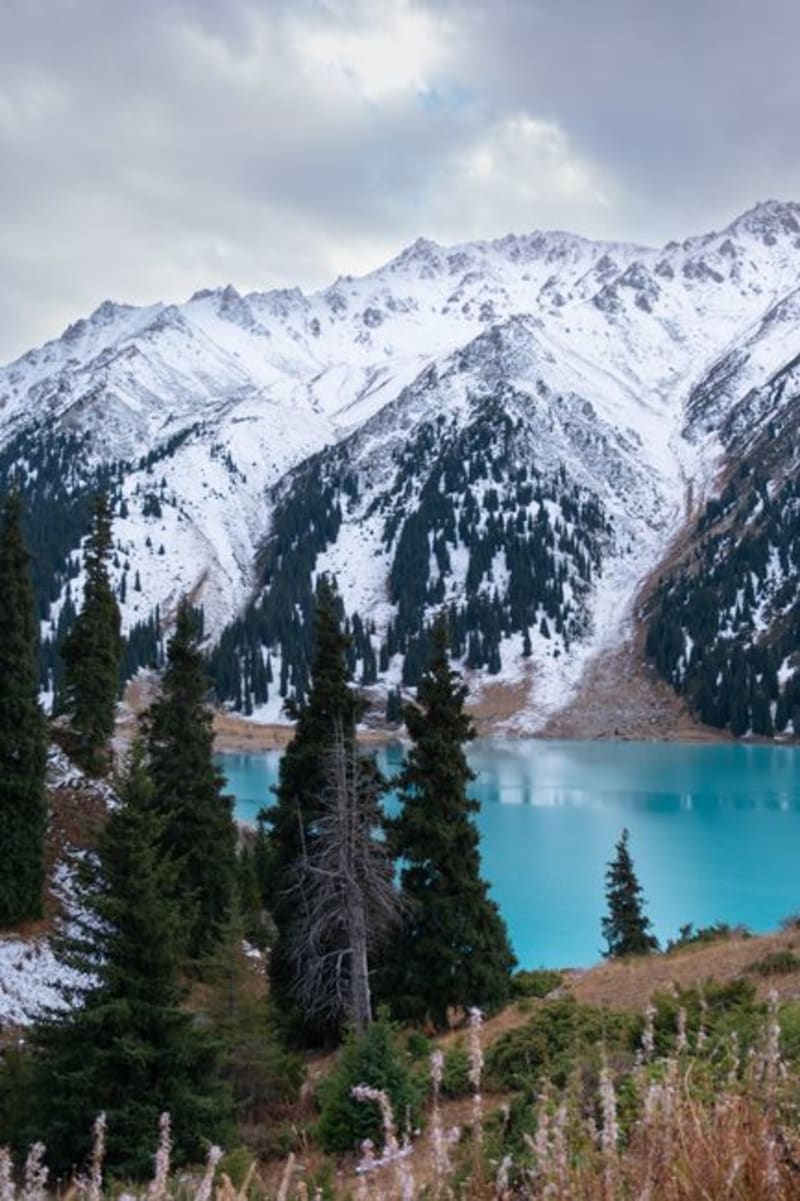 kazakhstan
Big Almaty Lake
An alpine mirror of glacial turquoise at 2,511 meters, ringed by peaks and watched over by a Soviet-era observatory.
Explore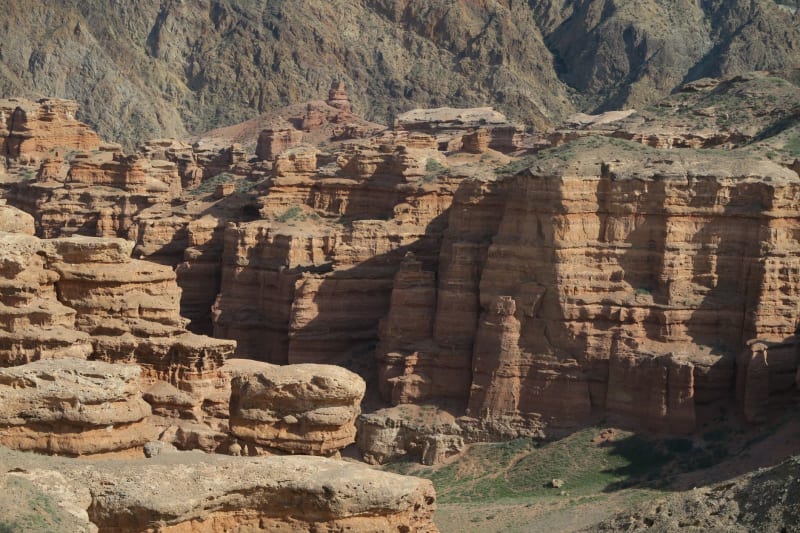 kazakhstan
Charyn Canyon
A Grand Canyon-scale gash in the earth two hours from Almaty that Kazakhstan barely bothers to advertise.
Explore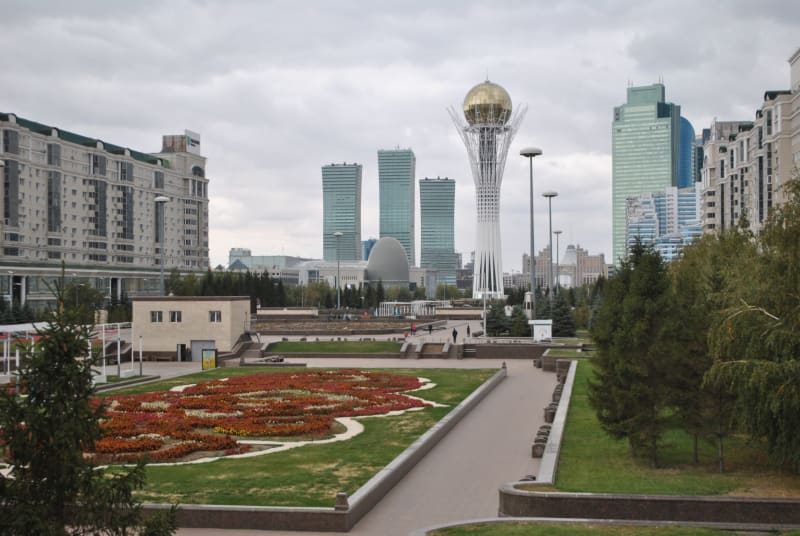 kazakhstan
Karaganda
A Soviet coal city built on Gulag labor that now carries its dark past with a directness that most countries managing similar histories never manage.
Explore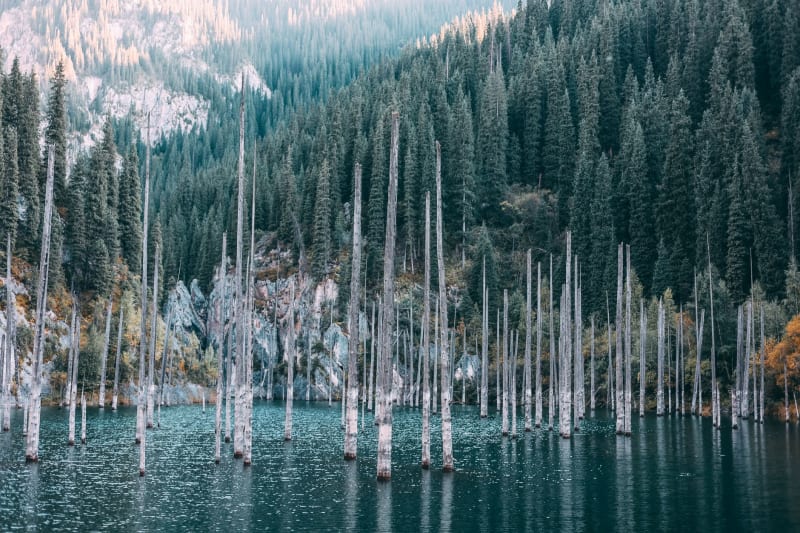 kazakhstan
Kolsai Lakes
Three glacial lakes stacked in the Tian Shan foothills, where the pine forests smell of somewhere much further north and the silence is absolute.
Explore