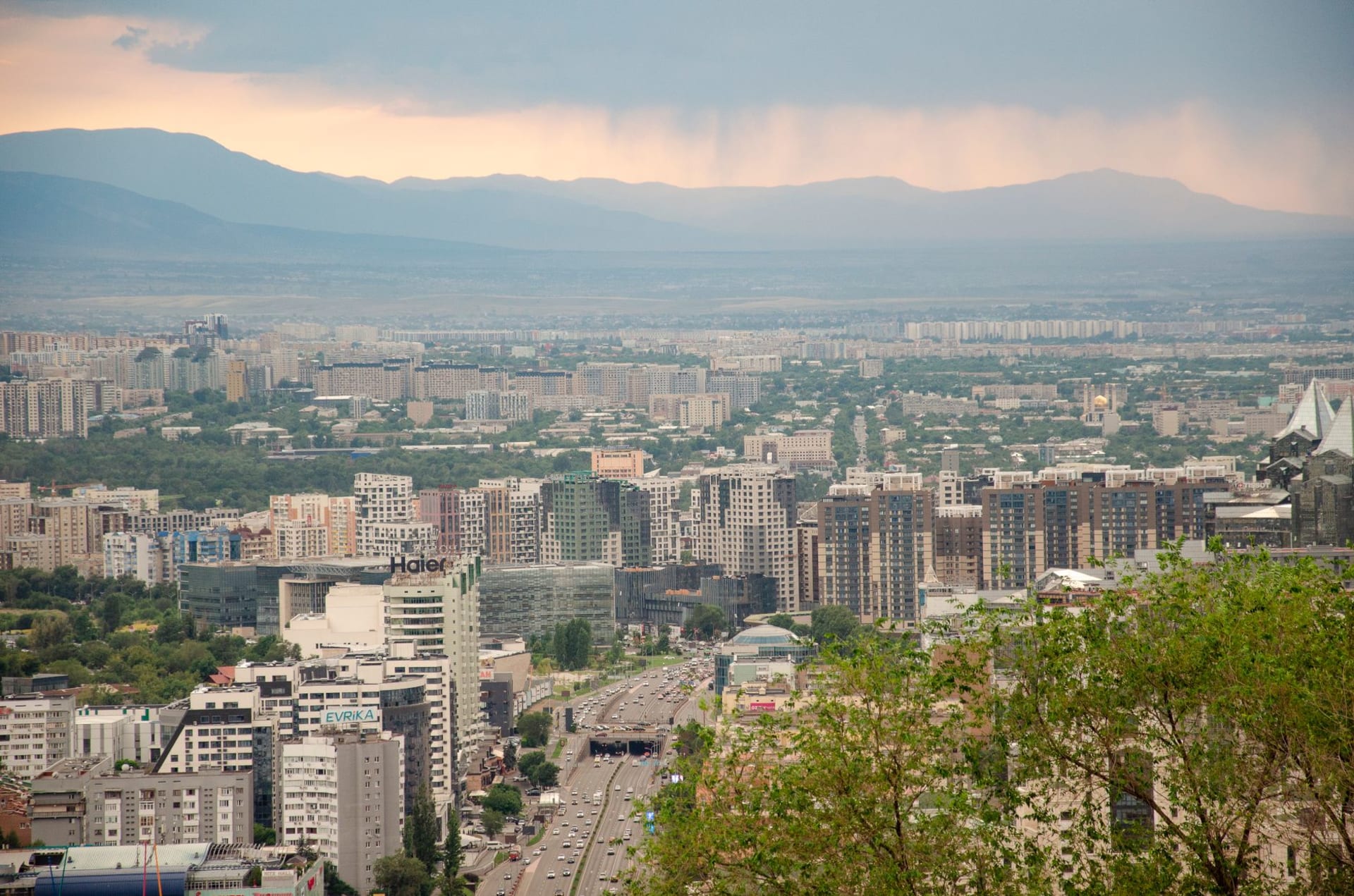
Almaty
"Every city has a backdrop. Almaty has mountains so close they feel like they're listening."
I arrived in Almaty at 6am with coal smoke still in my jacket from the overnight bus from Bishkek. The old terminal was a low concrete building in the grey pre-dawn, and the taxi drivers outside it were bundled into heavy coats, drinking tea from thermoses, entirely uninterested in my arrival. This was Kazakhstan’s largest city, home to nearly two million people. I had expected something louder, more insistent. Instead I got a city that seemed not to notice me at all — which, after weeks of being aggressively welcomed by tourist infrastructure across Central Asia, felt like the most honest greeting I could have received.
Almaty earns its beauty slowly. The Soviet-era boulevards are wide and shaded by the kind of mature elms and poplars that soften everything, and when the Zailiysky Alatau mountains appear at the end of a street — white-capped and vertical and enormous — the effect is slightly surreal, as if someone had placed a screensaver behind an entirely ordinary city. The name Almaty derives from “alma,” the Kazakh word for apple, and this whole region is considered the origin point of the cultivated apple. Wild apple forests still grow in the hills above the city. There is something grounding about walking down an urban street and suddenly understanding that the fruit in your pocket evolved here, among these specific mountains, in this particular altitude of light.

The Zelyony Bazar — the Green Market — is the city’s emotional center, the place where everything about Almaty compresses into smell and noise and color. In the dairy hall alone: five kinds of kurt (sour dried milk balls that taste like concentrated steppe), fresh qatiq yogurt ladled into clay pots, orange wedges of irimshik cheese, horse sausage called kazy hanging in dark ropes from hooks, and an entire section devoted to types of cream I couldn’t name but ate without hesitation. The produce hall smells of melon and fresh dill. The spice stalls run every gradation of red from mild paprika to something that made my eyes water. I spent three mornings doing nothing but eating small unidentified things, and those three mornings clarified Kazakhstan for me more completely than any amount of reading had managed.

In the evenings the city surprises you. Almaty has a genuine cultural life — cocktail bars in converted industrial spaces, restaurants where the menu moves between Korean and Kazakh without explanation, a wine scene that references the vineyards of the nearby Ili Valley. The Shymbulak ski resort is forty minutes from the city center, and on clear mornings you can see the cable cars moving against the white. The younger Almatians I met spoke Russian and Kazakh interchangeably, had strong opinions about Georgian natural wine, and knew the best place to get pelmeni at 2am. This is a city of almost two million people that has managed to stay, against all probability, genuinely itself.
When to go: April through June brings the long sweet spring, when the mountains are still snow-capped and the city is warm and the wild apple trees on the slopes above are in bloom. September brings crisp air and the apple harvest, and the quality of the light becomes something worth noticing. Avoid July and August unless you enjoy serious heat — the steppe bakes.