Gulmarg
"I rode the gondola above the clouds and forgot entirely that I was still in India."
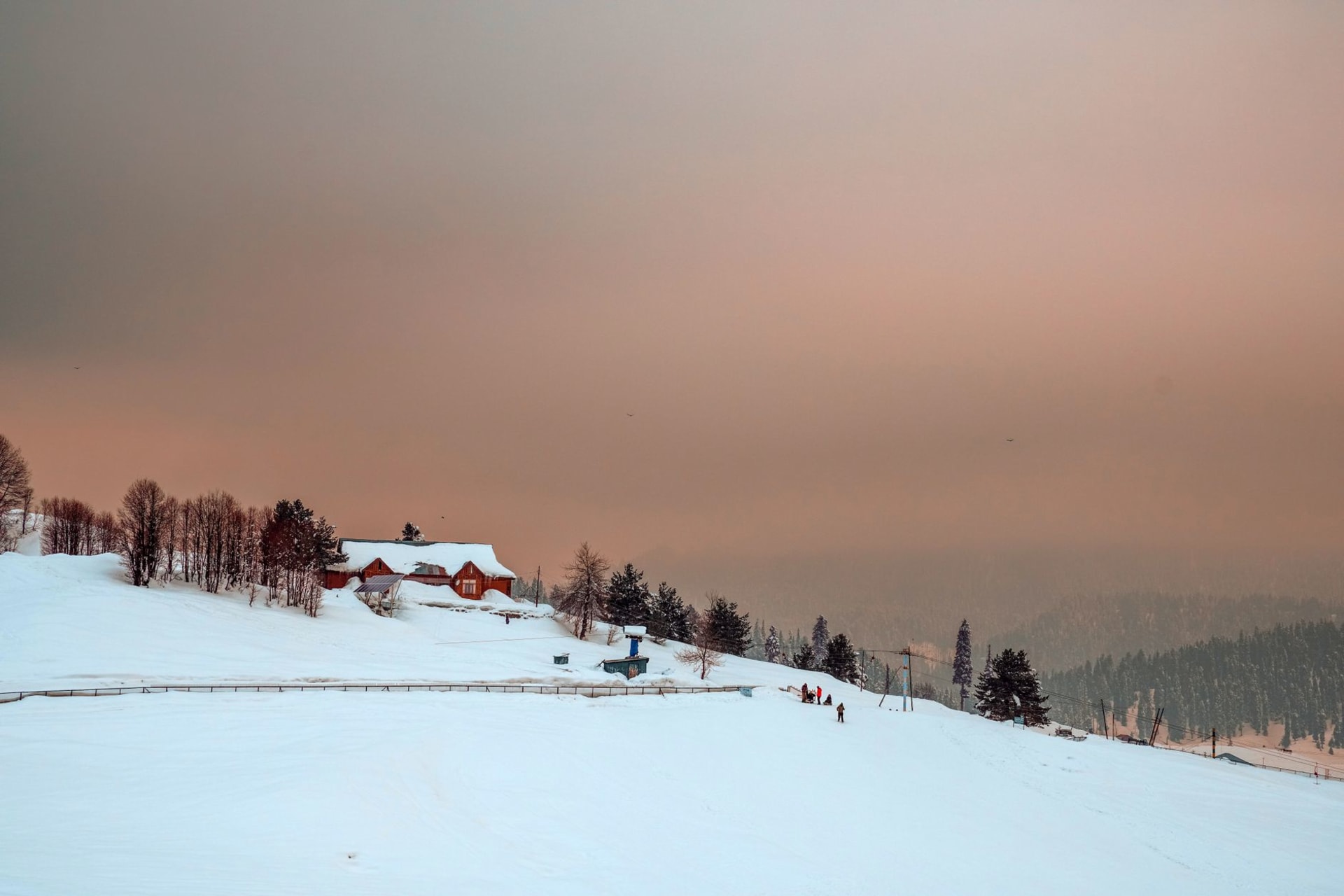
The road from Srinagar climbs through pine forest, switchbacking up the flanks of the Pir Panjal range, and then at some unmarked bend the trees thin and the meadow of Gulmarg simply opens up in front of you — a great bowl of land sitting at twenty-seven hundred metres, ringed by peaks that in winter carry so much snow they look architectural. I arrived in February on a whim, half-convinced I was making a mistake, and stepped out of the taxi into the kind of cold that informs your body very quickly that it is not on holiday anymore. Then I looked up, and the Apharwat ridge was right there above the village, enormous and completely white, and I thought: of course. Of course this exists.

Gulmarg’s gondola — the Gulmarg Gondola, two phases, reaching four thousand metres at the summit — is one of the highest cable cars in the world, and riding it in winter is one of those experiences that keeps surprising you. The first phase takes you through birch forest heavy with snow. The second climbs above the treeline entirely and deposits you on a ridge where the wind comes off the high Himalayas and the view stretches north into the white distance of the range. I skied back down through untracked powder — not a phrase I expected to write about India — and the snow was as good as anything I’d been on in the Alps. Gulmarg gets seven metres of snowfall in a serious winter. The skiing is real, the mountain is enormous, and the lift lines are short enough that you can feel slightly guilty about it.
In summer, the transformation is total. The same bowl that holds snow to the eaves of the wooden hotels fills up instead with grass so intensely green it almost reads as artificial, and the meadow blooms with wildflowers — buttercups and wild strawberries and something purple I kept failing to photograph properly. The golf course, built by the British in 1911 and still in operation, sits at the edge of the meadow and is probably the most absurdly scenic nine holes in the world. I watched an army officer playing a round one July morning with the entire arc of the Himalaya spread out behind him and thought that this was what the phrase “not a bad office” was actually invented for.

The village at the base is modest — a line of wooden hotels, a few ski-rental shops, tea stalls selling Kashmiri chai and plates of hot naan with butter. The food is not the reason to come. What is the reason: the air at altitude, which has a specific quality I’ve only encountered in a few places — thin, cold, carrying the smell of pine and snowmelt and something that I can only describe as the scent of the world being very large and very indifferent to your presence. Walking the bridle paths that loop around the meadow’s edge in the evening, with the peaks going pink above you and the village lights coming on below, is one of those things that doesn’t require documentation. I kept my phone in my pocket.
When to go: December through March for skiing — January and February are the deepest snow months and the most reliable powder. May through August for summer wildflowers, trekking, and the strange pleasure of the colonial golf course. September and October are transitional but clear; the first snow sometimes arrives on the upper ridge by late October.