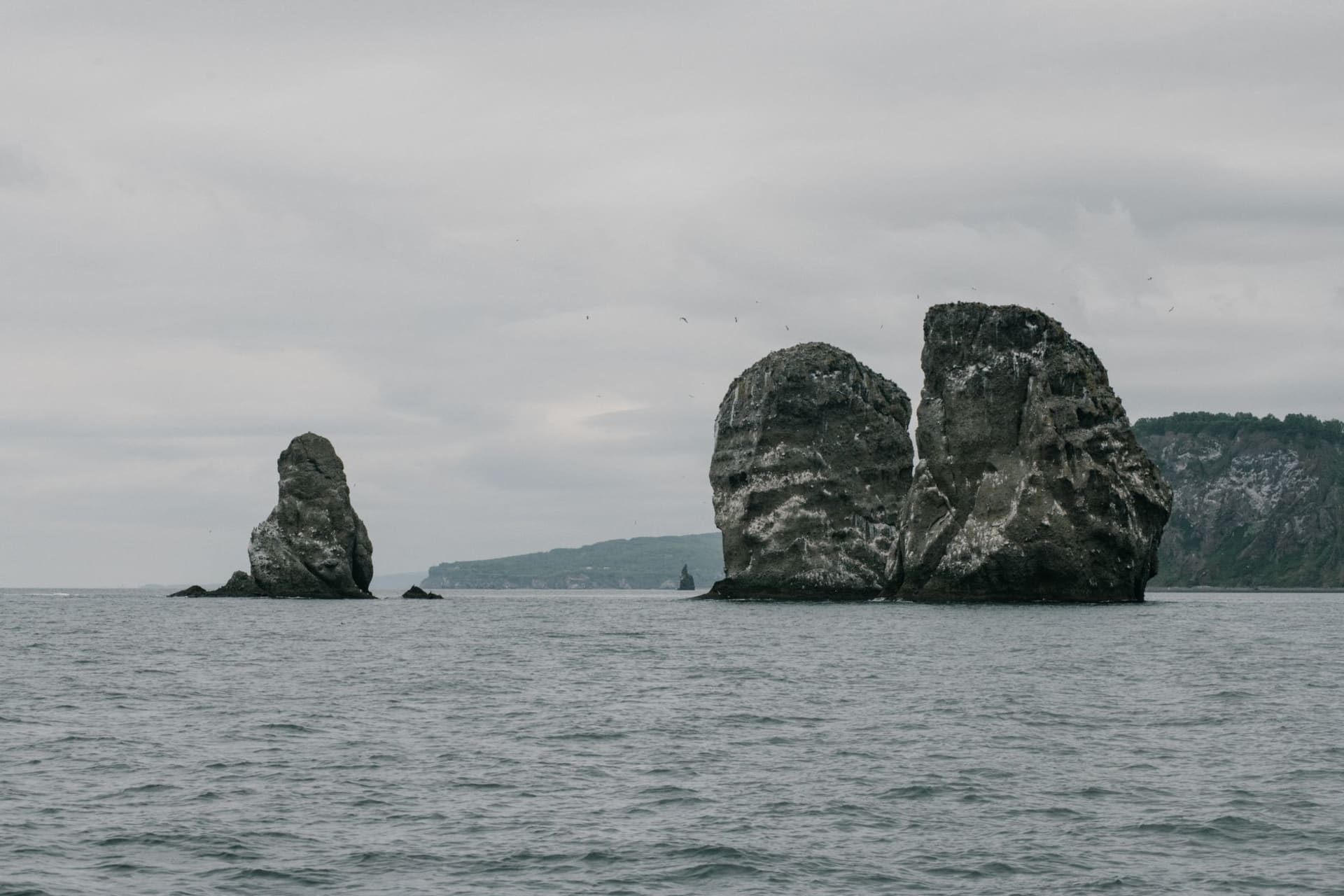
Avacha Bay
"The harbour is framed by volcanoes the way other cities frame their ports with cathedrals."
The boat left the PKK harbour at six in the morning and cleared the breakwater into a chop that was brisk without being serious — a Pacific headwind that the skipper dismissed with a wave. As we moved out into the bay proper, the scale of it imposed itself: Avacha Bay is enormous, one of the largest and deepest natural harbours on Earth, roughly twelve kilometers across at its widest, with a narrow entrance that makes it almost perfectly protected from Pacific storms. What the Soviet Pacific Fleet understood immediately was that this harbour was strategic perfection. What visitors understand when they first see it from the water is something else: it is also simply beautiful in a way that combines geology, light, and the particular quality of Pacific maritime air into something that resists description without superlatives.
Avachinskaya Sopka and Koryaksky Volcano rise directly behind the city, their cones visible from nearly everywhere in the harbour. On clear mornings — and there are more of them in summer than the peninsula’s reputation suggests — the volcanoes catch the first light while the city is still in shadow, and they hold that gold for twenty minutes before the sun angles around to illuminate everything else. I watched this from the bow of the boat and said nothing useful to anyone. The skipper handed me a cup of instant coffee in a paper cup and seemed to understand this was the appropriate moment for silence.

The Three Brothers are the bay’s most famous geological feature: three basalt columns rising from the water near the harbour entrance, the remnants of a volcanic dike eroded by ten thousand years of Pacific swell into these improbable shapes. They stand perhaps thirty meters tall, each slightly different in profile, and sea birds nest in their crevices — tufted puffins, kittiwakes, cormorants whose calls carry across the water. We circled them at close range and I understood how they became a symbol of the city: they have the quality of standing guard, of something that has been here longer than anything built on the shore and will be here after all of it is gone.
The bay itself rewards exploring slowly. Sea kayaking is possible from spring through early autumn, and several operators in PKK offer guided paddles that bring you close to the sea stacks and along the volcanic coastline south of the city. Orca and sperm whales pass through the bay regularly in summer; Steller sea lions haul out on rocky points; sea otters wrap themselves in kelp in the inner bay and watch the boats with an unnerving degree of intelligence. I was told by the skipper that he once counted forty sea otters in a single kelp bed near the Three Brothers, and I believed him because I could see three of them without the binoculars.

The fishing fleet gives the bay its working character. Boats come and go at all hours, their holds full of king crab, halibut, and salmon, and the smell of the harbour in the morning — diesel, brine, wet rope, the iron-sweet smell of fresh fish — is one of those port smells that is entirely its own and impossible to mistake for anywhere else. Some of the best meals in PKK come from buying directly at the dock, which requires knowing someone or asking around with confidence. My guesthouse host made this introduction happen in exchange for bringing back whatever looked good, which is how I ended up in a guesthouse kitchen with three kilograms of king crab and no particular plan.
When to go: June through September for boat trips, sea kayaking, and whale watching; the peak wildlife window for orcas and sea lions is July and August. The bay is navigable year-round but winter boat access is limited and conditions are rough. If weather grounds your helicopter plans, a half-day on the bay is the finest possible use of the time.