Asia
Kamchatka
"The earth here is still deciding what it wants to be."
I landed in Petropavlovsk-Kamchatsky on a morning when the city was socked in cloud and the pilot descended by feel as much as instrument. Through the porthole: nothing, then suddenly a runway, then mountains I could not see the tops of. The taxi driver spoke no English and I spoke no Russian but he pointed east, toward where I knew Klyuchevskaya Sopka stood — at over four thousand meters, the highest active volcano in Eurasia — and made a gesture that could only mean that thing erupted last week. That felt like the right introduction to Kamchatka.
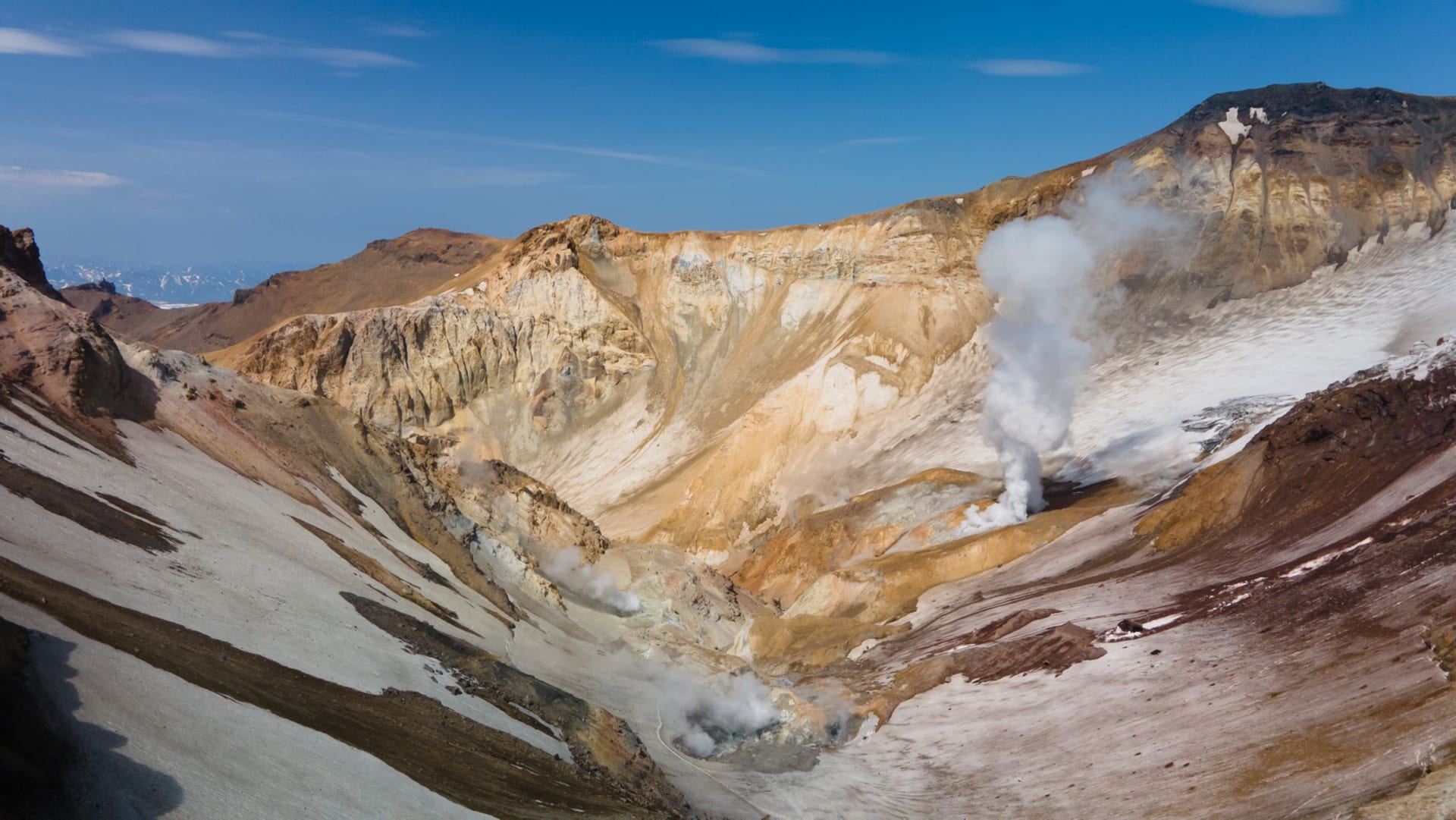
The peninsula is 1,250 kilometers long and connected to the Russian mainland by a thin strip of land that might as well not exist — everything comes in by plane or ship, and everything here operates on Kamchatka time, which is to say, on nature’s schedule. The Valley of Geysers, accessible only by helicopter, is one of the densest concentrations of hydrothermal activity on the planet: dozens of geysers erupting in sequence, fumaroles hissing, the ground itself appearing to breathe. You walk on boardwalks above it because the earth around you is too unstable to trust. The Kronotsky Nature Reserve, which contains the valley, is also home to the highest density of brown bears anywhere on Earth. I watched three of them at once from a hillside, fishing the Kronotskaya River in early September, completely indifferent to our presence. There is no fence, no ranger station nearby. Just bears being bears, doing what bears have been doing here for longer than written history.
Petropavlovsk itself is an afterthought of a city — Soviet-era concrete, excellent smoked salmon at the central market, and a harbor where fishing boats come and go at all hours. Eat the red caviar with black bread and butter the way locals do, not as a luxury but as a breakfast staple. Hire a guide to reach the thermal springs above Paratunka and sit in water heated by the volcano while snow falls around you. Take a small plane to Esso, a village in the interior where the Itelmen and Koryak people have lived for thousands of years and where the taiga gives way to high steppe and the silence is the loudest thing for miles.
When to go: July to early September for the Valley of Geysers (helicopters run this window only), bear watching on the rivers, and trekking on the volcanic slopes when snow has receded enough to make it possible. Late August is when the salmon run peaks — which means the bears are most active and most visible. Avoid June: mud season is serious and many routes are impassable.
What most guides get wrong: They treat Kamchatka as a bucket-list extreme adventure and miss that it is, more than anything, a place of radical patience. You cannot rush it. Helicopter flights cancel for weather three days running. Bears do not perform on schedule. Volcanoes erupt when they feel like it. The people who come here expecting a controlled wilderness experience leave frustrated. The people who come with no fixed agenda, who can sit with uncertainty and let the peninsula reveal itself at its own pace, leave changed in some way they can’t quite articulate.