
Zaō Onsen
"They really do look like monsters, Lia said, hunched and marching, and the wind agreed."
A Yamagata mountain resort where winter freezes whole forests into ghostly white 'snow monsters', sulfur baths steam milky-blue against the cold, and a jade crater lake surfaces in summer. One of the strangest and most beautiful nights we spent in Japan.
I had seen photographs of Zaō’s snow monsters and assumed, as one does, that they were exaggerated — a trick of a wide lens and good timing. They are not exaggerated. We took the ropeway up into the storm on a February evening, the cabin swinging, the world outside gone white, and when the doors opened at the top we stepped out among hundreds of them: whole conifers so thickly caked in wind-driven ice and snow that they had lost all shape of trees and become lumbering white figures, hunched and leaning downwind, an entire frozen army halted mid-march up the mountain. The Japanese call them juhyō, ice trees. Everyone else calls them what they plainly are. Lia grabbed my sleeve and we just stood there in the wind, laughing, half-frightened, entirely happy.
The snow monsters
The juhyō form only here and on a handful of northern peaks, and only when a very particular set of things align: a specific kind of fir, the moisture-laden winds off the Sea of Japan, and cold savage enough to freeze that moisture onto the branches faster than it can fall. Through January and February the trees swell into their monstrous forms, and at night the ski resort floodlights whole slopes of them, so that they glow blue-white against the black sky while snow streams sideways through the beams. We rode the ropeway up after dark for the illumination, and it was one of the eeriest, most beautiful things I have seen anywhere — a silent floodlit host stretching up into the murk. We don’t ski, so we simply walked a marked path among them, boots squeaking, breath freezing on our scarves.
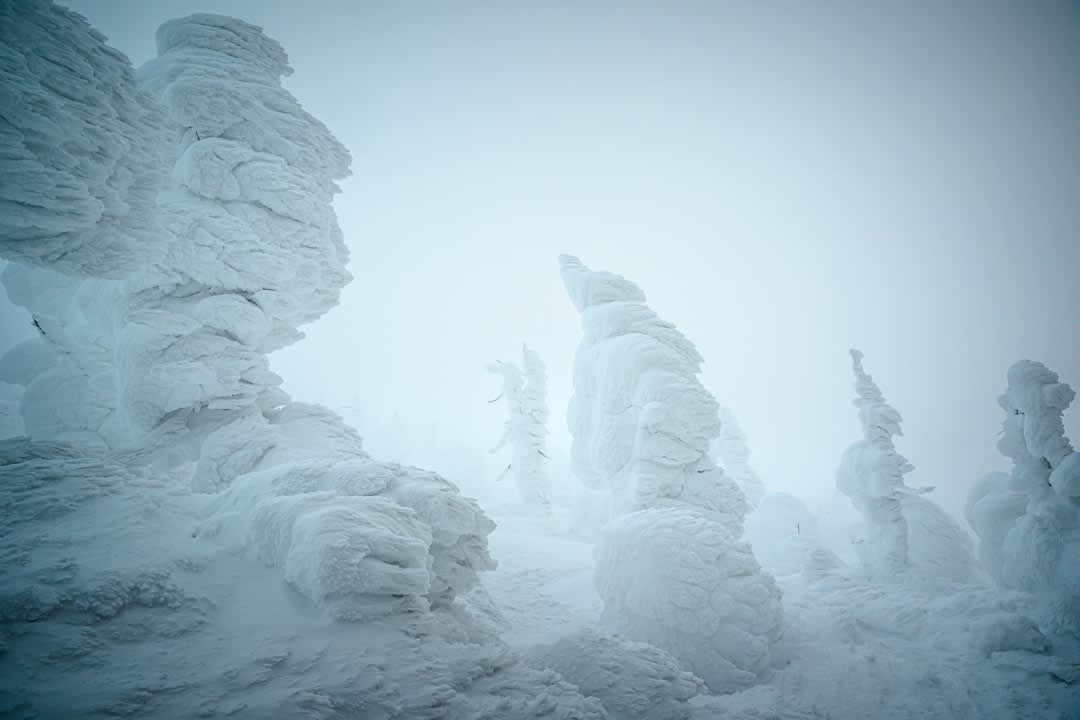
Back at the base the skiers came down through them in the dark, headlamps bobbing, threading between the monsters like something out of a dream.
The sulfur baths
Zaō has been an onsen village for far longer than a ski resort — the hot springs were supposedly found some nineteen centuries ago — and its water is fiercely, gloriously sulfurous, pale milky-blue and acidic and smelling of struck matches, the kind of bath that leaves your skin soft and your nose full of the mountain. After the ropeway we thawed out in the big open-air rotenburo built into the hillside, a series of wooden pools stepping down through the trees with the snow banked high all around and steam pouring off the surface into the freezing air. Sitting neck-deep in scalding milky water while snow settles on your hair and hisses out on the stones is a sensation I can only call complete. Lia lasted longer than me. She usually does.
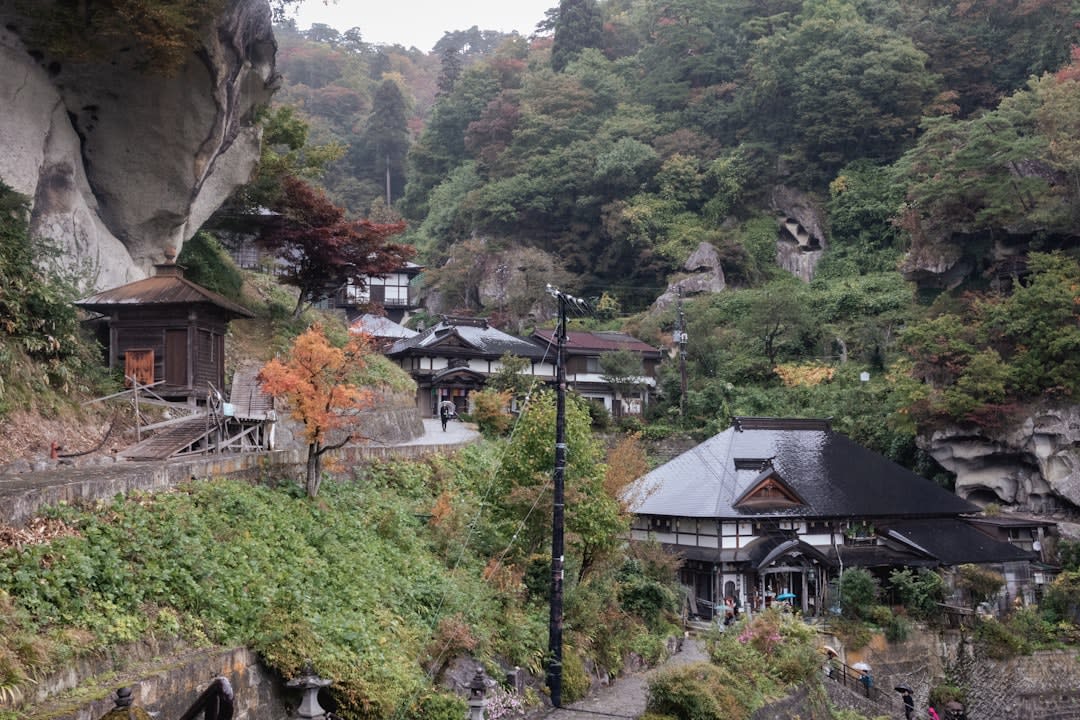
We ate that night in the village, a pot of Yamagata’s imoni stew simmering between us, and slept hard under thick futons with the wind working at the eaves.
The crater lake in summer
We came back to Zaō once more, years later, in the green of early summer, to see the mountain’s other face — and to find the Okama. High on the ridge sits a crater lake, a near-perfect circle of water held in the old volcanic bowl, coloured an unreal jade-green that shifts through the day with the light and the angle of the sun. They call it the five-colour pond for the way it changes. We drove up the high road and walked the last stretch to the rim, and there it was, luminous and still in its cauldron of grey scree, the summer cloud sliding across it. It was almost impossible to reconcile with the frozen white world we’d stood in that winter — the same mountain, utterly transformed.
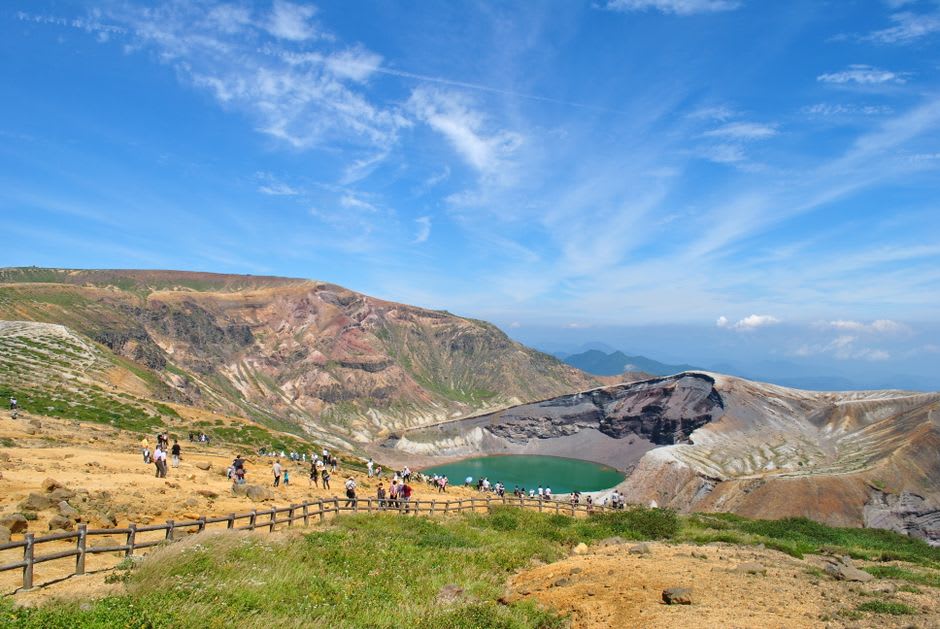
We picnicked on the ridge in shirtsleeves, and Lia pointed downhill and said that somewhere down there were our monsters, waiting for winter.
Getting There
Zaō Onsen sits above Yamagata City. Take the Yamagata Shinkansen from Tokyo to Yamagata — around two and three-quarter hours — then a bus up to the village in about forty minutes. For the snow monsters, come in the depths of winter, late January into February, and ride the Zaō Ropeway up at night for the illumination; check the forecast, as heavy storms sometimes close it. The sulfur baths run year-round. For the Okama crater lake, come between late spring and autumn, when the high road and the summit lift are open — the lake is often lost in cloud, so give yourself a flexible day and a little luck.
Keep exploring
More of Tōhoku