
A sulfurous, blasted volcanic caldera at the top of Aomori that Japan has held sacred for over a thousand years — a rehearsal of the Buddhist afterlife you can walk through. Grey ash, a milky lake, stacked stones and spinning pinwheels for lost children. Few places have unsettled and moved me as much.
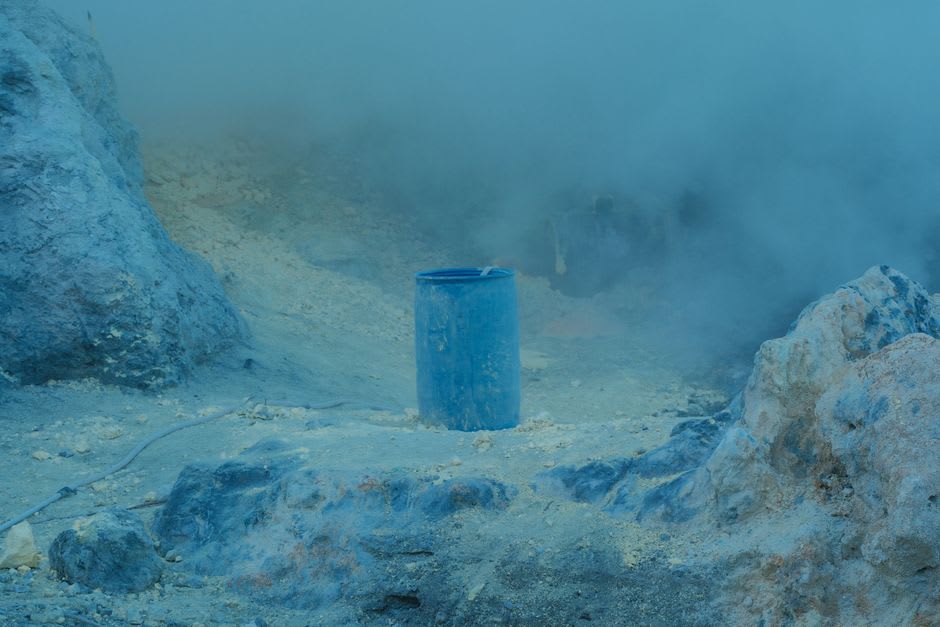
Osorezan translates, more or less, as Mount Fear, and I went in ready to find that name overwrought. I did not. This is one of the three most sacred sites in Japan, a caldera near the wild tip of the Shimokita Peninsula in Aomori where, for over a thousand years, people have come to feel close to their dead. You smell the sulfur from the road in. When the trees give out and the land turns to pale grey ash streaked yellow, with steam hissing from vents and a strange milky lake beyond, you understand why the old pilgrims believed they’d arrived at the threshold of the other world. Lia went very quiet, and stayed that way a long time.
Walking the afterlife
At the center stands Bodaiji temple, and around it the grounds are laid out — deliberately — as the Buddhist landscape of death. You cross a small red bridge said to represent the Sanzu River, the boundary the dead must cross, and then walk out across the sulfur fields on marked paths. Everywhere there are small stone jizo statues, guardians of dead children, and everywhere people have stacked little towers of stones — an act of merit for lost sons and daughters, the belief being that demons scatter them each night and the parents’ love rebuilds them. Bright pinwheels spin among the rocks, left as offerings, their cheerful colors almost unbearable against the grey waste. We walked slowly, saying nothing. It is not a comfortable place, and it isn’t meant to be.
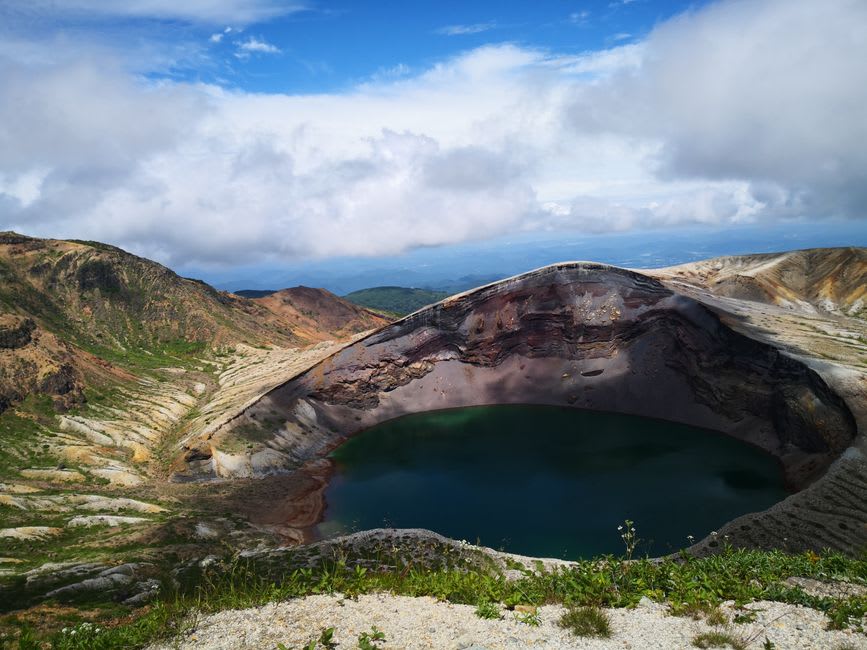
Lake Usori and the pale shore
The paths lead down at last to Lake Usori, whose water is so acidic almost nothing lives in it, milky pale turquoise and utterly still. Along one edge runs a beach of fine grey sand the pilgrims call the shore of paradise — Gokuraku-hama — and the contrast is deliberate and total: after the hellish sulfur fields, this sudden, serene, almost beautiful stillness. We stood on the pale sand while wisps of steam drifted over the water and the far mountains held their reflection. “Neither of us spoke for a long while,” Lia said afterward, and we didn’t need to. It is the quietest place I have ever stood. A single crow crossed the lake and its call carried the whole width of the water.
The itako and the living grief
Osorezan is famous, too, for the itako — blind female mediums who, during the summer festival, are said to call up the voices of the dead for those who come to speak with them one last time. We weren’t there for the festival, and I’m glad in a way; I’m not sure I could have watched. But the temple has simple lodgings and a hot spring on the grounds fed by the volcanic water, and we soaked there in a small wooden hut, the sulfur strong, the light going gold outside. What stays with me isn’t the strangeness of the place but its tenderness — a whole landscape given over to the impossible work of grief, run for the benefit of the living who cannot let go. I’ve thought about it often since. Lia has too.
Getting There
Osorezan sits on the remote Shimokita Peninsula at Aomori’s northern tip — reaching it is part of the pilgrimage. Take the Tohoku Shinkansen to Hachinohe or Aomori, then trains and the Shimokita Railway to Mutsu, the nearest town. From Mutsu, buses run up to Osorezan several times a day during the open season (roughly May to October); the site closes entirely in winter. It’s a long haul from anywhere, and that is exactly right — this is not a place to drop into between others. Come deliberately, stay the night if you can, and let it take its time with you.
Keep exploring
More of Tōhoku