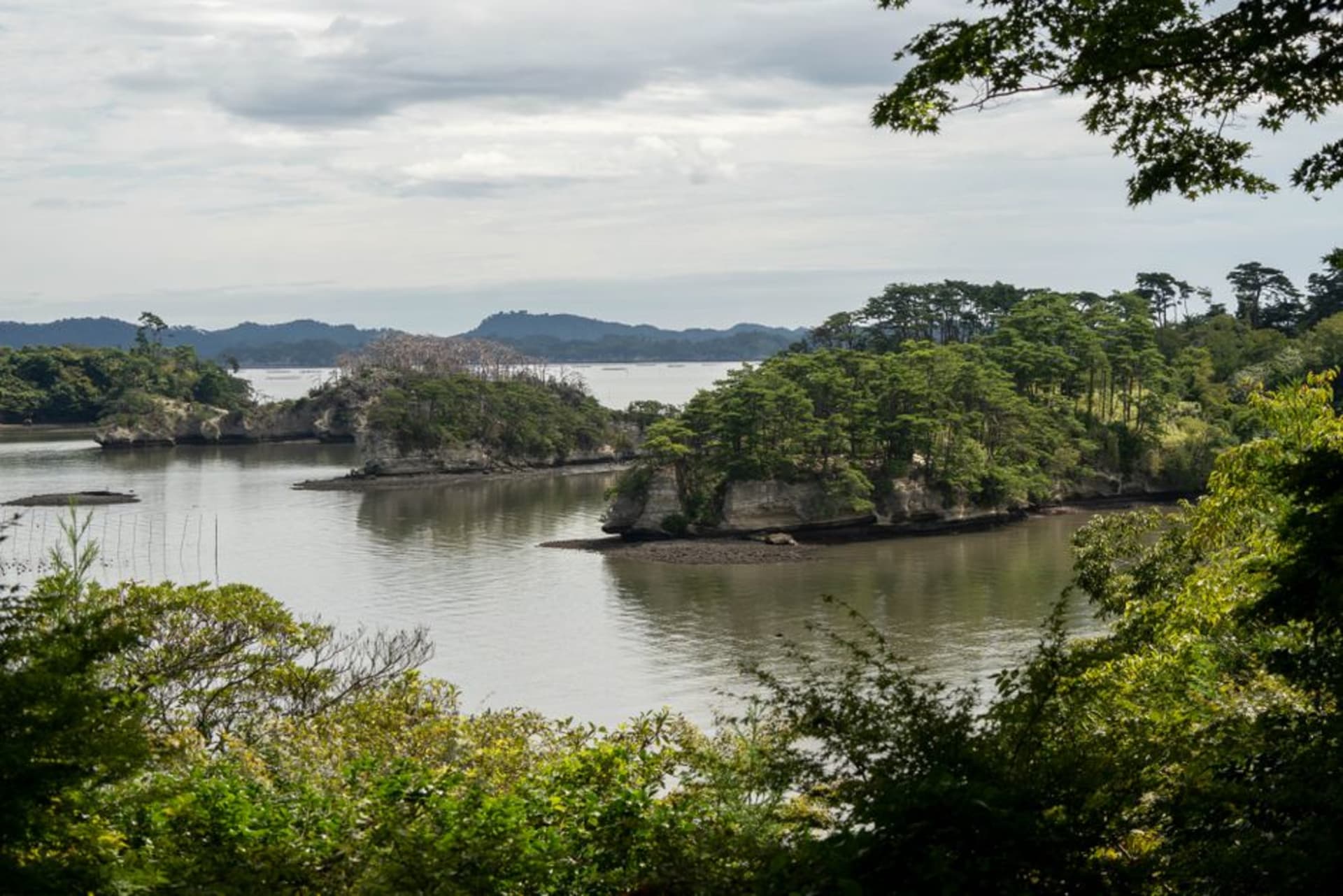
Matsushima
"Bashō came here and, the story goes, was too moved to write a proper poem. I understood him better than I expected to."
A Tōhoku bay strewn with hundreds of pine-topped islets, red-lacquered bridges to tiny shrine islands, and oysters pulled straight from the water. One of Japan's classic three great views, and the quietest of them.
Lia and I came to Matsushima almost by accident, a detour north from Sendai on a grey morning when the forecast promised rain that never quite arrived. We’d read the line every Japanese schoolchild knows — that the poet Bashō was so overwhelmed by the bay that he could only stammer its name — and I’d assumed it was the usual tourist-board embroidery. Then the train came around the headland and the water opened up in front of us, dotted with islets like a paragraph someone had scattered across the sea, and I stopped talking mid-sentence. Lia looked at me and laughed. Point taken.
The bay and its islands
There are, by the old count, more than two hundred and sixty islets in Matsushima Bay, each one a lump of soft white tuff rock that the sea has undercut and the wind has topped with twisted black pines. From the shore they layer into the distance, near ones sharp and far ones ghosting into the haze, and the whole composition shifts as you walk the waterfront so that no two minutes look the same. We took one of the little sightseeing boats that loop out among them, standing at the rail while a recorded voice named the more famous shapes — one island pierced clean through by a natural arch, another split into two by an earthquake centuries ago. Gulls tracked the boat the whole way, hoping for the shrimp crackers the other passengers were flinging into the wind.
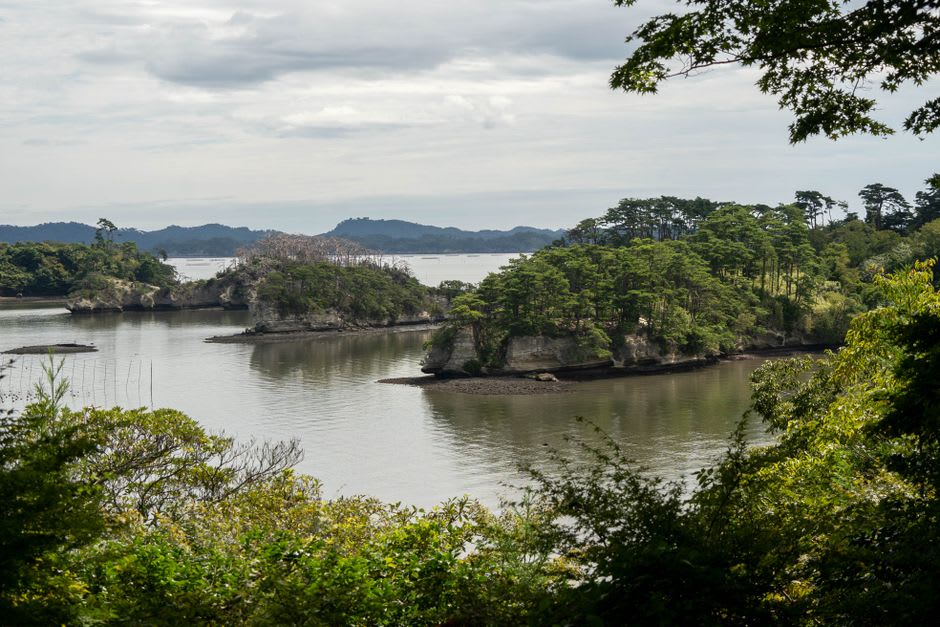
What struck me was how intimate it all felt. This is one of the Nihon Sankei — the three great views of Japan, alongside Miyajima and Amanohashidate — and I’d braced for crowds and coach parks. Instead the bay absorbs its visitors the way it absorbs everything, quietly, into the scale of water and pine.
Red bridges and small shrines
Two of the islets are reachable on foot, and both are worth the crossing. We walked out to Fukuura-jima over a long vermilion bridge that flexes faintly underfoot, onto a wooded island laced with paths through native plants, the bay glittering between the trunks. But the one that stayed with me was Godaidō, a small weathered temple hall perched on a rocky islet just off the main promenade, reached by short red bridges with deliberate gaps between the planks — designed, a sign explained, so that pilgrims would have to watch their feet and approach with attention rather than haste. Lia went across slowly, holding the rail, and I understood the design was working exactly as intended.
Back on the mainland we ducked into Zuiganji, the great Zen temple set back in a grove of towering cedars, its approach lined with caves that monks once carved into the rock for meditation. After the open glare of the bay the cedar dark was a relief, cool and resinous and hushed.
Oysters and the slow afternoon
Matsushima is oyster country, and in the cold months the town smells faintly of the sea and of charcoal. We found a low place near the water where they grill kaki over coals and serve them by the dozen, the shells cracking open with a hiss, the meat inside plump and faintly sweet from the nutrient-rich bay. Lia, who claims not to like oysters, ate most of mine. We drank cold local beer and watched the light go soft over the islands, and I finally gave up trying to photograph it and just sat there, which is what Bashō was getting at, I think.
Later we walked the promenade at dusk as the lanterns came on and the last boats came in. The bay had gone pewter and then black, the islets dissolving into it one by one, and the town settled into a quiet so complete I could hear the water moving under the pilings.
Getting There
Matsushima is an easy day trip from Sendai, itself under two hours from Tokyo by Tōhoku Shinkansen. From Sendai, the local Senseki line runs to Matsushima-Kaigan station in about forty minutes, dropping you a short walk from the waterfront, the boats and Godaidō. Come in autumn for the pines against clear cold skies, or in winter for oyster season and near-empty promenades. Stay a night if you can — the day-trippers leave by late afternoon, and the bay at dusk belongs to whoever lingers.
Keep exploring
More of Tōhoku