Aizu-Wakamatsu
"The castle wears a red roof, alone among Japan's keeps, and once Lia learned why I couldn't look at it the same way again."
A samurai castle town cradled in the Fukushima mountains, where a red-tiled keep rises over the snowfields and a hillside remembers the boy soldiers who died believing it had already fallen. Sake, lacquer, and a long memory.
We came to Aizu-Wakamatsu in the flat white light of a mountain winter, having read almost nothing about it, drawn mostly by a photograph of a castle with an unlikely red roof. What I hadn’t understood, until we stood in the snow beneath it, was that this town carries a wound. Aizu was the last great holdout of the old order in the civil war that made modern Japan, and it lost — brutally, and with a stubbornness the region still wears like a family crest. Lia noticed it before I did, in the way the woman at our inn spoke of events from the 1860s as though they’d happened to people she knew. Here, in a sense, they had.
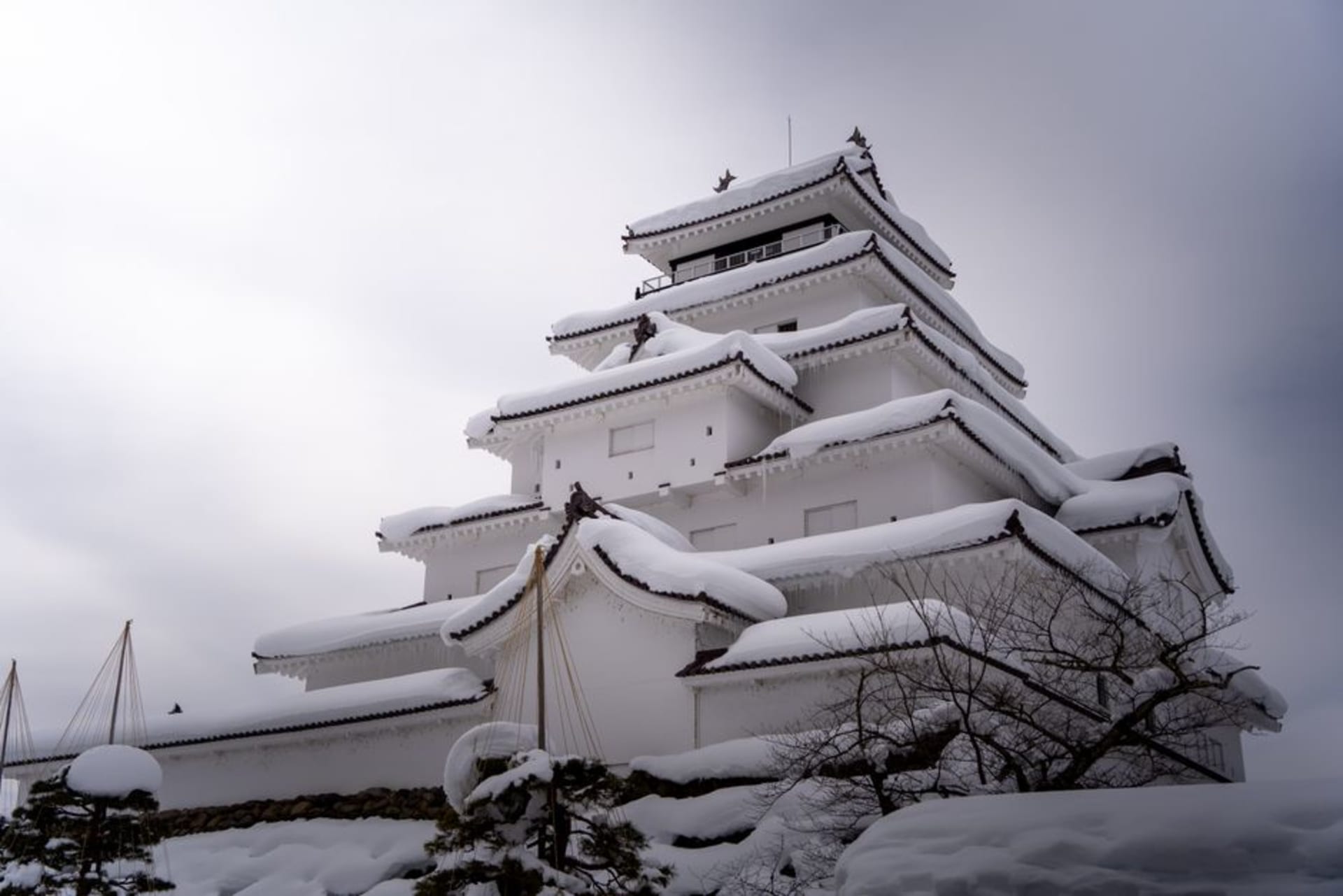
Tsuruga Castle and its red roof
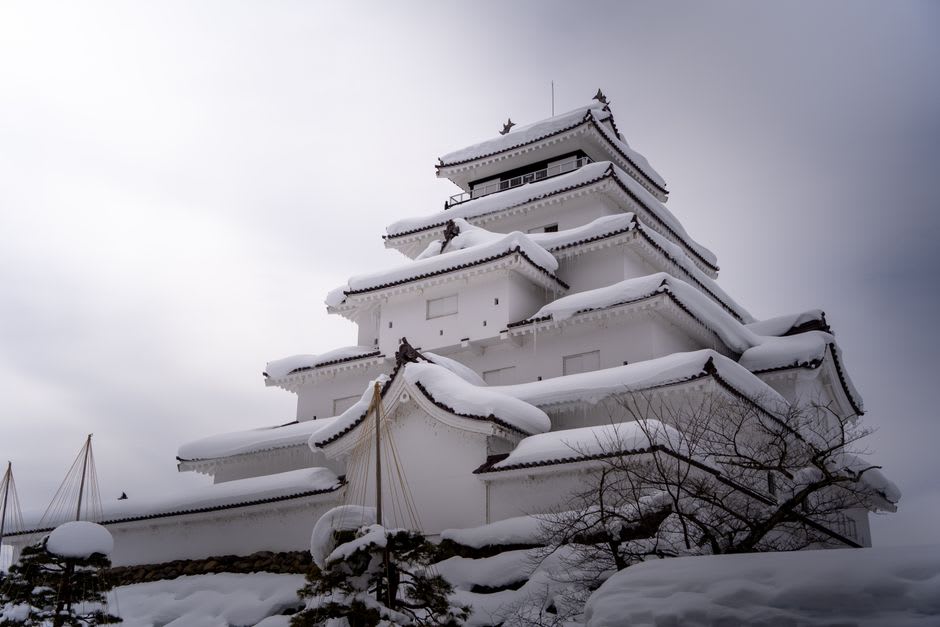
Tsuruga-jō is the reason most visitors come, and it earns the trip. The keep you climb today is a careful reconstruction — the original was dismantled after the war as punishment for the domain’s defiance — but in 2011 they re-tiled the roof in the deep russet red of the Bakumatsu era, and it is the only castle in Japan to wear that colour. Against fresh snow it looks less like a fortress than a lacquered box someone left out in the cold. We walked the frozen moat and climbed the tiers to the top, where the wind came straight off the mountains and the whole Aizu basin lay spread below, ringed white. Inside, the museum tells the story of the 1868 siege plainly, without softening it, which I appreciated.
Lia lingered longest over the domestic things — a child’s writing set, a woman’s naginata, the small evidences that a castle is also a home. That, I think, is what makes the place land.
Iimoriyama and the Byakkotai
Across town rises Iimoriyama, a wooded hill you climb by a long flight of stone steps, and it is the saddest place I visited in all of Japan. Here, during the siege, a unit of teenage samurai called the Byakkotai — the White Tigers, boys of sixteen and seventeen — became separated from the army and retreated to this hilltop. Looking down through the smoke they saw the castle town in flames and believed, wrongly, that the keep had fallen and their lord was dead. Nineteen of them took their own lives rather than surrender. The castle had not fallen. We stood at the spot where they’d knelt, the same view of the town below us now peaceful under snow, and neither of us said anything for a while.
Near the graves stands a strange curiosity — a stone column gifted by the city of Rome in the 1920s, an admirer of the boys’ loyalty. History makes odd bridges.
Sake, lacquer, and warmer rooms
Aizu is also, mercifully, a town that knows how to warm you up. The cold clean mountain water and heavy snows make it one of Japan’s great sake regions, and we spent a happy hour in a century-old brewery near the centre, tasting our way through cups poured by a man who explained each one as though introducing his relatives. We left carrying a bottle we had no way to keep cold. In the shops along the old merchant streets we found Aizu-nuri, the local lacquerware, deep red and black bowls that catch the light like the castle roof. Lia bought a small dish she still uses for soy sauce, and it makes her think of the snow every time.
We ended the day with a bowl of wappa-meshi, rice and vegetables steamed in a bentwood cedar box, in a small place where the windows fogged and the owner topped up our tea without being asked. Outside the snow kept falling on a town that has never quite let go of its ghosts.
Getting There
Aizu-Wakamatsu sits in the mountains of western Fukushima, reached most easily from Tokyo via the Tōhoku Shinkansen to Kōriyama, then the Ban’etsu-West line into the basin, roughly three hours in all. In winter the snows are heavy and the scenery magnificent; spring brings cherry blossom to the castle grounds. A loop bus, aptly nostalgic, connects the castle, Iimoriyama, and the samurai district, so a car isn’t needed. Give it a full day at least — this is a town that reveals itself slowly, and rewards the visitor who lets it.
Keep exploring
More of Tōhoku