
Hitachi Seaside Park
"We climbed a hill where the flowers were exactly the colour of the sky, so that for a moment I genuinely couldn't tell where the ground stopped."
A vast coastal park on the Ibaraki shore where, for a few weeks each spring, a whole hill turns sky-blue with millions of nemophila — and in autumn the same slope burns crimson with round bushes of kochia. One of the most photographed places in Japan, and for once the photographs undersell it.
I’d seen the photograph before I’d heard the name — everyone has — a hill so completely blue that the horizon disappears. I’d assumed, cynically, that it was one of those images built more of a wide lens and a lucky filter than of anything you could stand in. We went to Ibaraki in late April to find out, an early train and a long-ish haul out to the coast, and I owe the place an apology. It is exactly as blue as the picture. It might be bluer.
The blue hill
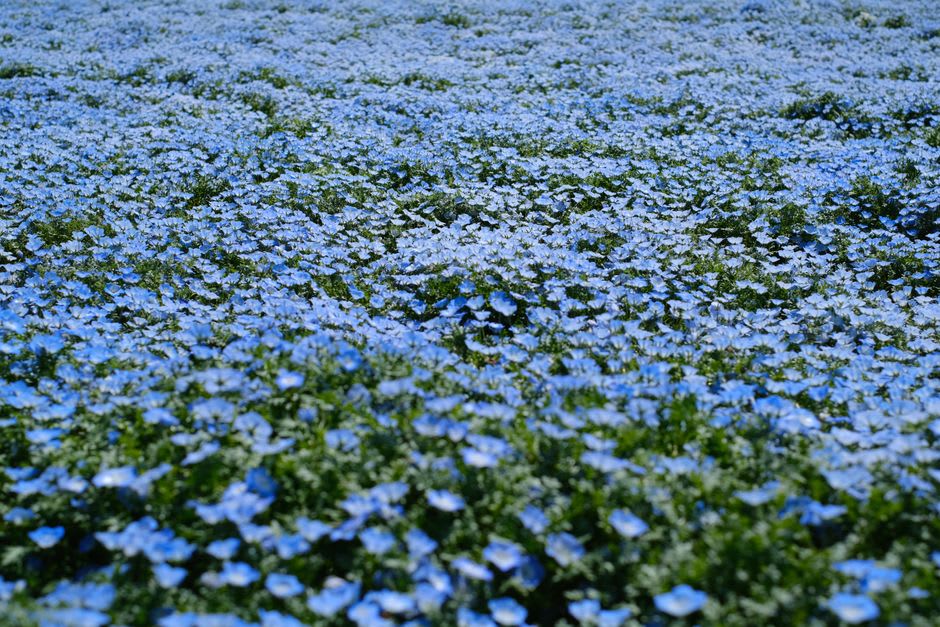
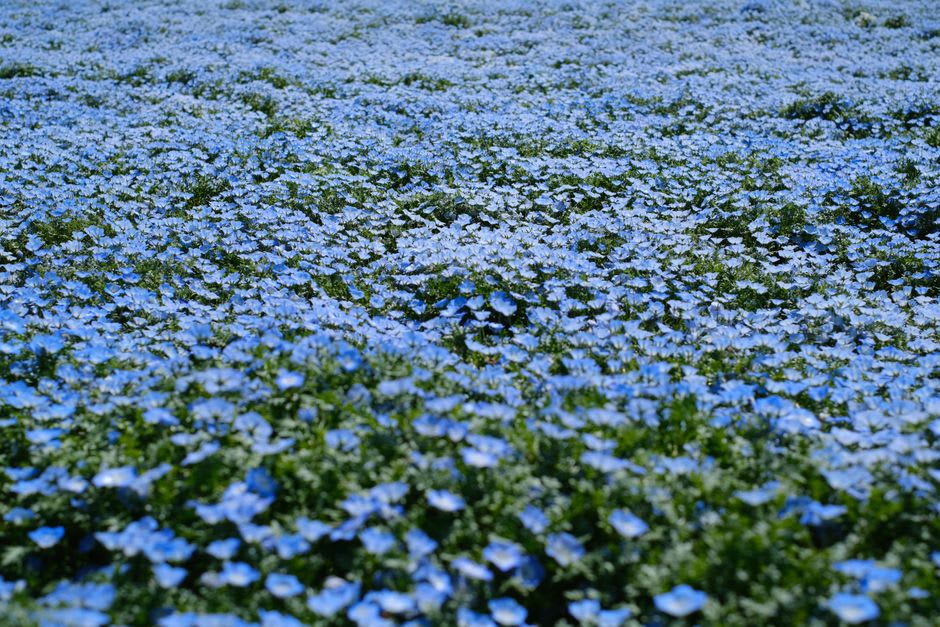
The flower is nemophila, “baby blue eyes,” a low, delicate thing with pale-blue petals and a white centre, and at Hitachi they plant it in the millions across a broad open rise called Miharashi Hill. For a couple of weeks around late April and early May the whole slope goes blue at once, and because the hill is bare-topped and faces the sea, the flowers meet the sky at the summit with almost nothing to divide them. You walk up a path through the middle of it and the colour is on every side and above and below, and the effect — I’m not being romantic — is genuinely disorienting, a soft blue vertigo. Lia laughed out loud at the top, which she rarely does, and I understood the crowds. There were thousands of us and it didn’t matter.
More than one hill
What the famous photo doesn’t tell you is how large the rest of the park is. Hitachi Seaside Park runs to hundreds of hectares along the coast — old land, once part of an American military airfield, now given over entirely to flowers and space. Beyond the blue hill there are fields of tulips in every colour, daffodils in their tens of thousands, a whole zone of poppies later in spring, and, off in the distance, a Ferris wheel turning slowly over the trees. We rented a couple of the park’s cycles and rode the loop path for an hour, past picnicking families and beds of flowers I couldn’t name, the sea appearing now and then through the pines. It is a place built with real generosity of scale — nothing crammed, everything given room.
The other season
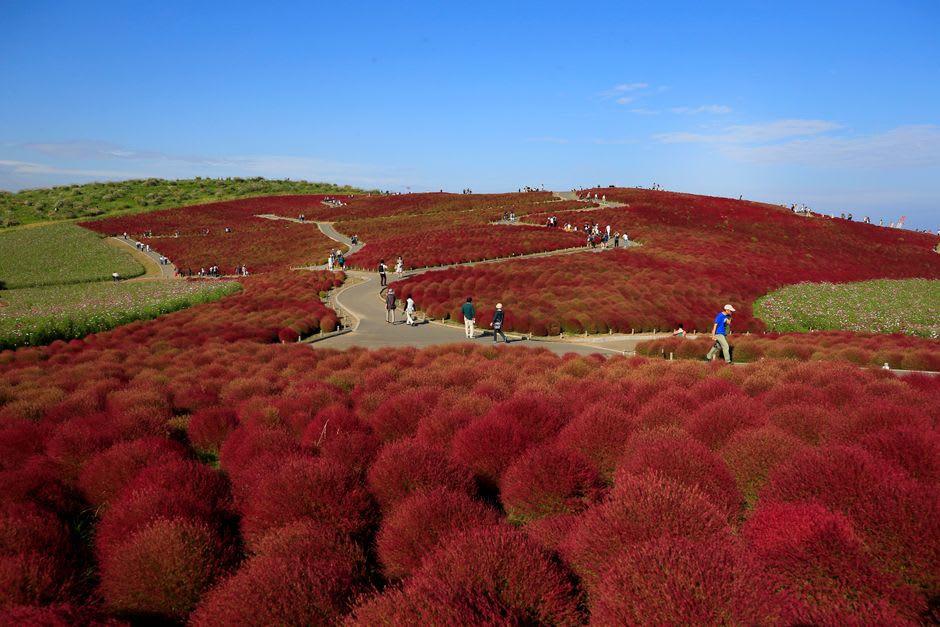
The same hill has a second act. In autumn the nemophila is gone and in its place stand kochia — summer cypress, round green bushes planted in the same great sweep across Miharashi Hill, soft as pom-poms. Through October they turn, and the whole slope burns from green through gold to a deep glowing crimson, set off by yellow ribbons of cosmos and kochia below. I’ve only seen it in photographs from friends who went in October, but the transformation is the thing that makes me want to return: the exact same hill we climbed under a blue sky, turned to fire. One park, two of the most extravagant colour displays in Japan, and a bare few weeks each to catch them.
Getting There
Hitachi Seaside Park is in Hitachinaka, on the Ibaraki coast north-east of Tokyo. Take the JR Joban line limited express from Ueno or Shinagawa to Katsuta Station — roughly seventy to ninety minutes — then a park-bound bus about fifteen to twenty minutes to the west or south gates. Time your visit tightly: nemophila peaks around late April to early May, kochia turns crimson through October. Both windows are short and popular, so aim for a weekday morning and check the park’s bloom calendar before you commit to a date.
Keep exploring
More of Kantō