
Tottori Sand Dunes
"Lia crested the big ridge ahead of me, threw up her arms, and shouted that Japan had a desert and nobody had told us."
A vast sweep of wind-carved sand along the Sea of Japan coast, Japan's largest dunes, where camels plod the ridgelines and the desert seems to run straight into the ocean. An improbable edge of the country, with a sand museum to match.
Nobody warns you about the wind. We’d come to the Tottori Sand Dunes half-expecting a modest curiosity — a photogenic patch of sand someone had cleverly marketed — and instead we climbed the first ridge into a gale coming straight off the Sea of Japan and found ourselves looking at something genuinely strange: a rolling desert of pale sand, kilometres of it, running down to a hard blue ocean under a sky that felt suddenly enormous. Lia got to the top before me, arms flung out, hair horizontal, laughing that this couldn’t possibly be Japan. It is, though — an accident of river silt and sea current and ten thousand years of wind, on the coast of one of the country’s least-visited prefectures.
Up the great ridge
The dunes stretch some sixteen kilometres along the coast and reach nearly fifty metres high, and the thing to do first is simply climb the biggest ridge, the one they call the “horse’s back,” between you and the sea. It looks like nothing until you start, and then the sand gives under every step, and you arrive at the top with burning calves and a view that stops you dead. Beyond the crest the dune drops steeply to a wind-scoured basin and then the water, and the wind up there sculpts the surface into fine rippled ridges that reshape themselves as you watch. We took our shoes off. The sand was cool underneath and warm on top, and Lia ran down the seaward face in great loping bounds while I picked my way after her, useless, laughing too hard to keep my balance.
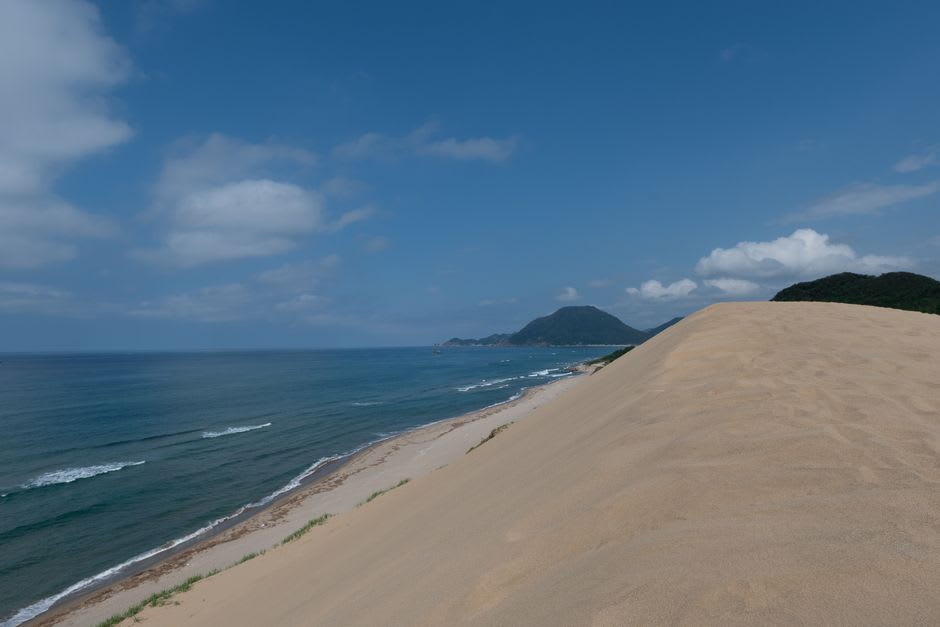
Down in the hollow there’s a small seasonal pool the locals call the oasis, mirroring the sky, which only sharpens the illusion that you’ve wandered somewhere you shouldn’t be.
Camels and sandboards
Tottori leans cheerfully into its own improbability. Near the entrance a small string of camels waits in the sand, and for a few hundred yen you can ride one along the ridge or, as we did, simply photograph Lia grinning beside one while its handler adjusted the saddle. It’s touristy and slightly absurd and we enjoyed it enormously. For the more athletic there’s sandboarding down the steeper faces, and paragliders too when the wind is right, drifting off the crest and out over the basin. We watched one launch, ran a little way to keep him in view, and lost him against the glare of the sea. The whole place has a holiday looseness to it that felt like a release after weeks of temples and reverence.
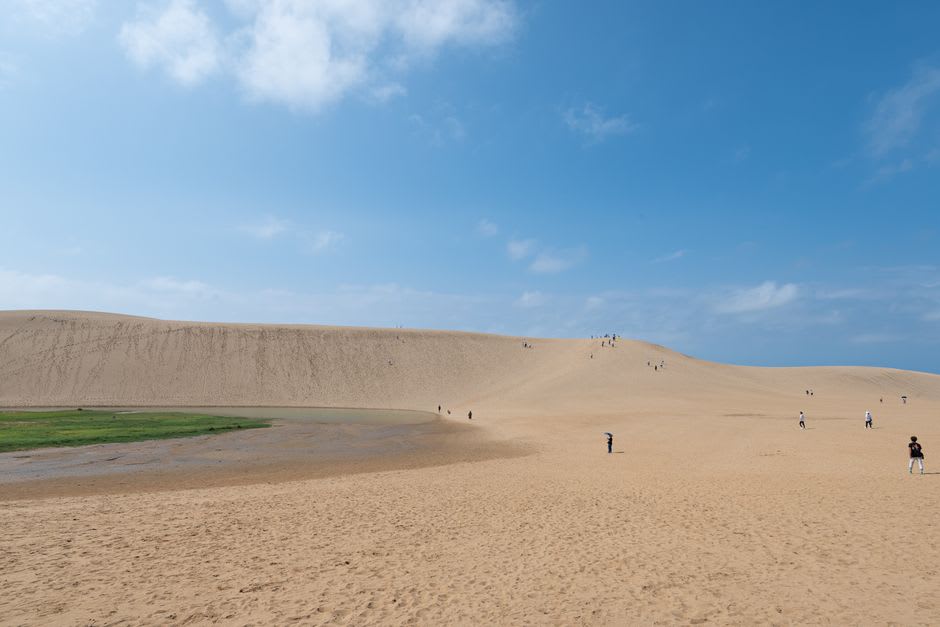
We stayed up top for the late light, when the low sun rakes across the ripples and throws every crease into shadow, and the sand turns from white to gold to a deep rose. It was, unexpectedly, one of the most beautiful hours of the whole trip.
The Sand Museum
Just beside the dunes sits a thing I’d have dismissed if I hadn’t seen it — the Sand Museum, the only museum in the world dedicated to sand sculpture, where artists from around the globe build enormous, absurdly detailed works from nothing but dune sand and water. Each year has a theme, a different country or era, and the pieces tower overhead, walls and figures and whole architectural scenes carved with a precision that seems impossible in so fragile a material. Lia, who had rolled her eyes at the idea, stood in front of a two-storey sculpted palace and admitted she’d been wrong. At the end of each run they simply return it all to sand, which I found oddly moving — a whole gallery built to be unbuilt.
We ate that evening in Tottori town, cheap and excellent seafood pulled from the same cold sea, and I kept finding sand in my pockets for days afterward, which felt like a fair souvenir.
Getting There
Tottori is off the usual routes, which is much of its charm. The city connects by limited express from Osaka or Okayama in roughly two and a half hours, and from Tottori station a local bus reaches the dunes in about twenty minutes. Any season works — summer for the beach heat, winter for the eerie sight of snow dusting the sand — but spring and autumn spare you both the crowds and the extremes. Go late in the day if you can; the dunes at low sun are worth planning around.
Keep exploring
More of Chūgoku